one dimensional two dimensional three dimensional something else
1 Activities for this section:
2 Points and Lines
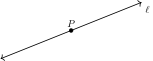
We’ve already been talking about points and lines, and you probably already have a good idea about what we mean when we talk about these objects: in the figure below, is a point, and is a line.
If you are expecting a definition here for lines or points, you might be surprised: points and lines actually don’t have definitions. The mental images you have for these objects are just about the best we can do. In mathematics, we have some ideas that we essentially have to take for granted. We try to minimize the number of those ideas, but we will still have a few. If we tried to define points and lines, we would run into trouble pretty quickly! (Pause and try to do it yourself to see how tough it is!)
We also make some important assumptions about points and lines that we should consider.
While we usually draw a little circle to represent a point (like above), we have to remember that a point doesn’t have any thickness at all. This is hard to imagine, but if you were our friend the little bug, and your entire world was the point above, you actually couldn’t move at all. In fact, this means that points are -dimensional, because there are different directions that the bug could move.
Also, in most kinds of geometry, we can identify points anywhere we like. So on the line below, we can identify points , , and , as well as many, many more points.
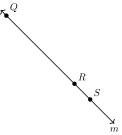
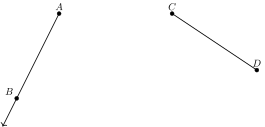
Lines extend forever in each direction, and we usually indicate that by placing arrows at each end. We can also draw a ray, which extends forever in one direction, or a line segment which has a definite length. In the figure below, is a ray, and is a line segment.
Lines are one-dimensional, meaning they have no thickness. In this case, our little bug could move in the forward-back direction, just not right-left. One of the most important things to keep in mind concerning lines is that if we are looking for the shortest distance between two points, it will be located along a line.
We have drawn all of our lines so far to be straight lines, and most of the time when we refer to a line we will want it to be straight. When we refer to curved lines, we will usually call them curves, but it’s best to be specific most of the time!
Finally, we can tallk about a plane, which is like a piece of paper with no thickness at all that extends in every direction. It’s easiest to visualize planes in three-dimensional space, and we typically draw a piece of the plane like in the image below.
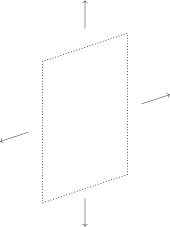
If you drew a line on the plane above, what dimension would the line be?
3 Angles
Next, let’s talk about what we mean by an “angle”.
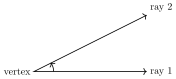
We can also indicate points on the rays that make up our angle, and name the angle according to those rays. The middle point should label the vertex as in below.
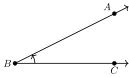
While our definition for an angle is a static object formed by the two rays and the vertex, the way we measure angles is most commonly done by thinking either about turning or about the relative direction between the two rays. The center of the turn must be the vertex of the angle.
The measure of an angle is given by the fraction of a full turn which is represented by the two rays. The turn can
be thought of as part of a circle whose center is at the vertex of the angle. We can also think of this turn as telling
us the relative direction between the two rays.
The arrow we frequently draw to indicate an angle reminds us to think about turning at the same time that we think about the two rays and the vertex. Keeping both perspectives in mind is important!
To measure an angle by thinking about turning, we have to first decide what the size or measure of one full rotation should be. The most common measure for one full turn is to use degrees (usually written ). From the measure of a full turn, we can either use the fraction of a turn that we have to measure an angle, or we can fill up the angle with copies of another angle whose measure we know.
Using what we’ve just discussed, what would be the measures of
the angles below?
- A half-turn would measure degrees, because it’s half of 360 degrees.
- A quarter-turn would measure degrees, because it’s a quarter of 360 degrees.
- A turn which is of a full turn would measure degree.
In the image below, each angle measures and there are five copies of this angle. What is the total measure of this
angle? 
In the previous example, we can see both the amount of turning as well as the relative direction ideas. In
both cases, we think about standing on the vertex and facing one of the rays (let’s pick the horizontal
one so that we’re all imagining the same thing). We can think of physically turning our bodies, still
standing on the vertex, until we are facing the second ray. The amount of turning that we did in this
case was of a full turn, which we can call . Or, we can think of the as the relative direction between
the first ray and the second ray, telling us how different the directions represented by the two rays
are.
The angle measures .
You should also know that there are other ways to measure a full turn. Another common way is to call a full turn radians, so that a half-turn is radians and a quarter-turn is radians. Or, you could invent your own unit for angle measures: say that you wanted a full turn to measure angle-units. In that case, a half-turn would measure angle-units, and a quarter turn would measure angle-units. One fiftieth of a turn would measure angle-unit, and from there you could measure angles of angle-units as well as others.
We will measure angles using degrees (so that there are degrees in a full turn) unless we say otherwise. A useful tool to measure angles is called a protractor. Watch the following video for a demonstration of using a protractor. If you’d like to practice using a protractor here is an online worksheet that uses a digital protractor similar to what kids use on state tests in Ohio.
_
Here is a common misconception about angles.
The angles in the previous question represent the same amount of turning or the same relative direction, even though the rays themselves have different sizes. This example is important to keep in mind so that we are thinking about turning and direction more than we are thinking about the space inside the angle.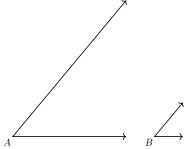
Angles are used to describe many different phenomena in the world as well as in mathematics. We’ll see them in many places throughout the course, and we hope you see them in many places in your every-day life as well!
4 Vocabulary
We end this section by talking through some vocabulary we will use to talk about lines and angles.
We sometimes call a half-turn a straight angle, because it looks like a straight line. Remember to distinguish when you are discussing a line and when you are discussing an angle! For example, if I am considering this object as an angle with vertex , it is a straight angle measuring degrees. If I am thinking about measuring a part of this object as a line, that measure would refer to its length, not an amount of turning.

We say two angles are supplementary when together they form a straight angle.
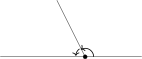
We say two angles are complementary when together they form a quarter turn.

We say that two angles are vertical or opposite if they are formed by two straight lines intersecting, and they are opposite of one another with regard to the vertex.
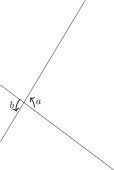
We also know that vertical angles are congruent, or have equal measure. Here are two ways to think about why this might be true.
If you are a very young child, say in second grade, you might fold the vertical angles so that the measure labeled
matches up with the measure labeled . You could also do this for some more examples of vertical angles, and you
might notice that in every case, the folded angles match up with one another. And then you could conclude that
vertical angles are equal.
The example above is important, because it describes a child making observations and then guesses about what could be true. Kids should be encouraged to explore like this and make guesses as to what is true, even if we don’t have the mathematics concepts yet for a full proof. Notice that this reasoning isn’t a proof, because we haven’t considered every single pair of vertical angles that could ever be drawn. But the argument helps us to get a feeling for what could be true.
In this example, let’s start by labeling the measures of all of the angles. 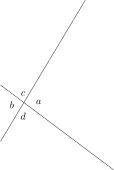 Since we have labeled the angle measures with letters, and we don’t know the exact values for those measures, these
letters or variables can stand for any angle measures at all. This means that now we are considering
every pair of vertical angles that could be drawn, because we can plug any values in for the letters
above.
Since we have labeled the angle measures with letters, and we don’t know the exact values for those measures, these
letters or variables can stand for any angle measures at all. This means that now we are considering
every pair of vertical angles that could be drawn, because we can plug any values in for the letters
above.
We know that the measures and add up to because the angles whose measures are and form a straight angle. In other words, these angles are supplementary complementary . Similarly, the measures of and add up to for the same reasoning. In other words, we have the following. \begin{align} a + c &= 180 \\ b + c &= 180 \\ \end{align}
Solving the first equation for , we get Plugging this in to the second equation, we get Finally, we subtract 180 from both sides and add to both sides to get
This second example is more appropriate for kids who have gotten more comfortable with algebra, perhaps in high school. Both examples are important steps in developing and proving geometric ideas.
2026-07-22 02:12:47