You are about to erase your work on this activity. Are you sure you want to do this?
Updated Version Available
There is an updated version of this activity. If you update to the most recent version of this activity, then your current progress on this activity will be erased. Regardless, your record of completion will remain. How would you like to proceed?
Now that we understand why length, area, and volume formulas make sense using our four-step process of
measurement, we want to investigate a theorem that can help us apply these formulas in more complicated
cases.
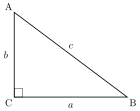
Let’s just dive in. We need a little bit of terminology to get started, so here is a right triangle.
When working with a right triangle, we call the longest side of the triangle, which is across from the right angle, the
hypotenuse. In the image above, the hypotenuse is side with length .
When working with a right triangle, we call the two shorter sides of the triangle, or the two sides which are not the
hypotenuse, the legs of the triangle. In the image above, the legs are sides and with lengths and ,
respectively.
The Pythagorean Theorem In a right triangle which has legs of lengths and and hypotenuse of length , it’s true
that
We will look at one proof of this theorem, but before we do so, it’s very important to notice a few things. They are
so important we’ll put them in a bulleted list.
The Pythagorean Theorem is only true for right triangles. In your explanations, it’s important to be
clear that you are using a right triangle before you use this theorem.
The legs in the Pythagorean Theorem can be listed in any order, but the hypotenuse length has to
go on the other side of the equals sign from the legs. We can’t mix up where the , , and go in the
theorem! In your explanations, it’s important to point out which side is the hypotenuse and how you
are calculating with it.
So why is the theorem true? We will look at one explanation in class, so here is a different one.
We start with a right
triangle whose legs have lengths and and whose hypotenuse has length .
We have also labeled the angles and in the picture which are not the right angle. We are going to need the fact that
which we got in a previous section from the fact that because the interior angles in a triangle add up to
.
Next, we will draw a square whose side length is .
Since the side length of the square is , we can fit the triangle inside the square by matching the hypotenuse of the
triangle with the side of the square. Here is what one triangle looks like inside the square.
Now let’s put all four triangles there. There will be one triangle attached by its hypotenuse to each of the four sides
of the square.
We know that the triangles fit into the square exactly like this because each corner of the big square is formed by
angle and angle from above. We know that angles and add up to , so we can fit the triangles inside this square
exactly.
Next, we see the piece in the center looks like a square. The definition of a square is that it is a quadrilateral with
four sides of equal length and four right angles. We can see that it has four sides, and the fact that it has four right
angles we can also see in the figure. Each side of the central figure is made from a straight side of one triangle by
cutting off a piece using the right angle of another triangle. In other words, we are taking away a right angle from a straightrightsupplementarycomplementary angle, leaving us with a right angle for the central figure’s corner. All four angles are formed this way, so all four
angles are right angles.
We now need to take a look at the sides of the central figure to determine their length. As we said
before, the central figure’s side is made by taking one side of the right triangle (the side of length
) and cutting off a piece of that side using the other leg of the triangle. In other words, the piece
we cut off is length . Let’s label one of the triangles in the figure to help us see what’s happening.
When we take away a length of from a length of , we get the length .
Check for yourself: is each side of the square formed in the same way?
YesNo
So, each side has the same length and all four corners are right angles, so the figure in the middle is, by definition, a
square.
Now that we know what figures we are dealing with, let’s remember that we started with a big square with all sides
of length . Since a square is a rectangle, we can use the area formula for rectangles to find the area of this square,
and we get .
But we also formed the square using four triangles and a little square. The triangles each have a base
length of and a height of , so the area of each triangle is . The little square in the middle is also a
rectangle with side lengths , so we can use the rectangle area formula to see that the area of the central
square is . Let’s put this together in an equation using our additivity principle, which says that when
we put together pieces of area without gaps or overlaps, we add those pieces of area together. Now
substituting our formulas for each piece of area, we get the following. We multiply out both pieces on the
right hand side of this equation. We have a and a on the right hand side, so those will cancel.
Since addition is commutative, this is the formula we wanted for the Pythagorean Theorem. Great
work!
This is only one proof of the Pythagorean Theorem; there are many more. In fact, the Guinness Book of World
Records mentions a textbook published in 1940 that contained 370 different proofs of this theorem! Some people
think it’s silly to have more than one proof of a theorem, but having many different kinds of proofs gives us different
kinds of insights into the theorem and the broader field of mathematics. Plus, some people think that coming up
with new proofs is fun!
Kids learn about the Pythagorean Theorem in middle school, but we like to talk about it here because it helps us to
really think about moving and additivity in a different way than we have previously, and it gives us more interesting
length and area problems to solve.
3 The converse
Another interesting fact about the Pythagorean Theorem is that its converse is also true. (Remember: we talked
about what it means to be a “converse” when we talked about the Parallel Postulate.) As we said before, just
because a theorem is true doesn’t necessarily mean that its converse or opposite is true, but it is in this
case.
Converse of the Pythagorean Theorem If a triangle has side lengths , , and for which it’s also true that then that
triangle must be a right triangle.
Is a triangle whose side lengths are 12 inches, 37 inches, and 35 inches a right triangle?
YesNo
Notice that we had to rearrange the side lengths to make these make sense. The hypotenuse should always be the
longest side of a right triangle, so we have to have 37 inches as the “” value here. We see that so the converse of the
Pythagorean theorem says this is a right triangle.
Is a triangle whose side lengths are 15 inches, 9 inches, and 8 inches a right triangle?
YesNo
Notice that we again had to rearrange the side lengths to make these make sense. The hypotenuse should always be
the longest side of a right triangle, so we have to have 15 inches as the “” value here. We see that so the converse of
the Pythagorean theorem says this is not a right triangle.
We won’t prove the converse of the Pythagorean theorem here, but you can try to do this on your own if you’d like.
A pretty famous proof actually uses the Pythagorean theorem to prove its converse (along with side-side-side
congruence of triangles).
A set of three numbers which form the sides of a right triangle are often called a Pythagorean triple. So, for
instance, would be such an example, along with the famous . Knowing a few basic Pythagorean triples is useful for
creating problems for your future students when you know you want them to be working with a right triangle. It’s
the converse of the Pythagorean theorem that makes this work!
4 A little history
One thing you might notice about the Pythagorean theorem is that we typically think about it as relating some
lengths: the side lengths of a right triangle. But our proof of the theorem was actually about some areas that are
equal. In fact, this is the way that Euclid and other Ancient Greek mathematicians would have thought about the
theorem!
The Pythagorean Theorem is named for an Ancient Greek philosopher and mathematician named
Pythagoras who lived around 500 BCE. However, most people think that it wasn’t actually Pythagoras who
proved this theorem! Pythagoras ran a school of mathematics which appears to modern eyes a bit more
like a cult of mathematics, and so sometimes mathematics that came from his school was credited
to him even though it was probably one of his students who actually did the mathematical work of
proving the theorem. In fact, women and men were both part of the Pythagorean school, and so it’s
possible that a female mathematician played a part in proving this theorem. We’ll never know for
sure!
Another interesting historical point about this theorem is the fact that the theorem was actually well known before
the Pythagorean school ever worked on proving it. There are some legends that the Ancient Egyptians used the
converse of the Pythagorean theorem to make sure the corners of the pyramids were exactly square, and the Ancient
Babylonian mathematicians also likely knew the theorem. So, if you’ve ever had someone else take credit for some
work that was yours, you have something in common with people other than Pythagoras who worked hard thinking
about this theorem!