You are about to erase your work on this activity. Are you sure you want to do this?
Updated Version Available
There is an updated version of this activity. If you update to the most recent version of this activity, then your current progress on this activity will be erased. Regardless, your record of completion will remain. How would you like to proceed?
Being able to physically make shapes that we are working with is good for several reasons. Sometimes having a
physical copy that we can manipulate helps us to really see what’s happening in a way that we have a hard
time imagining or visualizing. Sometimes, we can observe or even explain properties using a physical
copy of a shape. Sometimes, we want to have several copies of the same shape that are exactly the
same (perhaps for our classroom or just because we want to make several observations at once). Also,
how precise we want to be while building the shape depends on what we are going to use the shape
for.
We’ll call the process of physically producing a shape a construction.
One way that even very young kids can experiment with making shapes and looking at properties of shapes is by
using folding. When we fold paper, we can physically observe that parts of shapes might match up, and in this way
produce some evidence for claims that two things are the same. For instance, suppose that you would like to bisect
an angle. How might you do this by folding paper? First, we need to know what it means to “bisect”
something.
To bisect an object means to cut the object into two equal pieces.
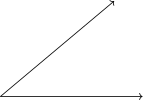
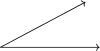
Let’s bisect the angle below.
Imagine that this angle is drawn on a sheet of paper. (Better yet, draw a copy of the angle for yourself, so that you
can do the folding!) To bisect this angle, we want to cut the angle exactly in half, so that we are making half of the
original turn. If we fold the angle so that the vertex is on the fold and the two original rays of the angle match up
with one another, the fold line can act as a new ray that we can use with the same vertex and either of the original
rays to make the bisected angle.
Why does this work? Look at your folded paper while it is still folded. The two pieces of the angle match up with
one another exactly, so that when we unfold, the part of the angle on one side of the fold has to be equal to the
part on the other side of the fold. So, we have cut the angle into equal-sized pieces, which was our
goal.
If you use folding to bisect a straight angle, what kind of angle do you get?
a straight anglea vertical anglea
right angleyou don’t get an angle
If you use folding to bisect a line segment, how is the fold related to the original segment?
the fold is a right anglethe fold is a perpendicular bisector of the segmentthe fold is perpendicular to the segment but does not bisect itthe fold does not intersect the segment
Notice something important here: one of the choices talks about a “perpendicular bisector” of the segment. To be a
perpendicular bisector of a segment means that we start with some segment, and then we use another segment (or
line, or ray) to cut that segment into two equal pieces, and our cutting splits the original segment, thought of as a
straight angle, into two equal pieces. In other words, the segment’s length is cut into two equal pieces, and we also
get two right angles from the cutting.
This is important because we can construct a perpendicular that’s not a bisector, and we can also construct a
bisector that’s not perpendicular, or we can construct a bisector that is perpendicular to the original segment.
Sketch pictures of each of these situations in your notes!
This folding construction is important for exploration and making conjectures, but there are a few issues that can
arise. First, we don’t know whether or not the two sides of your angle exactly match up. It could they look like they
match up, but our folding could still be off by just a little bit. The most we can really say is that they look like they
are the same, but we can’t be absolutely sure that they are exactly the same. Remember that when we prove
things, it’s important to be sure that we are being exact! Second, we have only looked at a single
angle. In this case, we could imagine folding any other angle and seeing a similar result, but that
won’t always be the case with folding. When we want to prove that a certain property holds for all
shapes, folding can give us a good idea about why the property should be true or where to start with
explaining why it’s true, but folding alone can’t help us explain what’s happening for every single
shape.
Let’s look at another type of example where folding can help us.
Let’s use paper folding to show that the
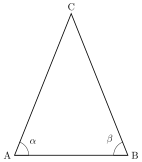
base angles of an isosceles triangle are equal. We’ll start by reminding ourselves of the definitions
that we need. An isosceles triangle is a triangle which has at least two equal sides. The base angles
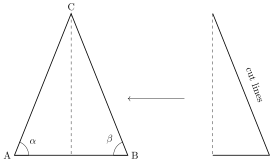
of the triangle are the ones opposite of these equal sides. In the figure below, we will assume that
sides and have the same length, and so the angles we are interested in are the ones marked and .
Next, we imagine that we cut out this triangle on paper. We are trying to decide whether the angles and are equal,
so let’s fold the paper.
What is our goal in making this fold?
We want to fold the triangle in half to see what the
two sides look like.We want to fold on to itself to see whether it is equal.We want to fold point to
point and point to point to make a new shape.We want to fold on top of to see if they match.
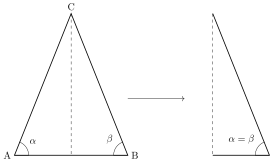
Here is a picture of what our folded triangle looks like.
After folding, it indeed appears that and match up exactly. Our next goal would be to try this same
process with some other isosceles triangles to see whether their angles would also match up. Try it for
yourself!
Notice that we could also make plenty of other guesses based on our work in the previous example.
Looking back at
the previous folded triangle, what else appears to be true about isosceles triangles? Select all appropriate options.
The fold appears to create a perpendicular bisector of the base.The top angle appears to be the
same as either base angle.The top angle appears to be bisected by the fold.The fold appears to
cut the base angles in half.The fold shows that and were actually the same point in the original
triangle.
As a final way to use folding to create shapes, notice that in our previous example, the folding also shows
that the two sides and are equal because they match up. In fact, if we started with a blank piece of
paper and wanted to create an isosceles triangle, we could use the reverse of the previous argument.
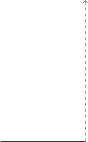
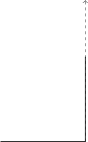
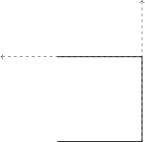
If we cut along the two solid lines and unfold along the fold, we’ll produce the triangle we started with. We’ll know
that sides and have the same length because they were made with the exact same cut, and so we can say that a
triangle made with this process is an isosceles triangle.
We can use folding constructions for many more types of shapes and examples, and we hope that both the examples
we’ve discussed here as well as the ones we talk through in class spark your creativity. We want young kids to be
exploring in this way, but as they develop more mathematics we want to also demonstrate that we have ways to be
more precise.
3 Measuring Constructions
The next way we want to think about constructing using definitions and properties is to use our tools to measure
the properties we want.
For our first example, let’s think about bisecting an angle again.
Use your compass, protractor, and ruler (as needed)
to bisect the angle below.
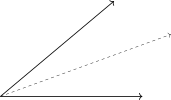
To do this, we could take our compassprotractorruler and measure the angle. This angle measures degrees. To bisect means to cut in two equal pieces, so we are trying
to draw an angle which measures degrees, and if we use the same vertex as the original angle, our drawing might
look like the following, where the bisected angle is formed using the same vertex, either of the original rays, and the
dashed ray.
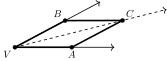
Hopefully you can also imagine using your tools to investigate various properties. For instance, if we
wanted to check whether a parallelogram had opposite sides with equal measure, we could grab our
ruler and measure the opposite sides. If we did this with a bunch of different parallelograms, we could
conjecture that perhaps this property holds for every parallelogram, but we couldn’t say much more
for sure. We can’t check every single parallelogram in this way, so if we wanted to prove that this
property holds for every parallelogram we would need a different strategy. We’ll come back to this idea
in a later section. So, constructing by measuring is a little more advanced than folding, because we
are using more advanced tools, but it has many of the same limitations that folding constructions
do.
For our second example, let’s think about actually making a shape using measuring constructions.
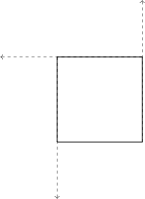
Construct a
square using your compass, protractor, and ruler (as needed).
We start by remembering the definition of a square. If we want to construct a square, it has to satisfy all of the
properties that are part of its definition. Select all the appropriate properties below that are part of the
definition of a square.
A polygonTwo pairs of equal, opposite sidesFour equal sidesFour right
angles
We can start by drawing one side of the square.
Next, we need create an angle that measures degrees, so we grab our protractor and measure.
This next side has to have the same measure as our original side, so we grab our ruler, measure the first side, and
then mark off that same length on the second side.
We repeat these steps for the next angle and the third side.
We repeat the steps again for the third angle and the final side.
We have constructed the shape to have four equal sides, and we can measure the last angle to see that it is also 90
degrees so that all four angles are right angles.
As we mentioned previously, being able to create a shape that we know is a square allows us to cut out this square
and explore its properties, which we could do with either folding or measuring!
4 Classical Constructions (Compass and Straightedge Constructions)
At this point you might be feeling like these constructions aren’t very powerful, since we haven’t been able to prove
anything with them. Many Ancient Greek mathematicians would have agreed with you. They were particularly
suspicious of any time we tried to measure something, because measurements can have a lot of inaccuracies in them.
(For fun, compare your answer to the angle measurement in the previous section to a friend’s answer. I’ll bet you
didn’t get the same answer!) Furthermore, the Ancient Greek mathematicians were very interested in both
simplicity and beauty in their mathematics, and so when making constructions they allowed only two tools: a
compass (for drawing circles) and an unmarked ruler which they called a “straightedge”. There’s no measuring
allowed, here! One famous place that these kind of constructions are found is in a book called “The Elements” by a
mathematician named Euclid. “Elements” is perhaps the most famous book in all of mathematics, and if you
are interested in the history and context of this work, you can glance through a textbook like this
one.
To see how these constructions work, let’s use the example of bisecting an angle again.
Use your compass and
straightedge (unmarked ruler) to bisect the angle below. Follow along on your notes with your own tools.
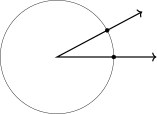
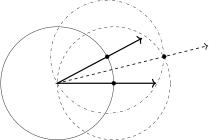
Let’s start by using our compass to draw a circle whose center is the vertex of the angle. We’ll mark the points
where that circle intersects the two rays of our angle.
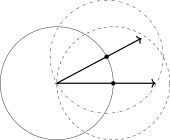
Next, we open our compass again, and use the same radius to trace a circle starting at each of our new marked
points. These will be the dashed circle and the circle with dots and dashes.
We can see a point where the dashed circle and the dot and dashed circle intersect. We’ll mark that point with a
circle and draw a line connecting the vertex of the angle to this new point.
This final ray bisects the angle exactly.
The steps of that construction might seem a little mysterious, but notice what we did: we opened our compass to a
certain distance and marked some circles. We know from the definition of a circle that all the points on the edge of
the circle are the exact same distance from the center of the circle. So, from the vertex (marked in the next image)
to either of the points on the original rays (marked and in the next image), we know we have the same distance.
Then, we used the same compass opening to make the second set of circles, and so we know that the intersection
point is at that same distance from and from because the point is on a circle with the same radius. (The
intersection point is marked in the next image). In other words, we have created a rhombus because the definition
of a rhombus is a quadrilateral with four equal sides, and we know all four of those sides are equal.
The rhombus is highlighted below, and the construction circles are removed so we can see a little
better.
We constructed this rhombus without measuring anything! So, as long as we can imagine using our compass to draw
a perfect circle, we’ve drawn a perfect rhombus. Then, we can use a property of rhombuses that says the diagonals
bisect the interior angles of a rhombus to say that we’ve exactly bisected angle . Explaining why rhombuses have
this property will take a bit more work (and is more on the level of high school mathematics), so we will postpone
that proof until a little later.
That was a pretty tough construction, but perhaps you can see how folding constructions and measuring
constructions are leading us towards compass and straightedge constructions.
Pause and think: what similarities and differences did you spot between the three angle bisection constructions that
we did?
Write some thoughts here!
Compass and straightedge constructions can also be used to make shapes using their definitions. We did that above
with a rhombus, but let’s finish by constructing an equilateral triangle.
Given a starting segment,
construct an equilateral triangle with sides the same length as that segment using only your compass and
straightedge.
First, let’s remember the definition of an equilateral triangle, which is a triangle with three sides of equal length.
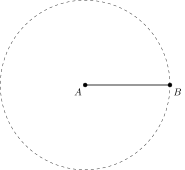
Next, we are given a segment to start with.
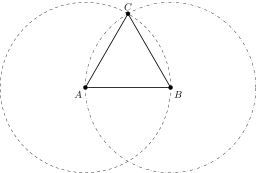
We start by opening our compass to the length of the given segment and then we draw a circle with center at .
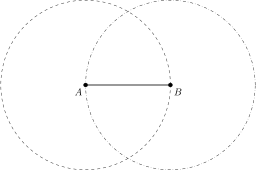
Next, we open our compass again to the length of and draw another circle, this time with center ;
Notice that the two circles have the samedifferent radius. Let’s mark one of the points where the circles intersect (we’ll call it ) and then draw and .
We have created the triangle , and we know it’s equilateral because all of its sides are the same length. We know
that the length of is equal to the length of because they are both the radius of the same circle (and the meaning of
a circle is that all points on the circle are the same distance from the center point, which in this case is ). We also
know that the length of is equal to the length of for a similar reason: they are both on the same circle with center .
This means that the length of is equal to both the length of and the length of , so that all three sides have the
same length.
Again, notice that we didn’t need to measure anything at all, and our reasoning plus the meaning of a circle told us
that we have what we want. These constructions are powerful, so perhaps you can see why the Ancient Greek
mathematicians favored them.
However, in our course we will focus mostly on folding and measuring constructions, since these ideas are a bit more
targeted at younger kids. We hope that seeing the full picture both gives you an appreciation for the goals of folding
and measuring constructions as well as a sense of how important definitions are when it comes to writing proofs and
explanations. If this subject is interesting to you, here’s a link to play a game based on Euclid’s book “Elements”.
The game reflects the way that Euclid developed his book, a strategy that mathematicians still use today in their
research, and the game can also help you to understand how straightedge and compass constructions work. Plus, it’s
full of puzzles!