- (a)
- What is the measure of angle ?
- (b)
- What is the scale factor from the smaller figure to the larger figure?
- (c)
- What is the length of side ? cm
1 Activities for this section:
2 Similarity
We’ve arrived at the last stage of this part of our work with comparing and contrasting shapes. Our work started with comparing and contrasting shapes using their properties, which as we’ve said is very important work in grades K-5. We then worked on comparing and contrasting shapes by talking about when they were the same shape using congruence based on transformations. This work was more related to middle school and high school geometry. Our final stage is to compare and contrast shapes by talking about when they might be the same shape but different sizes, and we’ll use the idea of dilations and similarity to talk about these ideas. This work really takes off in middle school and continues into high school. We hope you can see how the K-5 ideas really lay the foundation for this later work!
We talked about reflections, rotations, and translations so that we could use these ideas to define what it meant for two shapes to be congruent to one another. In asking whether two shapes were congruent, we only used basic rigid motions that don’t change distances, so dilations were not on the table. We then introduced dilations, and we will use them to define what it means for two shapes to be similar to one another.
We say that two shapes are similar if we can find a sequence of transformations,
including reflections, rotations, translations, and/or dilations, taking the first shape to the second
shape.
Informally, we say that two objects are similar if they are the same shape, but (possibly) different sizes. We also
refer to one shape as a scaled version of the other, and we often refer interchangeably to similarity and scaling.
Mathematically, because we are using a dilation when we consider similar figures, we have that element that’s
changing the distances. When two objects are similar, each of the lengths in the first figure are multiplied by some
factor to get the corresponding length in the scaled version. We call this factor the linear scale
factor.
When it’s clear we are only scaling lengths, we typically call the linear scale factor just a scale factor. Later, we will
also scale areas and volumes, and then we will want to distinguish between what’s happening with lengths, areas,
and volumes.
The two quadrilaterals in the example below are similar. Answer the following questions based on the
figures’ measurements. (The figures are not necessarily drawn to scale; use the measurements given.)
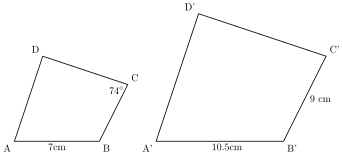 Angle measures , side measures cm, side measures cm, and side measures cm.
What are the values of each of the following?
Notice in the previous question that the scale factor doesn’t have units the way that angles and side lengths do.
One way to think about this is that the scale factor is scaling any length, no matter the units. Another way to think
about it is that the scale factor is the number of groups or copies that we use in multiplication, so that the units are
the objects per group and the total objects.
The fact that all of the lengths in similar figures are scaled by the same scale factor has another consequence. Let’s check out another example.
Let’s start with a rectangle which is cm wide and cm tall, and scale that quadrilateral using a scale factor of . Here
is a picture of the original and the scaled version.
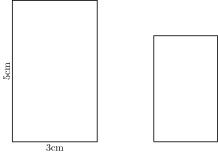
When we calculate the ratio of two parts of the same figure, and then use this ratio to find corresponding parts of a
similar figure, we will also call this ratio an internal factor. Notice that the internal factor doesn’t have to
only refer to height and width; any two lengths can be used. Most problems about similar figures
can be solved using either the scale factor or an internal factor. Practice solving problems using both
methods!
What is the width of the scaled figure? cm
What is the height of the scaled figure? cm
Now, notice that we could also consider the ratio of width to height in this rectangle, and this ratio is , or the height is as much as the width. In terms of a unit rate, we could say that for every unit of the width, there is of a unit of height. Let’s look at the same unit rate, but on the scaled version. How many inches of height do we have on the scaled version per inch of width? Remember that we can calculate this unit rate using “how many in each group?” division, and since the answer to a division problem can be written as a fraction, we can write the ratio as a fraction to get the unit rate. The scale factor cancels, and we are left with the same ratio of height to width as we had in the original.
3 The case of triangles
As part of the Congruence section, we said the following.
…we like to use the fact that triangles have some special properties that make it easier for us to talk about when triangles are congruent. The special thing about triangles is that they are the same shape when they have the same angles.
I hope that you can see now that this is actually a statement about when two triangles are similar: they have the same shape (but perhaps different sizes) when they have the same angles. Here is a more formal way of saying the same thing.
Two triangles are similar when two of their angle measurements are congruent. We refer to this as the
angle-angle criterion (and sometimes abbreviate it as AA).
As a reminder, this is a theorem for triangles only; in general it is not enough to just look at the angles of a pair of
shapes to determine whether or not they are similar. Why do we only need to look at two of the angles of a
triangle?
Remember that we know that the interior angles of any triangle add to , so once we know two of the angles
we also know the third angle. Once two of the angles are equal, the third angle must also be equal. Algebraically, we
are saying that if one triangle has angles with measures , , and and another triangle has angles with measures , ,
and , and we know that and , we have as well as and we also know because and that then we must also have as
we wanted.
Identifying similar triangles in the wild can sometimes help us answer questions about the world around us. For instance, there is a legend that an Ancient Greek philosopher, Thales of Miletus used the ideas of similar triangles to find the height of Pyramids in Egypt. Here is an example of reasoning that Thales could have used.
Thales took a
look at the pyramids and their shadows. He reasoned that the height of the pyramid and the shadow of the pyramid
made a right triangle. 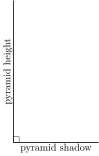 Thales then set up a stick in the ground, perpendicular to the ground, and considered both the stick and the stick’s
shadow. We’ll draw this as well as connect the dots forming two triangles.
Thales then set up a stick in the ground, perpendicular to the ground, and considered both the stick and the stick’s
shadow. We’ll draw this as well as connect the dots forming two triangles. 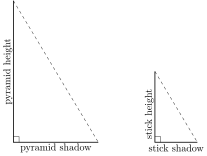 Next, Thales reasoned that the sun rays forming the shadow of each object were roughly perpendicular parallel
to one another, so the angles formed by the object and the sun rays in each triangle must be equal. In the figure,
these are the angles at the top of each triangle. We also have a right angle in each triangle, so we can use the SASAASAA
criterion to say that these two triangles are similar, because two of their angles have equal measure.
Next, Thales reasoned that the sun rays forming the shadow of each object were roughly perpendicular parallel
to one another, so the angles formed by the object and the sun rays in each triangle must be equal. In the figure,
these are the angles at the top of each triangle. We also have a right angle in each triangle, so we can use the SASAASAA
criterion to say that these two triangles are similar, because two of their angles have equal measure.
Most people actually think that Thales measured the length of the pyramid’s shadow when the height of the stick
was equal to the stick’s shadow length, or in other words when Thales knew that the triangles were congruent. In
fact, in some versions of the story, Thales uses his own height instead of a stick. However, we chose to use similar
triangles to illustrate a more general argument.
2026-07-22 02:13:19
Now, Thales could measure the length of the stick and the length of the shadow as well as the pyramid’s shadow, and use this information to calculate the height of the pyramid.