1 Activities for this section:
2 Parallel lines
Lines can come in lots of configurations, but one particular configuration that ends up being both important and useful is when two lines are parallel.

The lines and in the image above are parallel, but how do we know this? Our first clue is to use the definition.
To fully understand this definition, we would need to understand what we mean by the “same direction”, and a full explanation for this idea would take us into the topic of vectors. We’ll avoid that for now and just use our intuition to say that the lines above do in fact go in the same direction.
In a two-dimensional world, “going in the same direction” means the same thing as “the lines never cross”, and so if we are working in a two-dimensional world, we can use “the lines never cross” as the definition for parallel lines. But in three-dimensional space we have something called skew lines that never cross but also don’t go in the same direction. We don’t want these lines to classify as parallel. In the picture below, imagine that line is above line in 3D space. These lines will never cross, but they don’t go in the same direction, so they are not parallel.

3 The Parallel Postulate
Parallel lines are so useful in geometry that we would like to be able to talk about the angles formed when we have parallel lines as well as use angles to determine when two lines are parallel. For these tasks, we will use the Parallel Postulate and its converse.
A postulate is a statement that we assume is true, or a rule that we choose to follow when we do geometry. The geometry we are used to using is called “Euclidean Geometry”, and this Parallel Postulate is one of the things we have to assume in order to do Euclidean Geometry. If we don’t play by this rule, we might be doing a different kind of geometry!
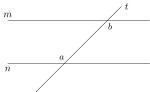
To state the parallel postulate, we also need to know that a transversal is a line that crosses two or more lines, and that alternate interior angles are angles on opposite sides of the transversal and between two of the lines that the transversal crosses. We’ll have an example below.
The Parallel Postulate states that if we have two parallel lines and they are crossed by a transversal, the alternate
interior angles formed by the transversal and the parallel lines must be congruent. In the picture below, lines
and are parallel, and is a transversal. The Parallel Postulate states that angles and are congruent.
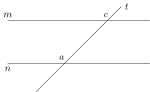
Sometimes, the Parallel Postulate is defined instead to say that the corresponding angles formed by the transversal have equal measure or are congruent. Angles and are corresponding in the figure below, because they are in the same relative position along the transversal but on different lines.
For our course, either statement of the Parallel Postulate is acceptable, but please be clear when you state it and point out which angles you are discussing.
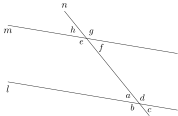
The image below shows two lines cut by a transversal.
Choose all options below which are a pair of alternate interior angles.
The image below shows two lines cut by a transversal.  Choose all options below which are a pair of corresponding angles.
We will also use the converse of the Parallel Postulate. The converse of a statement is what we get when we reverse the assumption and the conclusion. It’s a bit like the opposite or reverse of a statement. A statement and its converse don’t always have to both be true or both be false, but in this case we will assume both the Parallel Postulate and its converse.
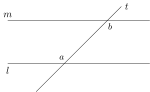
The converse of the Parallel Postulate states that when we have two lines and and a transversal which crosses
them, if the alternate interior angles formed by that transversal have equal measure, then the two lines and are
parallel. In the figure below, if we know that angles and are congruent (or have the same measure), then lines and
must be parallel.
We could of course also replace “alternate interior angles” with “corresponding angles” in the converse of the Parallel Postulate. Again, remember to be clear in your explanations!
Are the lines and below parallel? 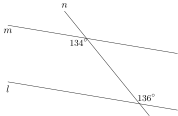
2026-07-22 02:12:37
Yes. No.
In the figure, we have a pair of alternate interior angles corresponding angles vertical angles
labeled with angle measures. The angle measures labeled are and . In order to tell whether these lines are parallel,
we would like to use either the Parallel Postulate or its converse. The Parallel Postulate says that if we
have two lines which are parallel, then their alternate interior angles must be congruent. In other
words, if lines and are parallel, then the alternate interior angles we have marked would have to
have the same angle measure. They do not have the same angle measure, so these lines cannot be
parallel.