You are about to erase your work on this activity. Are you sure you want to do this?
Updated Version Available
There is an updated version of this activity. If you update to the most recent version of this activity, then your current progress on this activity will be erased. Regardless, your record of completion will remain. How would you like to proceed?
Mathematical Expression Editor
Now that we have investigated functions from an algebraic perspective, how can we also investigate functions from a
geometric perspective? The answer is to use a graph, and the idea of connecting geometry with algebra in
mathematics was one of the most significant developments in the history of mathematics. The credit for this
groundbreaking idea generally goes to two different French mathematicians who lived roughly in the 1600s:
Pierre de Fermat and René Descartes. Actually, both men have rather interesting stories: neither was a
professional mathematician for their entire career (Fermat was a lawyer and Descartes was a soldier), which
perhaps shows that important mathematical discoveries aren’t always made by people working only math
jobs.
Imagine for a moment that the only way you could work with a function was by using algebra. This is pretty tough
for us – if I had to guess, you probably had some graphs in mind while reading the previous section! How would you
visualize a function? What kinds of visual intuition might you have about functions if all you knew about
was algebra? This was actually the state of mathematics for a long time! Try to put yourself in the
mind of Fermat and Descartes: what is the first thing you would need in order to draw a picture of a
function?
If you said “a coordinate system”, then you’ve come up with Fermat and Descartes’ big contribution to this
subject!
The rectangular coordinate system
When we think about functions, we start by thinking about the set of inputs, or the domain, for our function.
Typically these inputs are numbers, and we’ve seen that often these numbers come from the real numbers. In fact,
most of the time the inputs can come from any real number. When we draw the set of all real numbers, we most
often represent this with a number line.
What kind of information do we need in order to draw a number line?
Select all that apply.
We always have to mark the number zero.We don’t have to mark zero, but we need
to decide at least two numbers to mark.We always have to mark the number one.We don’t
always have to mark the number one, but we need a scale from which we can determine the size of one
unit.
While we can draw number lines very generally using the information above, a very common way to draw a number
line for a graph is to first mark zero, and then our one unit length is given by where we place the tick mark for the
number .
But, inputs aren’t the only thing we have with functions: we also have outputs. Our outputs are also usually
numbers, and so we could also represent them using another number line. But the outputs aren’t completely
separate from the inputs, they depend on what input we have. We want to represent this relationship, so we are
going to make this second number line vertical instead of horizontal. In other words, if we are given an
input, we draw the corresponding output directly above that input, using the vertical number line.
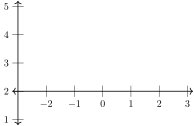
You might be ready to complain about the drawing I just made, but before I draw one that looks a little more
like what you were expecting, notice that what I did draw satisfies the requirements that I need in
order to draw a function. I have a horizontal number line (called the horizontal axis) and I have a
vertical number line (called the vertical axis) and they meet at right angles. I could use this set of
number lines (called axes) to graph a function if I wanted to, by playing dots on the output values
corresponding to my input values.
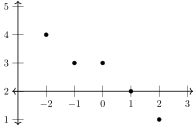
Use the graph of a function below to answer the questions which follow.
The graph above has a dot directly above at height , a dot directly above at height , a dot directly above at height
, a dot directly above at height , and a dot directly below at height .
What is the domain of this function?
all real numbersall integersthe set the set
According to the graph, what is ?
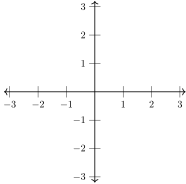
Of course, it is much more common to place the intersection of the two axes at zero on both number lines. When we
do so, we typically call the point which is zero on both number lines the origin. The axes below are
probably more what you are used to seeing, and the origin is located at the intersection of those axes.
While we are on the subject of vocabulary, we will sometimes use to represent the input values of our function, and
so the horizontal axis is also called the -axis. We will sometimes use to represent the output values of our function,
and so the vertical axis is also called the -axis. The variable represents the function’s output values, so we will
sometimes write to connect the -values to the idea of the function. The -variable is also sometimes called the
dependent variable because its value depends on the input. The -variable is then called the independent
variable because its value doesn’t depend on anything; we get to choose the inputs. As much as we aren’t tied to
placing the horizontal axis at we are also not tied to using and as our variables! If we used for the
independent variable (the inputs), then the horizontal axis would be called a -axis. Overall, the idea of
using a coordinate system to do geometry is called analytic geometry. These coordinates are called
rectangular coordinates because of the fact that the axes are at right angles to one another, and they are
also called Cartesian coordinates in honor of Descartes. (Sadly, Fermat doesn’t get as much credit
as Descartes!) This vocabulary lesson isn’t here because we want you to use all of these terms all of
the time (though you are welcome to if they help you) but more because we want you to make sense
of some vocabulary you might have heard in the past and connect it to the ideas we are discussing
now.
These two number lines set at right angles create a plane which is called the coordinate plane.
What dimension
is the plane formed by two number lines set at right angles?
one-dimensionaltwo-dimensionalthree-dimensional
The coordinate plane is sometimes referred to as the 2D coordinate plane for this reason.
We always assume that we are using rectangular coordinates unless we say otherwise. (Wait, there are other
types of coordinates?? Yes! But we won’t talk about them here. Please feel free to look it up if you’re
interested.) There is also a way to define a 3D coordinate space, but we would need three axes set at right
angles to do so. In fact, you could define a 4D coordinate space, a 5D coordinate space, or larger, but
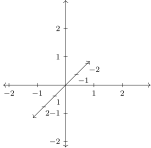
these are hard to visualize. Here is a picture of the axes for 3D coordinate space. Here the origin is
where the axes intersect, but it’s not labeled so that the markings on the tick marks are easier to see.
Now that we have a coordinate plane, we can describe any location in our plane using the and axes (and also the
-axis if we are working in 3D space). Say we have our axes, and we start at the origin and move units in the positive
-direction, and units in the positive -direction.
True or false: if we move first according to and second according to ,
we will end up in the same location as if we move first according to and second according to .
TrueFalse
Let’s look at this on our axes.
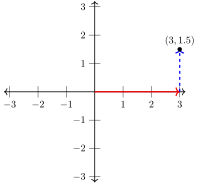
The solid red line shows us beginning at the origin and moving spaces along the positive -axis, while the dashed
blue line shows us starting at the end of the red arrow and moving vertically spaces. Notice that the red and
blue lines are at right angles to one another, just like the and axes are. This means that we are
“following” the -axis when we move vertically, even if we aren’t actually touching the -axis. (Remember that
it doesn’t actually matter where we place the -axis, so we could actually place it at if we wanted
to!) We have labeled the location at the end of the blue arrow as . We use parenthesis to indicate
that this is a point or location in the plane, and then the first entry (or coordinate) tells us how far
we moved in the -direction, while the second entry (or coordinate) tells us how far we moved in the
-direction.
How would we interpret the point in 3D space?
We move units in the -direction, then units in the -direction, then units in the third direction (we usually call this
last one ).
We now have all of the pieces we need in order to draw a graph of a function.
Say we have some function whose
inputs are real numbers and whose outputs are real numbers. We get the graph of by drawing a point at for every
possible input in the domain.
It’s time to tackle an example!
Let’s graph the function .
Our goal is to draw (or plot) the point for every in the domain of our function. So, what is the domain?
all real
numbersall integersthe set the set
We can plug in any real number into this function, so we will need to plot a point for every value of . That
sounds overwhelming, so let’s just start with a few that we know. I love to start by making a chart!
Input
Output
Point
-3
-2
-1
0
1
2
3
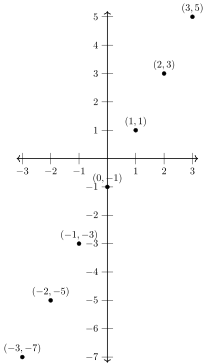
Next, let’s plot those points on a pair of axes. We’ll draw the usual type.
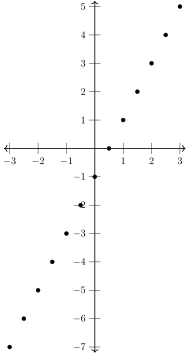
We could also plot points in between these points. For instance, when , we would have . Or when , we would have .
Let’s take off the labels of the points and draw in some points between the ones we already have.
Maybe you are starting to see a pattern, here. In fact, we could keep going, drawing more and more points on this
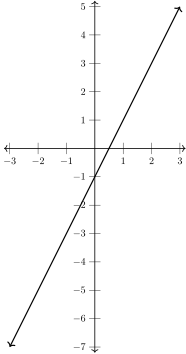
graph, but in this case we can see we will draw more and more points all in a straight line. So, instead of drawing
the individual points, we can draw a straight line that represents all of the points that we are trying to draw.
It’s incredibly important to remember that this graph, even though it looks like a line, is made up of all of the
points that we get from evaluating our function. It can be easy to forget this when we start by drawing a line rather
than by drawing a bunch of points!
We have motivated coordinate systems by wanting to draw graphs, but they are actually much more useful than
that. Any time you want to be able to describe all of the points in a certain space, you can add coordinates. You’ll
start with number lines, just like we have, so you’ll need a zero and a unit length to draw each number line.
Then, set up your number lines at right angles (however many of them you need depending on the
dimension of the space you’re working in) and you can use these ideas to describe all the points in your
space.
Interpreting graphs
Now that we understand how to draw a graph, what kind of information can we get about functions from a graph?
Let’s look at an example.
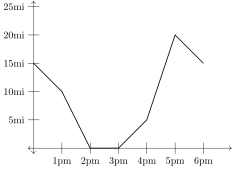
The graph below represents the delivery route of an Amazon driver from
noon until 6pm last Thursday. On the horizontal axis we are going to record the time of day, using
to mean noon. On the vertical axis we are going to record how many miles the driver is from the
warehouse, using to mean the warehouse itself. In other words, the variable represents the number of
hours after noon, and the variable represents the number of miles the driver is from the warehouse.
Let’s investigate some kinds of questions we can answer about this graph.
First, the point is on the graph. What does this point mean?
At 10pm, the driver is 1 mile from the warehouse.At 1pm, the driver is 10 miles from the warehouse.After 1 hour, the driver has driven 10 miles.After 10 hours,
the driver has driven 1 mile.None of the above.
The point means that we move unit along the -axis, and then
we move from there vertically units. The -axis is the time after noon, so means 1pm. The vertical axis is the
number of miles from the warehouse, so means the driver is miles from the warehouse. Being at the
point means that both and , so we have that it’s 1pm and the driver is miles from the warehouse.
The value of is when . What does this mean for the driver?
It doesn’t take the driver any time to travel 15 miles.At noon, the driver is traveling 15 miles per hour.The driver starts their route at noon.At noon, the driver is
15 miles from the warehouse.None of the above.
When we say that when , this means that the point is on the
graph. As we said previously, means that we are hours after noon, so it’s exactly noon. Next, the output of
means that the driver is miles from the warehouse. This is an example of a -intercept, because we
are talking about the point where the graph touches the -axis, or what the output value is when .
From 2 until 3pm, the graph touches the -axis. What does this mean for the driver?
The driver is at the
warehouse from 2 until 3pm.The driver is delivering packages from 2 until 3pm.The driver is stuck in a traffic
jam from 2 until 3pm.The driver is getting farther from the warehouse from 2 until 3pm.None of the above.
When the graph touches the -axis, this means that the output value for the function is zero. In this scenario, the
output values describe how far the driver is from the warehouse, so this means that the driver is
miles from the warehouse. But miles from the warehouse is actually the warehouse itself. So, the
driver is at the warehouse from 2 until 3pm. Perhaps they are loading more packages in the truck, or
perhaps they are taking a lunch break. We can’t be sure from the story, but we do know they are
at the warehouse for this entire hour. These points are all -intercepts, because we are talking about
points where the graph touches the -axis. These are input values for which the output value is zero.
The output values on the graph look like they range from 0 to 20. What is the driver’s maximum distance from the
warehouse?
0 miles15 miles20 miles25 milesNone of the above.
The maximum distance means the
farthest the driver is from the warehouse for the data we have. That farthest value will be represented by
the biggest output value. Since the number line for output values has higher numbers at the top of
the line and lower numbers at the bottom of the line, we can look at the output value that’s highest
for this graph. We can see that it occurs when or at 5pm, where the output value is 20 miles. Even
though the graph has higher output values on the number line, the graph doesn’t reach those values.
During which intervals is the driver getting farther away from the warehouse? Select all that apply.
Noon until
2pm2pm until 3pm3pm until 5pm5pm until 6pmafter 6pm
The driver is getting farther away from the
warehouse means that as time increases (or the -values get larger), the output values also get larger. On this graph,
we can see that from noon until 2pm, as time passes (or as the -values get larger), the distance drops
from 15 miles to 0 miles. From 2 until 3pm, we’ve already said that the driver is at the warehouse.
From 3 until 4pm, as time passes the output values go from 0 miles to 20 miles. From 5pm until 6pm,
as time passes the output values go from 20 miles to 15 miles. After 6pm, we don’t have any data.
The driver’s route looks to be made up of pieces of straight lines. Is this a reasonable graph for a delivery driver’s
route? Why or why not?
Yes. The driver has to get steadily closer to the warehouse or steadily farther from the
warehouse.Yes. The driver has to drive in straight lines.No. The graph doesn’t show enough turns
made by the truck.No. The graph shows the driver’s speed constantly increasing or constantly
decreasing, which doesn’t make sense for real driving.None of the above.
Since the driver’s graph is
made out of pieces of straight lines, each straight line piece has a constant rate of change. (We will say
more about this later! Come back and convince yourself that this is true once you’ve finished this
section.) That constant rate of change means that the distance between the driver and the warehouse is
changing at the same rate for the entire hour. In reality, the driver probably made stops to drop off
packages, and they would speed up and slow down to do so. Or, the driver perhaps made stops for
stoplights, or the speed limit changed, so the speed of the truck shouldn’t really be constant. This example
gives us an overall idea of where the driver is, but reality is much more complicated than this graph!
While we had some multiple choice prompts to help us analyze the graph in the previous example, in general we will
expect you to be able to use a story situation to describe what you are seeing in the graph. You might want to go
back to the previous example and write the correct multiple choice options in your own words to make sure that you
are ready to do this on your own in future problems.
Let’s also pause and collect some of the vocabulary we used to describe parts of the graph above.
The -intercepts
of a graph are where the graph crosses the horizontal axis. (They may be called by another name if you are using a
different letter for the horizontal axis!) We can also find these intercepts using algebra by setting , which represents
the -axis.
The -intercept of a graph is where the graph crosses the vertical axis. (Again, this might be called something else if
the vertical axis is named for a variable other than .) We can find this intercept using algebra by setting , which
represents the -axis.
Notice that a graph can have many -intercepts, but if the graph is a graph for a function it should have only one
-intercept since it should have only one output when . In fact, if you have heard of the Vertical Line Test in a
previous course, this test simply says that the graph of a function should have exactly one output
for every input, so if you draw a vertical line from any output it should only pass through a single
point on the graph. That single point on the graph represents a single output corresponding to that
input. But don’t be afraid to analyze graphs that don’t represent functions! They are still often very
interesting.
The maximum value of a function on an interval is the largest output value the function has on that interval. A
local maximum is the largest output value a function has in a particular neighborhood, but this neighborhood
does not have to be the entire domain.
The minimum value of a function on an interval is the smallest output value the function has on that interval. A
local minimum is the smallest output value a function has in a particular neighborhood, but this neighborhood
does not have to be the entire domain.
Minimum and maximum values can give us quite a bit of information about a function. We can find them
algebraically using techniques from calculus, or we can estimate them by looking at a graph of the function. In fact,
one of the reasons that calculus is important is that it can help us use algebra to be precise about what we are
seeing in a graph.
We say that a graph is increasing on some interval when the function’s output value is larger for larger input
values.
We say that a graph is decreasing on some interval when the function’s output value is smaller for larger input
values.
We say that a graph is constant on some interval when it is neither increasing nor decreasing on that interval.
When we talk about a function which is increasing, decreasing, or constant on some interval, we mean that it is
increasing, decreasing, or constant on that entire interval. So, if you have an increasing function, if you pick any two
inputs, the larger input has to have a larger output.
We can also talk about how the graph is increasing or decreasing: is it increasing slowly? Quickly? What might those
things mean for the story problem associated with a graph? Is the function increasing more and more quickly?
Increasing more and more slowly? These questions are associated with what we could call the concavity of a graph,
in case you have seen that terminology before.
As we investigate functions using both their equations as well as their graphs, pay attention to things which are
easier to know using an equation and things which are easier to know using a graph. It’s very powerful to have both
tools at our disposal, and it can be incredibly useful to go back and forth from one representation to the
other.
Pause and think: give an example of something that’s easier to know using an equation for a
function, and something that’s easier to know using the graph of a function.
Write your thoughts
here!
There is one more feature of graphs of functions that we should pay very careful attention to, and that is how the
domain of a function is represented in a graph. Remember that the domain is the set of all input values for a graph,
and we want to be sure that we are representing the domain accurately. Let’s use the next example to see how this
works.
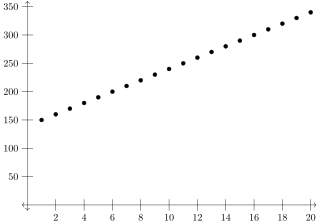
Here is a sequence we considered previously.
A school is renovating their football stadium. They can fit seats in the first row, and because of the bowl-shape of
the stadium they can fit an additional seats in each row as they go up each row. Previously, we figured out
that there are seats in the 20th row, and this time let’s assume that the th row is the last row in the
stadium.
What is the domain of this arithmetic sequence if we consider it as a function?
all real numbersall integersall
positive whole numbersthe set
Let’s now graph this function. Let’s use the number of seats on the vertical axis, because the number of seats
depends on the row number. So, we want the dependent variable to be our output values, which are the number of
seats, and we want the independent variable to be the input values, or the row number. We’ll use
to represent the number of seats, and we’ll use to represent the row number. If we wanted to write
down an algebraic expression for this function, we could use \[ y = f(x) = (10)(x-1) + 150. \] (Check whether you agree with this
equation!)
We start by plotting points that we know. You can look back at the table we made in the section on Sequences or
you can make another table for yourself.
We’ve now placed a dot for each of the rows in the stadium. Does it make sense to connect these dots with a line?
YesNo
The domain of this function is only the set , so we only have output values for those exact input values. If
we connected the dots on this graph, we would be indicating that we had input values between the ones we
marked, as well as corresponding output values between those we marked. But since we don’t have
half-rows or quarter-rows (or of rows, or anything else), we only want to mark the dots above for the
whole-number rows we have. We also don’t want to put an arrow on either end of this graph, because the
input values don’t continue in either direction. We’ve represented all of the input values here, and
there are no more that are off to the side of this graph. The arrows we sometimes use on functions
indicate that the graph continues in the direction of the arrow. That’s not the case for this example!
Graphs of linear functions
To wrap up this section, let’s look at the graphs of linear functions. Perhaps you remember that we defined a linear
function as one whose equation could be placed in the form for some values of and . Let’s use a specific example
to investigate what this means for its graph.
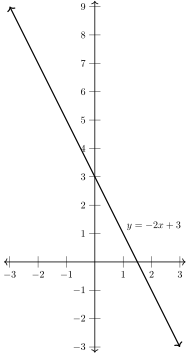
Let’s consider the example and draw a graph of this
function.
Usually, the first thing we want to do when we graph an equation is to plot some of its points. Let’s start by doing that
here.
Input
Output
Point
-3
-2
-1
0
1
2
3
Next, we can plot the points we found.
When we saw a graph like this before, we just went ahead and drew a line connecting the dots. Does that make
sense with the domain of this function?
YesNo
The domain of this function is all real numbers, so we do want
to connect the dots in some fashion here. We have an output for every single input on the number line, and this will
create a line of dots.
However, the last time we saw an example like this, we just guessed that the line would be straight. Let’s now
investigate why this is true. For simplicity, let’s focus on the points between and , but think about how the same
argument could apply to any other range of points.
We know that the equation of this function is , so we can think about what happens when we change by a little bit.
We know that the slope of this function represents a constant rate of change, so if we change the by one unit, the
has to change by : the for this equation is , which we can write as and think of this as our ratio of change in
outputs to change in inputs. In other words, we expect that the output value for has to be two less than
the output value for , and it is. But this ratio is the same no matter how much we change our input.
For , we changed our input by so we change our output by .
For , we changed our input by (from ) so we change our output by .
For , we changed our input by so we change our output by .
For , we changed our input by so we change our output by .
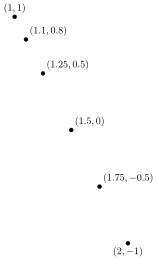
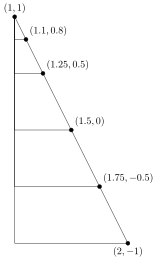
Let’s zoom in and take a look at all of these changes in one image together.
These points sure look like they are on a straight line, but we want to be certain that there won’t be some strange
point in between that doesn’t fall on the line. And the way we can tell is by looking at triangles formed by this
collection of points and the ratio of change in to change in .
We are paying attention to the five triangles in the image created by starting at and drawing a line straight down to
represent the change in -value, then a horizontal line to represent the change in the -value. We are confident that all
of these triangles are similar, because we have the same internal factor for each triangle given by the ratio of the
change in to the change in . Since these triangles are all similar, they have to have all the same angles.
Since every triangle makes the same angle with the horizontal line, all of the points here have to be
on the same line. And if we drew another change in and change in triangle, that one has to also
be similar to all of these because of the constant rate, and so that new point would also lie on the
line.
In other words, when we have a constant rate of change, all of our points have to lie on the same line because the
constant rate allows us to make all of these similar triangles. So, the graph of an equation in the form has to be a
straight line.
So, now we know that if we write an equation in the form of a linear function , the graph has to be a
straight line. But the opposite is also true: if a graph is a straight line, the equation of that graph can be
written in the form for some and .
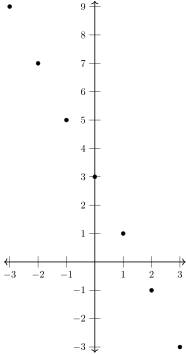
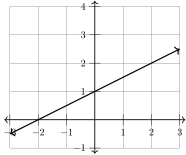
Let’s find an equation for the line whose graph is given below.
First, let’s observe that the graph crosses the -axis at the point , so we know that the -intercept-intercept is . This means that no matter what our equation for our function is, when we plug in , we get .
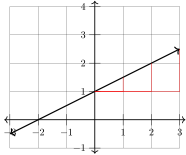
Next, let’s observe that because our graph is a straight line, we can draw a bunch of similar triangles just like we did
in the previous example. This time, we know that our triangles are similar because of the angles. The triangles we
draw are right triangles because the horizontal and vertical always make a right angle, and since the line is straight
it always makes the same angle with the horizontal. Let’s draw some of these triangles on our graph below.
Since these triangles are similar, the ratio of the bottom (horizontal) side to the vertical side has to be the same no
matter which triangle we consider. We could also consider triangles between the ones we drew, and they would also
be similar to these and thus have that same internal factor.
In this case, since the graph passes through the points and , when we increase the input by units, the output
increases by unit, and so the ratio of change in output to change in input must be . This ratio has to be constant
because our line produces all of these similar “slope triangles”.
Now we know that the graph has a constant rate of change and we know its -intercept, so we can write its equation.
This graph is the graph of the function because is the constant rate of change, and is the -intercept. In other
words, this is the graph of a linear function.
Now we know that our two definitions for linear functions are really the same idea, so it makes sense to use either
definition interchangeably. Linear functions and ratios and similar triangles are closely related ideas, so as you talk
with kids about any of these ideas, you are helping lay the groundwork for deeper understanding of the other topics
later in their mathematical journey.