The angle will still measure .
1 Activities for this section:
Reflections, rotations, translations
2 Transformations
The next way that we want to be able to compare shapes is to talk about when we have the same shape, but in a different location. Perhaps you think we could just look at two shapes and see whether or not they’re the same, but remember that when we want to prove things we need to be sure that they are exactly the same in every way. So, we need some technical terminology to talk about what it means to be exactly the same in every way. This section will give us that technical terminology using transformations. Informally, a transformation is a motion of the plane, such as a rotation or a horizontal stretch. Transformations that preserve angles and distance are called rigid motions. The basic rigid motions are reflections, rotations, and translations.
Throughout this section, we want to remember that our rigid motions don’t stretch or shrink shapes, or that distance is preserved. If two points are a certain distance apart, they will remain the same distance apart. It’s also true that rigid motions preserve angles. If you start with a particular angle measure, and then you do one of these transformations, however that angle moves in space, its measure doesn’t change.
If you begin with an angle measuring , what will the resulting angle be after a rigid motion?
The three transformations that we want to talk about in this section are reflections, rotations, and translations. In the elementary grades, these are usually called flips, turns, and slides.
3 Reflections
When we think of a reflection, our first thought probably involves a mirror. This is the right idea to have in our minds: a reflection is a mirror image of an object.
A reflection is what happens to all the points in the plane when
we flip them over a line. To specify a reflection, we choose a particular line of reflection, which we can call , and
use this line to exchange each point in the plane with its mirror image with respect to . The line of
reflection must be a perpendicular bisector of the segment connecting the original point and its mirror
image.
But what does that mean practically? Let’s look at two examples that will help us see how to draw reflections of
points and objects.
Let’s begin with a point and a line . Our goal is to reflect point over line .  We want to produce the mirror image of this point on the other side of the line. To do this, we’ll start by drawing
another line which goes through point .
We want to produce the mirror image of this point on the other side of the line. To do this, we’ll start by drawing
another line which goes through point . 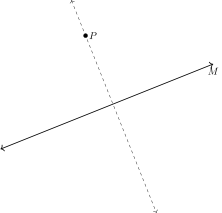 The new line we drew isn’t any line between and , it’s the one which is parallel piecewise supplementary perpendicular
to . So we could make right-angle marks indicating this relationship if we wanted to.
The new line we drew isn’t any line between and , it’s the one which is parallel piecewise supplementary perpendicular
to . So we could make right-angle marks indicating this relationship if we wanted to.
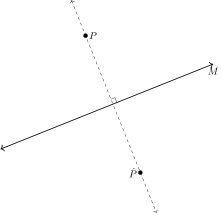
We will say that the new point is the image of when we reflect over .
Next, we want the mirror image of to be exactly the same distance from the line as , but on the opposite side of . We could measure this distance with our ruler or we could use our compass if we didn’t want to measure. The new point, which we’ll call , is the point we are trying to construct.
If the point was on the line , where
would its reflection be?
Above the line On the line Below the line None of the above
Let’s try again, but this time let’s reflect an entire shape.
Let’s reflect a triangle over the line . 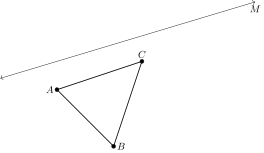 Let’s start by drawing the reflection of each of the points , , and , just like we did with point above. First, we draw
a line which is parallel piecewise supplementary perpendicular
to through each of , , and .
Let’s start by drawing the reflection of each of the points , , and , just like we did with point above. First, we draw
a line which is parallel piecewise supplementary perpendicular
to through each of , , and . 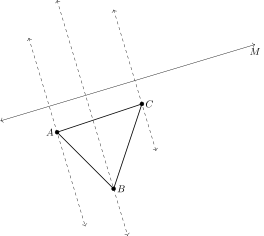 Next, we mark the image of each point by measuring the angle shape distance
between each point and the line . We mark the same angle shape distance
on the other side of the line, and use a hat to distinguish the image from the original point.
Next, we mark the image of each point by measuring the angle shape distance
between each point and the line . We mark the same angle shape distance
on the other side of the line, and use a hat to distinguish the image from the original point. 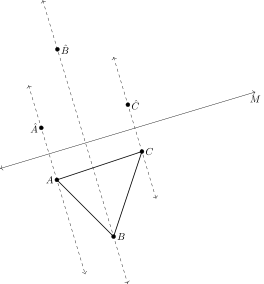 Finally, to see the reflected triangle, we connect the images of the points in the same way that the original points
were connected.
Finally, to see the reflected triangle, we connect the images of the points in the same way that the original points
were connected.
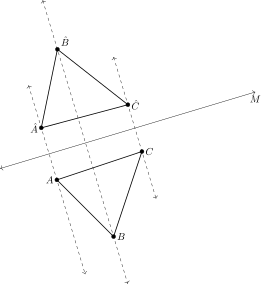
Why does this construction reflect the entire triangle? We are reflecting all of the points in the plane over the line , so all of the points between and also get reflected in the exact same way. Imagine every single point along the segment between and being reflected using the same process that we used. Since the reflection is a basic rigid motion, we’re not stretching or shrinking, so we get the same result by connecting with as we would if we reflected each individual point. The same is true for the segment between and and the segment between and , so we can connect the dots from to to to get the reflected triangle.
Pause and think: what would happen if the line of reflection went through the middle of the triangle?
4 Rotations
The next type of transformation that we want to discuss is a rotation. Informally, we might think of a rotation as a turn of some kind.
A rotation is what happens to all of the points in the plane when turn all of the points in the
plane around a given point. To specify a rotation, we choose a particular point to act as a center
point, and then a particular angle , and we turn all of the points of the plane an angle of around
.
Think of using a piece of regular paper and a piece of transparent paper. Draw the point on both pieces of paper
and line up the two copies of . Draw a point that you are trying to rotate on both pieces of paper as well, and begin
by also lining up the two copies of . While holding down both papers at , rotate the top (transparent) paper
according to the chosen angle . The new location of on the transparent paper is the image of the original . Let’s see
how to construct this with our tools.
We are given the point below and an angle of counterclockwise. We are also given the point below. Rotate around
using the angle . 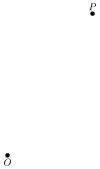 In order to do this rotation, we need to ensure that the angle made by , , and the image of measures . So, we use
point as the center of this angle and the ray as the starting ray of the angle. So, let’s draw the line from to as a
solid line and then the other ray of the angle as a dashed line.
In order to do this rotation, we need to ensure that the angle made by , , and the image of measures . So, we use
point as the center of this angle and the ray as the starting ray of the angle. So, let’s draw the line from to as a
solid line and then the other ray of the angle as a dashed line. 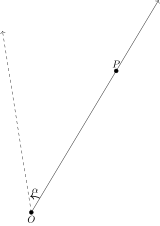 Now, since we aren’t stretching or shrinking the points in the plane, we need to mark the image of , which we will
call , along the dashed line so that it is the same not the same
distance from as is from . We can do this by measuring with our ruler, or we can use our compass.
Now, since we aren’t stretching or shrinking the points in the plane, we need to mark the image of , which we will
call , along the dashed line so that it is the same not the same
distance from as is from . We can do this by measuring with our ruler, or we can use our compass.
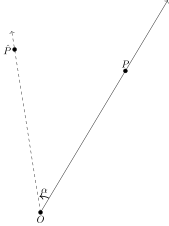 As we said, this is the image of under this rotation of angle counterclockwise with center .
What happens if the point is on the point ?
The point moves to the other side of . The point moves
farther away from . The point moves closer to . The point does not move. None of the above.
To see an example of rotating an entire triangle, watch the video below.
_
What happens to a triangle if we rotate using an angle of ?
The triangle ends up as a mirror image of the original
triangle. The triangle ends up upside-down compared to the original. The triangle twists around
and moves farther from . The triangle ends up in the same spot it started. None of the above.
5 Translations
The final type of transformation that we want to discuss in this section is a translation. Another word you could use for a transformation is a shift.
A translation is what happens to all of the points in the plane when we move each
point a certain distance in a certain direction. To specify a translation, we often use a vector to describe the
distance and direction.
You can think of a vector as an arrow. For instance, the arrow below could tell us to move three spaces east:
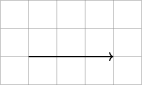
First, let’s look at what happens to a single point when we translate.
Translate the point according to the arrow
given. In this case, the arrow points a bit down and to the right, but we don’t have specific direction words to use
for this direction. 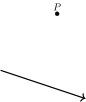 In order to translate this point , our goal is to move the length of the arrow in the direction given by the arrow.
There are many ways to actually construct this; we’ll talk about several in class. In the image below, we’ve drawn
the arrow again, but starting from the point . This means that the image of , or is exactly at the other end of the
arrow.
In order to translate this point , our goal is to move the length of the arrow in the direction given by the arrow.
There are many ways to actually construct this; we’ll talk about several in class. In the image below, we’ve drawn
the arrow again, but starting from the point . This means that the image of , or is exactly at the other end of the
arrow. 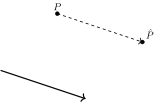
When you construct the arrow starting from , remember that we aren’t just guessing which direction the
arrow goes. It has to be parallel to the original arrow that was drawn so that it goes in the same
direction.
What property of shapes or of parallel lines could you use to verify that the arrow is exactly parallel to the original
arrow?
Vertical angles The Parallel Postulate Opposite sides are equal Adjacent angles are equal You do
not need to verify that the two vectors are parallel
Next, let’s see how we can translate an entire figure.
Let’s translate the quadrilateral by the vector given. The quadrilateral is not any special type, and the vector
points up and to the left, but we don’t have specific words to describe the direction. 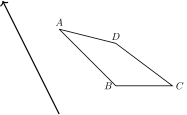 When we translate, all of the points in the entire plane figure direction of the arrow
move according to the vector. So, we can translate each of the vertices of our shape (getting , , , and ). The
translation shifts the points on the line segments in the same way, so we can then connect the dots to see the final
shape. In the figure below, we show the arrow translating each of the vertices, and then we draw the final shape.
When we translate, all of the points in the entire plane figure direction of the arrow
move according to the vector. So, we can translate each of the vertices of our shape (getting , , , and ). The
translation shifts the points on the line segments in the same way, so we can then connect the dots to see the final
shape. In the figure below, we show the arrow translating each of the vertices, and then we draw the final shape.
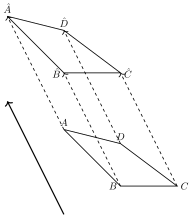
Even though the final image above looks a bit like a prism, remember that we are dealing with 2D shapes here,
because we are sliding around all of the points on the plane. However, there’s a good reason that the final picture
looks like a prism. Remember that we made a prism by taking a second copy of a shape and moving it in 3D
space. When we draw the lines from the top copy to the bottom copy, they should all be the same.
So, if our vector is in 3D space, we could actually use the translation lines to make the sides of a
prism.
There’s another type of transformation we want to mention.
The identity transformation, sometimes called the
“do nothing” transformation, doesn’t move the plane at all.
Is the identity transformation a translation? A reflection? A rotation? Select all true statements below.
The
identity transformation is a translation using a vector of length zero. The identity transformation is not a
translation because it doesn’t move the points anywhere. The identity transformation is a reflection, because we
can reflect over the -axis. The identity transformation is not a reflection, because reflections flip things over. The identity transformation is a rotation using an angle of zero degrees. The identity transformation is not a
rotation because it doesn’t turn the points.
As a nearly final thought for this section, you might have heard the term glide-reflection to refer to what happens to all of the points in the plane when we do both a translation and a reflection across a line parallel to the translation. We won’t use this terminology, but you should be prepared to perform any sequence of the basic rigid motions we have discussed.
Pause and think: what are the characteristics for each of a reflection, a rotation, and a translation that you want to
highlight in your explanations?
2026-07-22 02:13:32