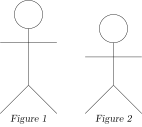
Figure 1 Figure 2
Did you need to measure the two heights to know the answer to this question?
Yes No
So far, we have talked about comparing shapes in terms of comparing the properties that shapes have. There is another way to compare shapes that we haven’t touched on yet: measuring them in various ways. We can ask something like “which shape is bigger?” or “which shape is taller?” or similar questions about shapes.
One of the first ideas that kids explore on their way to measuring things is to compare things by “lining them up”. For instance, kids could ask a question like, “which kid is the tallest in our class?” To solve this problem, the kids could start with someone that they guess is the tallest, and then have each kid stand back-to-back with that kid until they try everyone in the class, or until they find someone taller. The taller kid would then compare their height against all of the remaining children, and so on.
Did you need to measure the two heights to know the answer to this question?
This height comparison should remind you a little of a one-to-one correspondence. With one-to-one correspondence, we matched up items in each set until we ran out of items in one set, and then said we had more in the other set. We didn’t need to be able to count to make that conclusion. Here, we are essentially matching up the height of the two people until we run out of height on one of them, and then we say that the other is taller. And we didn’t need to be able to measure to make that conclusion.
We make this type of comparison regularly in our every-day lives. We might decide which of two books is wider by putting them both flat on a table, or we might decide which of two charging cables is longer by matching them up. We don’t need to measure length, area, or volume in order to make these comparisons, and we didn’t need any numbers at all in order to make our comparisons. However, there are other types of comparisons can be more difficult to make without numbers. For instance, we could ask “is it farther from here to Denver, Colorado, or from here to Miami, Florida?” Perhaps we could look at a map and guess, but it’s hard to hold up these two objects and be very sure. Instead, we would measure the distance from here to Denver, and then measure the distance from here to Miami, and then compare the two numbers we get from doing those measurements. In a sense, we are comparing both distances to a common unit, which in this case is probably a mile.
When we compare and measure things, we need to be a little bit careful. Perhaps you’ve noticed this already in the questions we’ve asked. For instance, when discussing the kids in the class, we asked “which kid is the tallest?” Instead of something like “which kid is the biggest?” There are lots of ways to interpret the question “which kid is the biggest?”, so we want to be sure that we are being specific when we ask such questions.
Asking specific questions can be tricky, so let’s make sure we practice as often as we can!
In order to move from comparisons to measurements, we need to first choose a unit of measurement. As we mentioned in the previous section, when we make a measurement, we are essentially comparing the object we are trying to measure to the unit we have chosen. As we learn to use units of measure, we want to use a bunch of different kinds of units, and we want to use unexpected or non-standard units. There are two main reasons for this: first, because we want to experience measurement the way kids do when they are first learning it and having their first experiences with units of measure that we already know well, and second because we really want you to see how the process of measuring is the same regardless of what unit we are using. Please be looking for these themes!
The units of measure that you are probably familiar with are things like inches, centimeters, feet, miles, kilometers, square inches, square miles, cubic feet, milliliters, and so on. These are all standard units of measure, meaning that each of these units has a specific definition that we agree on all over the world. We want to focus right now on non-standard units of measure, which could be nearly anything else. Let’s start with an example.
Perhaps we want to use the length of the golf pencil; in this case we would say that our unit of measurement is the length of the golf pencil.
From the last example, there are two things to observe. First, we need to be specific when we describe our unit of measure, so that we don’t have more than one option for how we’d like to use the unit. The other thing we’d like to point out is related to dimension. The golf pencil itself is a 3D object, but the thing we are trying to measure is a 1D length (the length of the golf club). In order to be able to talk about how many units it takes to measure that golf pencil, we need our unit of measure to also be one-dimensional. The length of the golf pencil is a one-dimensional unit, so we can use it to make a one-dimensional measurement. When the dimension of the unit matches the dimension of the aspect we are trying to measure, we will say that our unit is appropriate for that measurement.
Thinking about how the size of a particular unit of measure affects the measurement we get is an important skill for kids to learn. For instance, let’s think about measuring a soccer field.
So far, we have talked about units for measuring length, area, and volume, because we will focus the most on these ideas moving forward. However, we also have units for measuring other aspects like temperature, time, speed, and all kinds of other objects!
The idea of measuring occurs in some unexpected places throughout mathematics, including when we talk about fractions. Remember that we defined a fraction by first taking a whole and cutting it into equal pieces. Each of these equal pieces is what we mean by of the whole, and then to get , we take copies of . In this sense, we can think about as a sort of unit of measure that we are using to measure out the parts we need.
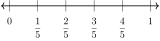
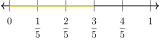
We hope this helps you to see some connections that you might not have seen before, and to understand the idea of fractions a little better!
2026-07-22 02:12:24