1 Activities for this section:
2 Expressions from a picture
As children become more familiar with numbers and operations, we would like for them to begin writing their own expressions to describe their mathematical thinking. We have been talking about expressions all semester, but let’s start by giving a definition for an expression.
An expression is a collection of numbers, variables, exponents, and/or functions that are connected by any
operations and any grouping symbols.
This definition is a little bit technical so you can think about expressions as the mathematical phrases we write
down to describe our mathematics. Think of the things in the definition as options that we can use for forming an
expression. For example, is an expression, as well as something more complicated like In each case, we
are putting together some of the options from our list to form an expression. The expression uses
numbers and variables as well as multiplication and addition. The expression contains numbers, variables,
exponents, the square root function, multiplication, addition, subtraction, and some parenthesis for
grouping. (Remember that according to our convention on the order of operations, we always evaluate
parenthesis first, then multiplication or division, and finally addition or subtraction.) What is not
included in either expression is an equals sign or an inequality symbol. If we include an equals sign we
are talking about an equation, and if we include an inequality symbol like or we are looking at an
inequality.
When we write expressions, as we have done all semester, we want to focus on using the meaning of operations to describe what we are seeing. Let’s take a look at two examples.
Below, we have a design made of dots. 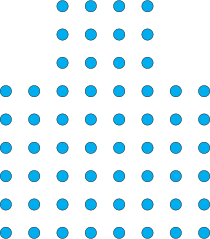 We would like to write an expression to describe the number of dots in the design.
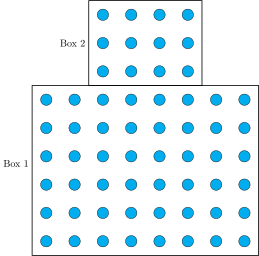 Since these are both arrays, the appropriate operation to use to count the number of dots is addition subtraction multiplication division
. For both arrays, we will use one circle as one group object
and one row of dots as one group object
, and then we see that in Box 1 we have a total of rows with dots in each row for a total of dots. In Box 2 we see
that we have rows with dots in each row for a total of dots. To get the total number of dots in the entire design,
we want to combine together the amount of dots in Box with the amount of dots in Box , so the operation we
should use is addition subtraction multiplication division
. All together, we get the following.
Since these are both arrays, the appropriate operation to use to count the number of dots is addition subtraction multiplication division
. For both arrays, we will use one circle as one group object
and one row of dots as one group object
, and then we see that in Box 1 we have a total of rows with dots in each row for a total of dots. In Box 2 we see
that we have rows with dots in each row for a total of dots. To get the total number of dots in the entire design,
we want to combine together the amount of dots in Box with the amount of dots in Box , so the operation we
should use is addition subtraction multiplication division
. All together, we get the following.
One way that we could describe the design is to say that we have a -by array of dots stacked on top of a -by- array of dots. Let’s draw rectangles around these two arrays to make them more obvious. We will also label the lower array as box and the upper array as box .
Pay attention to the way that we wrote our expression to describe the way that we were seeing the diagram. The way we looked at the diagram suggested which operations to use, and the expression we got at the end of the problem reflects how we decomposed the diagram. We could simplify this expression to get a numerical value for the total number of dots, but simplifying this expression would remove any hints of our thinking so let’s leave it as-is. However, this is not the only way to see the diagram. Let’s work through the example again, but look for a different expression to describe the number of dots.
Below, we have a design made of dots. (This is the same design as in the last example.) 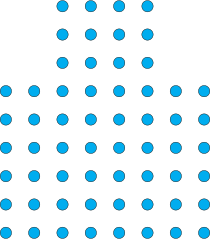 We would like to write a different expression to describe the number of dots in the design. This time, let’s view the
diagram as a -by- array of dots, but with two -by- arrays of dots removed from the top corners. Let’s draw a
rectangle to represent the entire array of dots, and then draw the removed dots as circles that are not filled in.
We would like to write a different expression to describe the number of dots in the design. This time, let’s view the
diagram as a -by- array of dots, but with two -by- arrays of dots removed from the top corners. Let’s draw a
rectangle to represent the entire array of dots, and then draw the removed dots as circles that are not filled in.
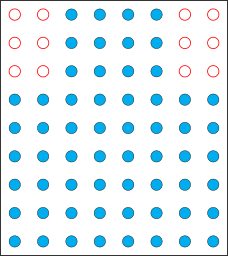
We are still working with arrays, so we want to begin by thinking about multiplication. Continuing to use one dot as one object and one row as one group, we can count the full -by- array by seeing that we have rows with dots per row for a total of dots. But now we want to remove the two arrays at the corners. They are identical, so let’s start by counting one of them. The removed array is a -by- array so we have rows with dots per row for a total of dots in each of them. Since we want to remove or take away these from the bigger array, the correct operation in this case is addition subtraction multiplication division . We have the following expression.
We got a different expression than the first example, because we used a different process of thinking about the diagram. This is something we should expect! However, many times it makes sense to simplify the expression so that we can work with it to solve a problem or so that we can present our answer as a single number. Let’s go ahead and do that here to verify that both of the expressions we got are actually equal.
For our first expression we got the following. \begin{align*} 6 \times 8 + 3 \times 4 &= 48 + 12 \\ &= 60 \end{align*}
For our second expression we got the following. \begin{align*} 9 \times 8 - 2 \left ( 3 \times 2 \right ) &= 72 - 2\times 6\\ &= 72 - 12 \\ &= 60 \end{align*}
When we replace an expression with a different expression that has an equal value, we can refer to these two expressions as equivalent. For example, and are equivalent expressions. Our work here showed that is an equivalent expression to , or that we got the same number of dots with either way of thinking.
Many expressions that we use to describe our thinking will also involve a variable. We use a variable when there is a part of our work that we don’t yet know or a part of our work that could vary. For instance, we could draw the same design of dots, but instead let the bottom array be any number of rows, each containing dots. We will draw this with an ellipses () in the middle of the bottom part of the array to indicate that we could have any number of these rows.
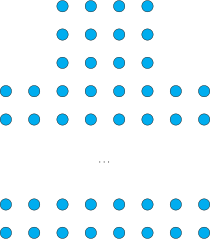
We could use the letter to indicate the number of rows in this bottom array, so that the array is an -by- array.
Using the same thinking as the first example (subdividing the design into two rectangles), what expression would
we write for the total number of dots?
Using the same thinking as our second example (subtracting the corners from a full rectangle), we would have to think of the entire big array as being made out of total rows with dots in each.
Using the same thinking as the second example, what expression would we write for the total number of
dots?
Let’s see that each of these expressions is still equivalent. We will simplify the first expression first. When we have a variable multiplied by a number, it’s customary to place the number before the variable, so we will do that as well as simplify the . For the second expression, we first have to distribute the to each of the and the as well as simplify the . After that we multiply by the other and then combine like terms. \begin{align*} (R+3) \times 8 - 2 (3 \times 2) &= 8R + 24 - 2(6) \\ &= 8R+24 - 12\\ &= 8R+12 \end{align*}
We ended up with the same expression after simplifying, so these two expressions are equivalent. Simplifying to gives us a form of this expression that is easy to work with, but the original expressions we wrote down are still valuable since they represent our individual thinking about the diagram. You should be able to work with both!
3 Expressions from a description
As we were working with the previous examples, we came across a few points where we verbally described an expression and then wrote it down. For example, Being able to transition from a verbal description to a mathematical expression is an important skill for children to develop as they get closer to working with algebraic expressions in middle school and beyond. This skill is also included in our mathematical practice standards. Let’s practice one final example for this section.
Let represent the number of crayons in Dale’s pencil box and let represent the number of crayons in Edwin’s pencil
box. Write an expression for the quotient of more than the number of Dale’s crayons and less than the number of
pencils in Edwin’s pencil box.
Notice the way that we worked slowly as we transitioned from English into mathematics. We start to form
expressions that have some mathematical symbols and some English phrases, which are an important step for
children to take. Modeling our thoughts using the language of mathematics is a challenge, but the more we can
break it down into steps that seem familiar to us, the easier it gets!
2025-11-23 00:07:02 We will start out by recognizing that we want to form a quotient, which is another word for the operation of addition subtraction multiplication division . Since we have explained why we can write a division problem as a fraction, we are looking for the following. The phrase “ more than Dale’s crayons” can be represented with an expression as because we want to combine together and the number of Dale’s crayons which is . The meaning of addition is to combine, so we add together these quantities. The phrase “ less than Edwin’s crayons” can be represented with an expression as because we want to take away crayons from the number of Edwin’s crayons which is . The meaning of subtraction is to take away, so we start with the and subtract . We can now plug these expressions into our fraction above to get our final expression.