Activities for this section:
Division and fractions
You may have noticed that we have so far written division problems like this. \[ 5 \div 2 \] But you might also recall having seen division problems written like this. \[ 5 / 2 \] And that notation is really the same as writing division like this. \[ \frac{5}{2} \] However, this last notation is the same thing that we have used for fractions, but we have different definitions for fractions and for division. However, once we understand how these two ideas are different, we will also see that the answer to the division problem is the fraction . We’ll use a story problem to illustrate.
Consider the following story problem.
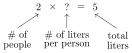
Manuel and Akira have a total of liters of water that they would like to split equally between them. How many liters of water will each person get?
First, we want to see that this is a division problem, so that it can be solved by . Next, we want to solve it with a picture to see that the answer is .
To see that this is a division problem, we need to identify our groups and objects as well as the type of division. The water is going to be split between the two people, so it makes sense to take one group as one liter gallon person container . And then, we will take one object to be one liter gallon person container . We know that we have a total of liters of water, which is our total number of objects. We also know that there are people that are getting water, and this is our number of groups. The piece of information we don’t know is how many liters per person or in other words how many groups how many objects in each group this is a multiplication problem . We can write this using our definition of multiplication as follows.
In other words, this is a how many in each group division story for . This expression represents the answer to this division problem in the same way that something like represents the answer to a multiplication problem or represents the answer to an addition problem.
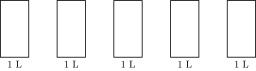
Next, let’s draw a picture to solve this problem. We’ll start by drawing the liters of water as rectangles.
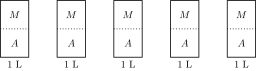
Since there are people getting water, the easiest way to be sure that we are distributing the water fairly is by cutting each liter into equal pieces and passing out one piece to each person. Let’s draw that in our picture. We will use a dotted line to split each box in half horizontally, and label Manuel’s piece with an and Akira’s piece with an .
The question asks us how much water each person gets, so we can look at just Manuel’s pieces (since Akira’s amount will be the same). We can count in the picture that Manuel gets a total of pieces, and each piece is worth of a liter of water. In other words, using our meaning of fractions, Manuel’s share of the water is liters of water. These calculations tell us that the answer to this problem for is , or that
\[ 5 \div 2 = \frac{5}{2}. \]
We have shown in this example that when we divide, we can also write our answer as a fraction. It makes sense to use the same notation for both ideas, since both of them are the answer to the same division problem. Let’s keep exploring this idea, but now also include decimals in our thinking.
Fractions and decimals
Another thing you might have noticed is that we use the same language to describe and . Both of them are called “one tenth”, but we defined them differently. Let’s see how these ideas are actually the same thing.
Explain why and are the same value.

 Using our definition of fractions, this shaded piece is of the whole. But what if we thought about this using
bundling? We started with one unit, and then unbundled it into equal sections. By definition, each section has the
value because when we unbundle, we move one place value right.
Using our definition of fractions, this shaded piece is of the whole. But what if we thought about this using
bundling? We started with one unit, and then unbundled it into equal sections. By definition, each section has the
value because when we unbundle, we move one place value right.
We will start by drawing a whole which also has the value .
To find of this whole, we need to cut it into equal pieces, based on the meaning of the denominator, and then shade piece, based on the meaning of the numerator. Let’s do that in our picture.
In other words, this shaded region is of the unit, and its value is also . Since it’s the same shaded region, these values must be equal. \[ \frac{1}{10} = 0.1 \]
Similarly, we could unbundle each of the -sized pieces, meaning that the new, smaller pieces would each have the value . Unbundling each of the equal pieces into more equal pieces would mean that our whole is split into equal pieces, or that each piece is worth . In this way we can see that \[ \frac{1}{100} = 0.01. \] This process could continue as long as we like.
Using thinking like we just described, what are the decimal values of the fractions
below?
We can use this connection between fractions and decimals to write other fractions as decimals as well.
Write as a decimal.
Since we want to use one of the facts above, we want to change this fraction into an equivalent fraction whose denominator is , , , or some other power of . We know that , so we can make an equivalent fraction with denominator in this case. We have \[ \frac{9}{20} = \frac{\answer [given]{45}}{100}. \] Now, we know that as a decimal, and that according to our meaning of fractions is pieces, each of size . This means that is also pieces, each of size as a decimal. We can think about this as individual blocks, each of value . These blocks could be organized into bundles and individual blocks, and so the total value of all of these blocks would be . In other words, \[ \frac{9}{20} = 0.45 \] as a decimal.
The previous example shows us that if we can make an equivalent fraction whose denominator is a power of (like , , , etc), we can write the fraction as a decimal by looking at the numerator of that fraction. Decimals like this one, which can be written as a fraction whose denominator is a power of and whose decimal values stop at some place value, are called terminating decimals.
Using the strategy of the example above, what is the decimal equivalent of the fraction ?
Using a strategy similar to the one above, how would you write the decimal as a fraction?
We saw in our Fractions and Decimals activity that we also have another class of decimals called repeating decimals, where the decimal does not stop at any place value, but repeats over and over in a pattern. For example, the decimal number \[ 4.36\overline{25} \] could also be written as \[ 4.36252525252525\dots \] Where the and repeat forever. We draw a line over the repeating part of the decimal so that we know it’s the part that repeats.
Repeating decimals cannot be written as a fraction whose denominator is a power of 10, so we cannot use the strategy of the example above to find these decimal numbers. However, we can use the connection between division and fractions to help us.
Use the connection between division and fractions to write as a decimal.

We know that the fraction can be written as the answer to the division problem . So, if we calculate the answer to the division problem by using long division, this answer will be equal to the fraction . Let’s write down the first few steps in the long division.
We can see a pattern here: every time we subtract, our remainder is , and then we drop down a zero next to that and divide by to continue. We’ll get another remainder of , drop down another zero, and this pattern will continue forever. We can keep placing more zeroes on the end of because we will never see a remainder of zero, no matter how many steps we take. So we can see that the answer to is or in other words that \[ \frac{5}{9} = 0.\overline{\answer [given]{5}} \] as a decimal.
As we saw in the Fractions and decimals activity, the fact that we only have a finite number of remainders that are possible when we divide by guarantees that the long division will repeat at some point. In this case the repetition started at the first decimal place.
We found the pattern very quickly in this case, but sometimes the pattern can take longer to find.
Using long
division, what is the decimal equivalent of ?
The numbers we have been considering are decimals which can also be written as fractions. Any number which can also be written in the form for integers and is called a rational number. (Notice again we said integers, but you can think about this as whole numbers for now.)
Which of the following are rational numbers? Select all that apply.
The previous question might give you the impression that every number is a rational number, but in fact that’s not
true. There are many numbers that cannot be written as fractions, no matter how hard we try. For example, the
number or the number are good examples to keep in mind. These numbers, which cannot be written as fractions,
are called irrational numbers. (If you are interested in a proof that is irrational, you can find one
online.)
Remember that a rational number can be placed in the form , it does not have to look like that right now!
These connections between division, fractions, and decimals allow us to ask and answer many interesting questions about numbers. (In fact, there is an entire branch of mathematics called “number theory” where mathematicians ask and answer questions about numbers!) If this sounds interesting, try out some of the following puzzles!
- How can we predict what power of we will need to write a terminating decimal?
- How can we predict whether a fraction’s decimal will terminate or repeat?
- How can we predict how many long division steps we need to take before a repeating decimal will repeat?
- How can we write down a number we know will be irrational?