Activities for this section:
The meaning of multiplication
As we did with addition, we want to develop a definition for multiplication that helps us recognize when a problem should be solved using multiplication. We’ll investigate what physical actions we are taking with blocks or other small objects when we multiply, so that multiplication becomes a solution strategy that we recognize rather than a memorized procedure. This will continue the kind of thinking we set out in the Operations section. As usual, let’s start out with an example.
At the grocery store, Horatio sees baskets. Each basket contains apples. How many apples did Horatio see?
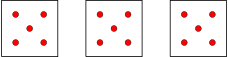
Looking back at our example, how was this different than the problems we solved using addition? Remember that when we add quantities together, we are essentially combining them and counting. While we did that here, the things we wanted to count were organized into equal groups. We drew one basket at a time with the five apples in each instead of just drawing all of the apples. This is the underlying structure we want you to recognize when it comes to multiplication, and so the definition of multiplication that we want to use in this course is the following.

Let’s return to Horatio and the grocery store and see how our definition of multiplication applies in this situation.
At the grocery store, Horatio sees baskets. Each basket contains apples. How many apples did Horatio see?
For our meaning of multiplication, we need to organize our objects into equal groups, In this particular story, we know that one group is one apple basket fruit grocery store . Notice that these groups are all equal in the story. They each contain the same thing. But what do they contain? We also know that inside these groups we need to have objects, and so in this story one object is one apple basket fruit grocery store . Now, to solve the problem we can use multiplication. We count the number of groups and get baskets, and we count the number of objects in each full group and get apples in each basket. According to our meaning of multiplication, that means that we can write the total number of apples as \[ \answer [given]{3} \times \answer [given]{5}. \]
For the purpose of clarity in your explanations, we will ask you to always write the number of groups as the first number in your multiplication expression, and the number of objects in one full group as the second number in your multiplication expression. In shorthand notation, we are looking for the following order.
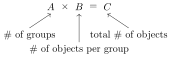
In some situations, it will be easy for us to identify what is playing the role of one group and what is playing the role of one object, but in other situations these roles might be harder to see. We would like you to be able to see this same structure spanning all kinds of multiplication problems. As with addition and subtraction stories, children often don’t recognize that different models of multiplication are actually all the same operation. One of our goals for you as teachers is to be able to bring all of these different meanings and examples of multiplication into the same category in your mind, fitting inside the one meaning we have chosen as our definition.
Repeated addition
The first experience that many children have with multiplication is using repeated addition. In this type of multiplication problem, the goal is to add together the same quantity over and over again. Let’s take a look at an example, and see how repeated addition fits into our definition of multiplication.
Camdyn eats two cookies every day for lunch at school. How many cookies did Camdyn eat this week (Monday through Friday)?
A child who hasn’t yet learned multiplication might solve this problem by adding, using something like this. \[ \answer [given]{2} + \answer [given]{2} + \answer [given]{2} + \answer [given]{2} + \answer [given]{2} = \answer [given]{10} \] This child might reason that we need to combine together the cookies that Camdyn is eating each day, so we add together all of the cookies from each weekday. This is a great way to solve the problem, and gets us the right answer. It also connects back to the idea of skip counting, which children start practicing much earlier than they learn multiplication. We are counting by twos starting from zero, and we can keep track on our fingers of how many days have passed.
Notice that this example still fits into our definition of multiplication using groups and objects per group. In this case, the objects we are trying to count are the cookies the days the week 2 , or we could say that one object in this problem is one cookie. Then we can look to see if these cookies are grouped in any way, and they are: we have equal groups based on each day of the week. So we could say in this problem that one group is one cookie day week 5 . It’s important to notice that Camdyn eats the same number of cookies each day, so that these groups are all equal. To fit this situation into our definition of multiplication, we write the number of groups in place of and we write the number of objects in each group in place of . The total will be the total number of cookies that Camdyn ate. \[ \answer [given]{5} \textrm{ (number of groups) } \times \answer [given]{2} \textrm{ (number of objects per group). } \]
Our meaning of multiplication agrees with this repeated addition example. The things we are repeatedly adding are the objects, and each group is one repetition of the addition. Another way to say this is that the number of groups is the number of times we need to repeat the number we are adding.
Array and area problems
The next example of a multiplication situation we might encounter is an array or area model, where the things we would like to count are arranged in a grid. Here is another example for us to consider.
Angel has a bunch of trading cards that she laid out on the table in front of her in the shape of a grid. The grid is six cards wide and four cards tall. How many cards are on the table?
In this situation, a child who is just learning multiplication might draw out or model the cards on the table and count them. Here is an example picture.
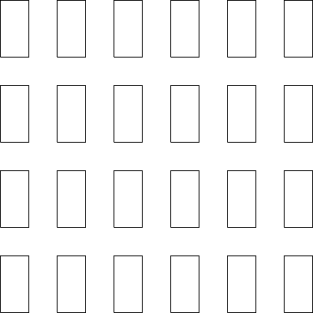
To find the total number of cards, a child with such a picture could count them and find that there are total cards.
But to see how this fits with our meaning of multiplication, we need to connect this counting to the idea of making equal groups. First, we are trying to count the total number of cards in this example, so one object will be one 4 6 row column card . Next, we need to group these cards into equal groups. Let’s use the rows of the array to do this. We will re-draw our picture, using an oval to circle each of the groups in the picture.
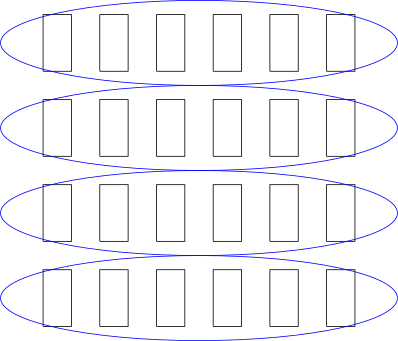
We can now use the rows as our groups, because each row has the same number of cards in it. In other words, we want one group to be one row in this example. Now we can count the number of groups and the number of objects per group to write the total number of cards using multiplication. \[ \answer [given]{4} \textrm{ rows } \times \answer [given]{6} \textrm{ cards per row} \]
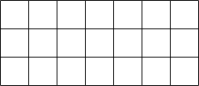
Our meaning of multiplication also agrees with this array example. Notice that we chose to use the rows for our groups in this case, but we could also have chosen one group to be one column instead. We also titled this section “array and area models” because we could also use this grid arrangement to find the area of a figure. To connect these ideas, we have to realize that when we are trying to find the area of a figure, we are usually trying to find the number of squares that cover the object. For instance, here is a rectangle whose width is inches and whose height is inches, covered with squares.
Scaling problems
Our next type of multiplication problem is a scaling problem. Let’s see an example.
Geoff ran for minutes in gym class today, but his friend Usain ran times as long. How many minutes did Usain run in gym class today?
First, if you were drawing a picture to help yourself solve this problem, notice that you might draw an array to represent the minutes that Usain ran. Or, you might think of this problem using repeated addition, adding up or skip counting using Geoff’s minutes. Usain ran for \[ \answer [given]{9} + \answer [given]{9} + \answer [given]{9} = \answer [given]{27} \textrm{ minutes in total.} \]
Actually, this already gives us a hint as to how we can connect this “times as many” type of problem to our meaning of multiplication. To solve this problem, we are trying to find how many minutes Usain ran, so one object in this problem is Usain Geoff one minute one mile . We need to see these minutes arranged into equal groups, which they already are based on our skip counting. The challenge here is to describe these groups. If we model the picture with an array, using a circle to represent one minute, we might draw an array with rows and dots in each row.

This scaling or “times as many” type of multiplication can sometimes feel easy to recognize, since the word “times” reminds us of multiplication, but don’t forget to connect back to the groups-and-objects meaning of multiplication in your explanations.
The multiplication principle of counting
Our last type of example of multiplication for this section involves a specific type of problem called a counting problem. We will deal with counting problems more in another chapter, but we will preview them briefly here to strengthen their connection to multiplication.
The multiplication principle of counting says that when you have several events that occur in order and you are trying to find the total number of ways that these events can happen, you multiply the number of ways that each event can happen in order to find this total. Let’s take a look at an example and explain the principle as well as why multiplication is the right idea in this case.
Jordan went to the dining hall for lunch, where they had three different sandwiches available as well as two different kinds of soup. If Jordan picks one sandwich and one soup for lunch, how many different lunch combinations can Jordan choose?
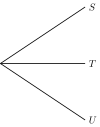
To solve this problem, we are going to draw a specific kind of diagram called a tree diagram, where we represent the choices as branches on a tree. Selecting a sandwich is an event which can occur in different ways. We will start at a point on the left side of the diagram, and draw three branches for the three different sandwiches that Jordan can choose. Let’s call these sandwiches , , and .
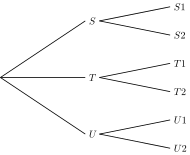
To connect this to our meaning of multiplication, we need to find some groups and objects per group here. Since we are trying to count the lunch combinations, one object in this case should be one lunch combination Jordan soup sandwich . How are these lunch combinations organized? We organized them by first splitting them up by which sandwich was chosen. So there is one group for sandwich , one group for sandwich , and one group for sandwich . We can circle the sandwich group on our tree diagram.
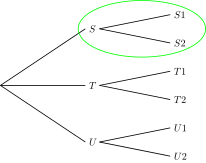
We have total groups, each labeled by one sandwich, and then we have lunch combinations in each of these equal groups. So our total number of lunch combinations can be given by \[ 3 \times 2. \]
We encourage you to start looking for ways that you can identify this groups-and-objects structure of multiplication not only in class, but in the everyday world around you.