1 Activities for this section:
2 Dividing fractions with how many groups
So far, we have worked on dividing whole numbers and decimals. It’s time to turn our attention to fractions. Before we go farther, note that the examples in this section are designed for you to read after you have worked through some more basic examples in the in-class activities. If you haven’t done those activities yet, please go do so and come back when you’re finished!
Let’s start with a how many groups example.
Consider the following story problem.
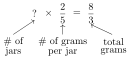 This shows we have a how many groups division story for . We have solved how many groups problems in the past
by starting with drawing all of the objects and then making sections for each group. Let’s start the same way by
drawing the of a gram of beads that Min has.
This shows we have a how many groups division story for . We have solved how many groups problems in the past
by starting with drawing all of the objects and then making sections for each group. Let’s start the same way by
drawing the of a gram of beads that Min has.
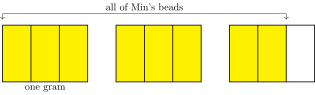 In this picture, we want to circle groups of of a gram. Right now this is difficult because each gram is split into
equal pieces, not . If we split each of the three equal pieces into equal pieces, then each gram will be split into
equal pieces. This means that of a gram will replaced by its equivalent fraction of a gram. Let’s see the equal
pieces in each gram in our picture.
In this picture, we want to circle groups of of a gram. Right now this is difficult because each gram is split into
equal pieces, not . If we split each of the three equal pieces into equal pieces, then each gram will be split into
equal pieces. This means that of a gram will replaced by its equivalent fraction of a gram. Let’s see the equal
pieces in each gram in our picture. 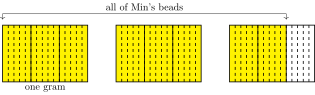 In order to draw groups of of a gram, we also need to make an equivalent fraction whose denominator is . So, we
replace with its equivalent fraction . We want to create groups of pieces in the shaded region in our picture.
Notice that we are making groups of pieces because the numerator tells us how many pieces we are
working with, or in this case how many pieces are in each of the groups we want to make. We will do
this below with different colors and we will also label the different groups with small numbers above
them.
In order to draw groups of of a gram, we also need to make an equivalent fraction whose denominator is . So, we
replace with its equivalent fraction . We want to create groups of pieces in the shaded region in our picture.
Notice that we are making groups of pieces because the numerator tells us how many pieces we are
working with, or in this case how many pieces are in each of the groups we want to make. We will do
this below with different colors and we will also label the different groups with small numbers above
them.
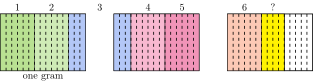 So far, we have made full groups, and there are small pieces left that we haven’t placed into a group. We see that
these pieces are marked with a and are still yellow in the picture in order to indicate that they haven’t been placed
into a group yet. Let’s look at those last four pieces as a fraction of one whole group. Notice that we’ve changed the
whole from the gram to the jar!
So far, we have made full groups, and there are small pieces left that we haven’t placed into a group. We see that
these pieces are marked with a and are still yellow in the picture in order to indicate that they haven’t been placed
into a group yet. Let’s look at those last four pieces as a fraction of one whole group. Notice that we’ve changed the
whole from the gram to the jar!  This jar is cut into equal pieces, and we have shaded of those pieces. In other words, this last jar is
full. This means that our final answer is that Min can fill Notice that we could have written this
answer as jars: the jar is cut into equal pieces, and the original yellow shading representing all of
Min’s beads was made up of pieces, each size of a jar. And of course is equivalent to as a mixed
number.
This jar is cut into equal pieces, and we have shaded of those pieces. In other words, this last jar is
full. This means that our final answer is that Min can fill Notice that we could have written this
answer as jars: the jar is cut into equal pieces, and the original yellow shading representing all of
Min’s beads was made up of pieces, each size of a jar. And of course is equivalent to as a mixed
number.
Min is arranging her bead collection into jars. She knows that each jar will hold of a gram of a particular size of beads. If Min has a total of of a gram of this particular size of beads, how many of the jars will she need (including fractional jars if the last one isn’t full)?
We will explain why this is a division problem, then solve it with a picture. To explain why this is a division problem, we need to identify our groups and objects. Since the beads are going into jars, one group is one jar bead gram collection and one object is one jar bead gram collection . Notice that the unit for the beads is how many grams Min has, not how many beads she has! Next we’ll consider the numbers in the problem. The fraction of a gram is measuring the number of groups the number of objects in one full group the total number of objects because it is the number of grams in one full jar. The fraction of a gram is measuring the number of groups the number of objects in one full group the total number of objects because it is the total amount of grams of beads that Min has. We can fit this problem into our definition of multiplication like so.
Solving this division problem with a picture is something we could have done at the beginning of the semester based only on our meaning of fractions and drawing a good picture. This is a lot like when we solved fraction multiplication problems. Explaining what operation we are seeing in the story, or identifying the structure of the problem, is a separate from solving it. It’s good to keep our work with fraction multiplication in the back of your mind as we work through problems in this section!
3 Dividing fractions with how many in each group
Next, let’s see how we could solve a how many in each group fraction division story.
Consider the following story problem.
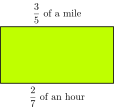 Notice that this shaded region is not one full hour or one full mile, so we don’t want to cut it into equal pieces or
into equal pieces. In fact, one mile and one hour would have to be different rectangles from each other based on this
information. Because this is the shaded region for the fraction of a mile, it represents the pieces in the
numerator of this fraction. It is also the shaded region for of an hour, so it represents the pieces in the
numerator here as well. In other words, we need to cut the rectangle according to the numerator, not the
denominator. But which fraction do we want to use? There are many ways to solve this problem, and you
may have seen others in class. For now, let’s remember that we are trying to fill up one group and we
know that this shaded region represents of one group, so let’s cut the shaded region into equal pieces
and then tack on more unshaded pieces so that we can see the pieces that make up one full group.
Notice that this shaded region is not one full hour or one full mile, so we don’t want to cut it into equal pieces or
into equal pieces. In fact, one mile and one hour would have to be different rectangles from each other based on this
information. Because this is the shaded region for the fraction of a mile, it represents the pieces in the
numerator of this fraction. It is also the shaded region for of an hour, so it represents the pieces in the
numerator here as well. In other words, we need to cut the rectangle according to the numerator, not the
denominator. But which fraction do we want to use? There are many ways to solve this problem, and you
may have seen others in class. For now, let’s remember that we are trying to fill up one group and we
know that this shaded region represents of one group, so let’s cut the shaded region into equal pieces
and then tack on more unshaded pieces so that we can see the pieces that make up one full group.
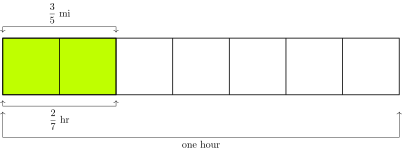
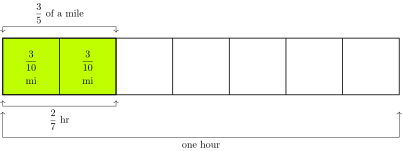 The unshaded boxes must be the same size as the other boxes in the picture because the hour was cut into equal
pieces, so they must also each be worth of a mile. Let’s add that to our picture.
The unshaded boxes must be the same size as the other boxes in the picture because the hour was cut into equal
pieces, so they must also each be worth of a mile. Let’s add that to our picture. 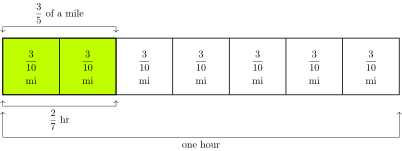 Finally, to find how many miles fill up the entire hour, we see that we have copies (or groups) with of a mile per
copy for a total of that Oliver will swim in one hour.
Finally, to find how many miles fill up the entire hour, we see that we have copies (or groups) with of a mile per
copy for a total of that Oliver will swim in one hour.
Oliver is on the swim team, and recently swam of a mile in of an hour. If Oliver kept swimming at this pace, how many miles would he swim in one hour?
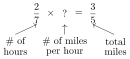
Let’s explain why this is a division story, and then solve it with a picture. First, we need to identify our groups and objects per group. The question in this story is asking how many miles Oliver will swim in one hour. This combined unit of “miles per hour” sounds a lot like “objects per group”, so let’s take one group to be one Oliver swim mile hour and one object to be one Oliver swim mile hour . Now, let’s look at the numbers in the problem. The fraction of a mile represents the number of groups objects in one group total objects . The fraction of an hour represents the number of groups objects in one group total objects . We can fit this into our definition of multiplication as follows.
It’s very important with fraction division problems to think about the number of objects in each group as the number of objects in one full group, since the total number of objects could be larger or smaller than this number. Using our meaning of division, we see that this story is a how many in each group division problem for . Let’s solve this with a picture.
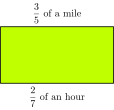
In other how many in each group pictures, we have started by drawing the total number of objects and passing them out to the groups that we have. Since we don’t have a full group in this problem, we could instead interpret this action as “filling up” our full group and counting how many objects we have in that full group. We know from the problem is that of an hour and of a mile represent the same thing, so these need to occupy the same space in our drawing.
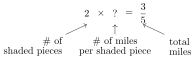
Remember the green shading is also the shading for of a mile, or it represents the pieces, each size of a mile. But the shading is pieces right now and we need to determine how much of a mile is in one of these two pieces so that we can fill up the full hour. So we are working with a total of of a mile and we want to place this equally into groups, where one group is one of the two shaded pieces. We can fit this into our definition of multiplication as follows.
This is a how many in each group division problem for , and we can simplify this to get of a mile in each piece. Let’s mark that on the picture.
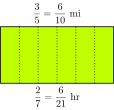
The key step in solving this problem is recognizing that the of an hour and the of a mile have to be the same physical shaded region in the picture. It was also important to recognize that we need to work with the numerators instead of with the denominators here, because we start with the shaded region instead of starting with the whole. We used the meaning of division to find that there were of a mile in each of the pieces of the hour, but there are many other ways to do this. For example, we could think about our first picture showing that of a mile is equal to of an hour and cut this picture differently. Here is the picture again.
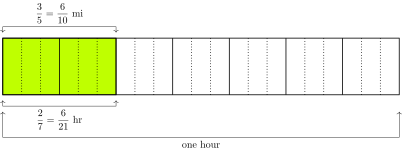
Remember that you are free to use any correct method to solve these problems; you do not need to use the method we used in the previous example!
How can you distinguish how many groups fraction division stories from how many in each group fraction division
stories?
4 Fraction division algorithms
To speed up our calculations, we would like to have an algorithm for fraction division.
Let’s see how we can solve using the fraction division algorithm. The first step is to flip over the second fraction,
which in this case is . It’s important that this is the second fraction (the divisor), not the first one, and flipping it
over means exchanging the numerator and denominator. So turns into . This is called inverting the fraction or
finding the reciprocal of the fraction. The next step is to multiply the first fraction with the inverted second
fraction. In other words, we calculate Now, we can use the fraction multiplication algorithm, which
says we multiply the numerators and multiply the denominators. We can simplify this as to get our
answer.
This algorithm is sometimes called “invert and multiply” because we invert the second fraction and then use fraction multiplication. Some teachers call this algorithm “keep-change-flip” because we keep the first fraction as it is, change the operation from division to multiplication, and flip or invert the second fraction. Why does this algorithm make sense with our meanings of multiplication, division, and fractions? Watch the next video for one explanation.
_
Remember that the video shows only one way to think about why we invert and multiply. If one of the methods from our in-class work made more sense to you, please feel free to explain it another way!
Another way to think about this algorithm involves using our connection between fractions and division. Remember that is the same as . Let’s use this fact to look at again.
If we use our connection between fractions and division on , we can see that this division problem is the same as the
fraction
This fraction is hard to understand because we don’t have a whole number in the denominator, so let’s change that. Remember that we said we can make equivalent fractions by multiplying the numerator and the denominator by the same number, or In this case, let’s use . We have Looking at the denominator we can see why we’ve done this: So our original fraction is now equal to Coming back to our relationship between fractions and division, we can replace this fraction with a division problem. Anything divided by is the same as that number (can you use the meaning of division to show this?) so putting it together we see the following. \begin{align*} \frac{3}{5} \div \frac{2}{7} &= \frac{\frac 35}{\frac 27} \\ & = \frac{\frac{3}{5} \times \frac{7}{2}}{1} \\ &= \left ( \frac{3}{5} \times \frac{7}{2} \right ) \div 1 \\ &= \frac{3}{5} \times \frac{7}{2} \end{align*}
That’s the exact same thing we got from our invert and multiply procedure.
While this algebraic argument might feel more familiar to you than drawing pictures to explain why the fraction division algorithm makes sense, we encourage you to practice both. Children should be able to draw good pictures and notice patterns in their work well before they are ready to formalize things with the language of algebra, and the teacher being able to identify rules like “invert and multiply” in kids’ pictures can be very powerful for their learning.
2026-06-06 21:54:21