1 Activities for this section:
2 Divisibility tests
Another common technique in mathematics that is connected to the idea of factors and multiples is that of divisibility tests. A divisibility test is a criteria we can use to tell whether one number is divisible by another. Let’s start with an example that you are likely already familiar with.
First, we need to remember that “divisible” means that we take the integer and compute . If we get a remainder of zero, then is divisible by . If the remainder is not zero, then is not divisible by . Using the division theorem, we should be able to find some quotient so that which reduces to Here we see our connection to the idea of factors, since according to our definition of factors if and satisfy the equation above then is a factor of . So, if ends in a zero, then how do we know that is a factor of ?
The answer lies in our bundling system. If the last digit of is a zero, this means that if we draw a picture of using bundled objects or base ten blocks, we would have no individual objects. Let’s use the example of to illustrate, but you should try to think about this argument more generally. So, if we represent with base ten blocks, we will draw superbundles and bundles. Let’s draw this.

According to our definition of multiplication, if for some quotient , we want to find equal groups and then will tell us how many objects are in each group. In our picture, we could use one group as one row. Let’s shade in one group in the image below.
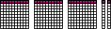
Each of these groups has blocks in it, so the total blocks can be written as If we had a different number of superbundles and bundles, we could still separate them into equal rows. Even if we had megabundles or larger place values, everything could be broken down into bundles with no blocks left over, and so we could use the rows as groups and make equal groups out of these blocks. In other words, if has a zero in the ones place, it must be divisible by .
In our previous example, we saw our first example of a divisibility test: and integer is divisible by if it has a zero in the ones place. We understand why this test makes sense from the explanation, but we use divisibility tests when we want to know quickly whether a number is divisible by another number. This is like our algorithms for the operations: we get the answer quickly but most of the time we trade speed for understanding. Remember that there are times for both!
Let’s take a look at the divisibility test for and explain why it is true.
Again, if we are given an integer and we want to know whether this number is divisible by , we can rephrase this question to ask whether is a factor of . In other words, can we find some quotient so that (Of course, we could use as either the number of groups or the number of objects per group; we are going to use it as the number of groups in this example.)
Let’s work with the example of , but as usual we would like you to try to continue thinking generally so that our reasoning applies to any number and not just this specific example. Let’s start by drawing the quantity using base ten blocks. We’ll need to draw superbundles, bundles, and individual blocks.

Now we would like to know whether or not we can make groups of blocks with no blocks left over. We will start with the bundles since every superbundle, megabundle, and so on is made out of bundles. Each bundle is made out of blocks, or group of blocks and block leftover. In the image below, we will shade in the blocks in each bundle and leave the leftover block unshaded. We will also draw the leftover block underneath each bundle so that we can use it later.
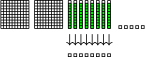
So far we have made groups of and we have blocks left over. Next let’s take a look at what’s happening with the superbundles. Each superbundle is made out of bundles, so we can repeat the process we just took with the bundles with the superbundles as well. In other words, we will start by making groups of and we will have blocks left over. Let’s shade the groups of in the columns of each superbundle.
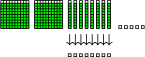
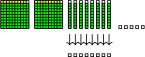
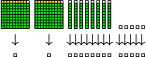
Let’s finish this one up by showing that is not a factor of . If we look at the leftover blocks, we can make more group of , but then we will have blocks left over, which is not a reminder of . Let’s circle the last group of in the picture.
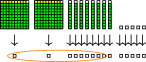
Since the sum of the digits of is , which is not divisible by , we know that is also not divisible by .
The divisibility test for is very similar to the divisibility test for , and we will explain why this makes sense using an in-class activity. Let’s write down the test here and practice using it.
The divisibility test for says that an integer is divisible by if the sum of the digits of is divisible by . Let’s apply that to . We start out by adding up the digits of this number. Is the sum of the digits divisible by ?
Now we have a quick test to determine whether or not is a factor of a number. This sort of test can be useful when we are making factor trees or trying to determine a prime factorization.
There are many other divisibility tests, and you should practice explaining why they make sense. Below you will find a list of divisibility tests that you can practice on, and there are still others out there!
- A number has as a factor if it ends in , , , , or .
- A number has as a factor if you can divide it by and get an even number quotient.
- A number has as a factor if the last two digits have as a factor.
- A number has as a factor if it ends in or .
- A number has as a factor if it’s even and the sum of the digits is a multiple of .
- A number has as a factor if the difference between twice the last digit subtracted from the remaining digits is a multiple of .
- A number has as a factor if the last digits have 8 as a factor.