You are about to erase your work on this activity. Are you sure you want to do this?
Updated Version Available
There is an updated version of this activity. If you update to the most recent version of this activity, then your current progress on this activity will be erased. Regardless, your record of completion will remain. How would you like to proceed?
It might seem a little strange to say at this point, but mathematics is a pretty natural idea for human beings. As
long as there have been people, those people have tried to look for patterns in the world around them, to measure
the world in various ways, and to keep track of things.
You might think that counting is the most basic mathematical idea, since it’s one of the first mathematical things
we learn to do as humans. But there’s an idea underlying that of counting: comparison.
Imagine for a moment that you haven’t yet learned how to count. Use a strategy other than counting to determine:
are there more stars or more circles in the image below?
More stars.More circles.Neither the stars nor the circles has more.We can’t answer this question from the
information we have.
Let’s take a moment to rearrange the shapes above in a different way, which might help us a bit.
Continue to imagine that you haven’t yet learned how to count. In the image below, are there more stars, or are
there more circles?
More stars.More circles.Neither the stars nor the circles has more.We can’t answer this question from the
information we have.
This time, could you tell just by looking at the picture which of the two shapes has more? A little organization and
a good picture can go a long way! The mathematical strategy that we’re considering here is comparison. The
picture helps us to match up the circles and the stars and see how they are related. We could have
an exact match between circles and stars, meaning we have the same number of circles as stars. We
could have some extra stars that don’t have a circle to match with after we’ve matched everything up,
meaning there are more stars than circles. Or we could have some extra circles that don’t have a star
to match with after we’ve matched everything up, meaning there are more circles than stars. Stop
here and draw a picture in your notes for each of these situations. Notice, too, that we lined up the
circles and the stars with equal spacing everywhere. This equal spacing is very important when we
look at the picture and see which line appears “longer” to see which set has more elements. Keep in
mind that it’s fairly common for children to think that a “spaced out” collection of things has more
objects than a “bunched up” collection of things. Equal spacing helps kids focus on this matching
idea.
It’s time to add some terminology to this discussion.
Here, we are talking about something mathematicians call sets. A set is a collection of objects, where the objects
are all the same. This can be a little tricky, though, because a set could have just a single object, or it could have no
objects in it at all! A set with no objects in it is called the empty set. We could also have a set that has both
apples and oranges in it, but in this case we would refer to the objects as “fruit” so that they are all the
same.
Which of the following are examples of sets?
A bunch of marbles in a bag, where the objects are the marbles.A bunch of marbles in a bag, where the object is the bag.The numbers , where the objects are the
numbers.A piece of rope, where the objects are scissors.A box of markers, where the objects are
the markers.All the fruit in a bag which has both apples and oranges in it, where the objects are
apples.
Now, when we were matching up our stars and circles above, we were really starting with two sets. One set is the
collection of stars, and the other set is the collection of circles. When we match in this specific way, we make a
one-to-one correspondence.
A one-to-one correspondence is a matching between two sets and where every object in set has exactly one
match in set , and every object in set has exactly one match in set .
In our example above with the stars and circles, do we have a one-to-one correspondence between the set of stars
and the set of circles?
YesNo
Look back at our definition of one-to-one correspondence: a matching between two sets and where every object in
set has exactly one match in set , and every object in set has exactly one match in set . We let set be the set of
stars and set be the set of circles. Then, we match the stars and circles in a one-to-one fashion: one circle
matches with one star and vice versa. We can do this until we run out of circles. All the circles have been
matched with one and only one star. But now there are some stars left over that aren’t matched with any
circle. So the condition that every star is matched with exactly one circle doesn’t hold in this case.
Our picture shows the matching used dashed lines, making it easier to see that not everything has exactly one
match. That means that these two sets do not have a one-to-one correspondence.
Let’s finish up with two more examples.
Syahida is helping her art teacher prepare for a drawing contest. The teacher has asked Syahida to
place one pencil on each desk in the art room. In this case, we do have an example of a one-to-one
correspondence between pencils and desks. Let’s explain how we know. First, we draw a picture to represent
this situation, where we use our circles to represent the pencils and our stars to represent the desks.
Remember our definition of one-to-one correspondence: a matching between two sets and where every object in set
has exactly one match in set , and every object in set has exactly one match in set . Now, let’s explain how this
definition applies to this particular situation. Let’s let set be the pencils (circles) and set be the pencilsdesksSyahidathe art teacher (stars). Every pencil is matched to exactly one desk, and every desk is matched to exactly onetwo pencil. There are no pencils left over, and we didn’t run out of pencils early. Similarly, there are no extra desks
without a pencil, and no desk has two pencils on it. Nothing left out, nothing left over. Our picture shows this
situation by showing the circles exactly matched to the stars, one circle matching with one star, and we drew the
dashed lines to show this matching. In this example, we do have a one-to-one correspondence between these two
sets.
Marisol’s baby brother got into her box of markers and took all of the caps off of them! Explain how
Marisol can use the idea of one-to-one correspondence to figure out if any of the marker caps have been
lost.
We know that a one-to-one correspondence means matching every object of one set (the markers)
to every object in the other set (the caps). So, Marisol can start putting the caps on the markers.
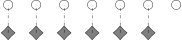
Here’s an example drawing of her work, where the diamonds represent the markers and the circles
represent the caps. Notice that in the picture we have shown one circle that is not matched to any square.
Marisol notices that she doesdoes not have a one-to-one correspondence, because (in this example) there is an extra capmarker which doesn’t have a capmarker which matches to it. In other words, every object in the set of caps is not matched with exactly one object in the
set of markers. So, even though we don’t have a one-to-one correspondence in this example, the idea of
one-to-one correspondence helped Marisol to realize that in fact she is missing one of her markers!
Notice that when Marisol puts the caps on the markers, she does not have to pay attention to whether or not the
colors match. The question is asking whether or not any caps have been lost, not whether the caps match the
markers.