You are about to erase your work on this activity. Are you sure you want to do this?
Updated Version Available
There is an updated version of this activity. If you update to the most recent version of this activity, then your current progress on this activity will be erased. Regardless, your record of completion will remain. How would you like to proceed?
The main point that we would like for you to see in this section is that the meaning of addition and the meaning of
subtraction fit with any kinds of numbers we would like to add or subtract, not just whole numbers. We don’t need
to change the way we think about these operations just because the kind of numbers we are working with change.
We think this is an advantage, meaning that as the difficulty of problems we consider goes up, we don’t need to
rethink the meaning of the operation.
Gino is baking some brownies. Starting with an empty bowl, he places of a cup of water and of a
cup of oil into the bowl. How much liquid (how many cups of water and oil together) are now in the
bowl?
Let’s draw a picture to solve this problem, and use our picture to think about what operation we could use to solve
this problem.
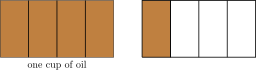
First, we’ll use the meaning of fractions to draw a picture of of a cup of water. In this case our whole is 34waterone cup of liquid. The whole is cut into equal pieces, because the denominator tells us how many equal pieces to cut our whole
into, and then we want to shade of those pieces, because the numerator tells us how many pieces to
shade.
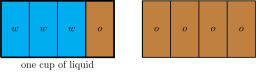
Next, we want to represent cups of oil. This is one full cup of oil and of a second cup. In this case our whole is 4waterone cup of wateroilone cup of liquid, and this whole will be cut into equal pieces. We need to shade one full cup, and then piece out of the second
cup.
Now, Gino takes all of the shaded pieces and puts them together in a bowl. We want to combine these pieces
together, and that means we are going to use the operation additionsubtractionsomething
else because the definition of addition is to combine things together. In this case, since the story problem mentions the
water first, we will write the amount of water before the amount of oil in our expression. So the total amount of
liquid in the bowl is \[ \answer [given]{\frac{3}{4}} + \answer [given]{\frac{5}{4}} \textrm{ cups of liquid. } \]
We could stop here, because this expression is the total amount of liquid in the bowl. However, most of the
time we want to simplify this expression, or in other words find the total as a single number. So let’s
continue working with our picture by putting together all of the shaded pieces that we had. Notice that
each cup of liquid is cut into the same number of pieces so that all the pieces are the same size. We’ll
mark the water ones with a small and the oil ones with a small to make them easier to see in the
picture.
In order to see how much liquid this is, we need to think about what size each of these pieces are. Each of the
original fractions had a denominator of , so both the cup of water and the cup of oil were cut into equal pieces. This
means that each of the pieces in our picture is of a cup of liquid.
There are a total of shaded pieces in the picture when we consider the water and oil together, and our whole cup of
liquid is cut into equal pieces, so we could write our answer as \[ \frac{\answer [given]{8}}{\answer [given]{4}} \textrm{ cups of liquid, } \] or if we simplify this fraction we can see that it’s the
same as cups of liquid in total.
We hope that felt similar to the problems we solved in the previous section, but there are two big ideas to watch out
for when we work with fraction problems. The first is that we need to be particularly careful with how we ask the
question when we are working with fractions. Let’s consider a series of questions all referring to Gino and these
brownies.
Gino is baking some brownies. Starting with an empty bowl, he places of a cup of water and of a cup of oil into
the bowl. How much water is in the bowl?
of a cup of a cup cupsSome other numberWe cannot answer the question from this information.
Gino is baking some brownies. Starting with an empty bowl, he places of a cup of water and of a cup of oil into
the bowl. How full is the bowl?
of a cup of a cup cupsSome other numberWe cannot answer the question from this information.
Gino is baking some brownies. Starting with an empty bowl, he places of a cup of water and of a cup of oil into
the bowl. How much more oil is in the bowl than water?
of a cup of a cup cupsSome other numberWe cannot answer the question from this information.
Yikes. Even with the same setup, how we ask the question makes a big difference in what we get for our answer –
and there are some questions we can ask that we can’t answer without more information! When we add
and subtract fractions, it’s important for each of the fractions to have the same whole, and for the
question to also be asking for the same whole. That might seem a little surprising since we just worked
with a problem where we added water and oil, but notice that each of the water and the oil can be
considered liquid. So, we added of a cup of liquid to cup of liquid, and the answer was also in cups of
liquid.
If we asked something like “how full is the bowl?”, we are taking of a cup of liquid and putting it together with of
a cup of liquid, but asking for our answer in terms of a different whole, the bowl. Addition or subtraction can’t
answer this question because the wholes aren’t the same.
The question “how much more oil is in the bowl than water?” is a comparison question, and so it’s not asking us to
add . We could solve this problem, but our picture and our actions would both be different from Gino’s original
problem. Pay close attention to the wording any time you are writing or considering a word problem, and try to
anticipate things that might be confusing. This takes practice!
The second idea to keep in mind when we are working with fractions is that if we would like to simplify a number
like , it’s much easier to tell what fraction we are working with if all of our pieces are the same size and out of the
same whole.
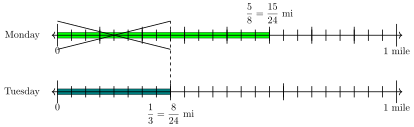
Shonda ran of a mile on Monday, but only ran of a mile on Tuesday. How much farther did Shonda run on
Monday than on Tuesday?
We want to see how we could write the answer to this question as a subtraction expression, and then simplify our
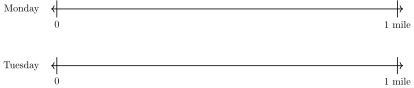
answer into a single fraction. We’ll use a number line to represent our fractions this time. First, let’s draw our whole,
which in this problem is 83one miledistance. We’ll draw two different number lines, one on top of the other, so that we can compare Monday’s distance and
Tuesday’s distance.
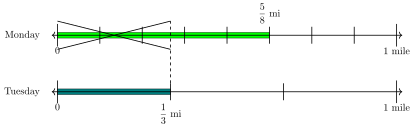
Because Shonda ran of a mile on Monday, the denominator tells us that we need to cut the mile on Monday’s
line into equal pieces, and the numerator tells us that we need to shade of them. Because Shonda
ran of a mile on Tuesday, the denominator tells us that we need to cut the mile on Tuesday’s line
into equal pieces, and the numerator tells us that we need to shade of them. Let’s do that on our
picture.
We want to find out how much farther Shonda ran on Monday, so we want to take away Tuesday’s distance from
Monday’s distance. In a sense, we want to line up the end of Tuesday with the Monday line, and then cross off
Tuesday’s distance. Let’s show that in our picture.
This picture shows us taking away of a mile from of a mile, so the operation we are using here is additionsubtractionsomething else. As an expression, we could write our answer as \[ \answer [given]{\frac{5}{8}} - \answer [given]{\frac{1}{3}}. \]
We would also like to be able to simplify this answer, but right now that’s difficult because we don’t know exactly
where the of a mile crosses Monday’s number line. Because our pieces are not all the same size, let’s cut all of these
pieces some more. If we cut Monday’s eight equal pieces into equal pieces each, and if we cut Tuesday’s equal
pieces into equal pieces each, we will have the one mile made out of equal pieces of both Monday’s number line and
Tuesday’s number line. In other words, we are making equivalent fractions whose denominators are . Let’s go ahead
and do that in our picture.
Now we can see that the mile mark is at the th mark after zero, so it is equivalent to of a mile. We can also see
that is at the th mark after zero, so it is equivalent to of a mile. And now that both lines are marked in units of of
a mile, we can take away the copies of of a mile from the copies of of a mile to see that we have
copies of of a mile left. Using our meaning of fractions, we see that the answer to this problem is
\[ \frac{\answer [given]{7}}{24} \textrm{ of a mile.} \]
You might remember that we have a rule for adding and subtracting fractions which says that we first make a
common denominator and then add or subtract just the numerators. For instance, if we want to add \[ \frac{5}{6} + \frac{4}{9}, \] first we would
exchange these fractions for ones with a common denominator. Frequently, we multiply the denominators together
to get a common denominator, but any common denominator will do. In this case we’ll use the denominator of ,
which will keep our numbers a little bit smaller. So, we exchange these fractions for equivalent ones which
have denominator . \[ \frac{15}{18} + \frac{8}{18} \] Notice that this step is the same thing we did in the previous example when we
made all of the pieces of our mile the same size. Once the pieces are the same size and from the same
whole, it’s easy to combine the pieces or take away pieces and know how many pieces you have in
total. In other words, now that we have a common denominator, we only need to add the numerators. \begin{align*} \frac{5}{6} + \frac{4}{9} &= \frac{15}{18} + \frac{8}{18} \\ &= \frac{15+8}{18} \\ &= \frac{23}{18} \end{align*}
We hope that you see how this algorithm for adding and subtracting fractions makes sense with both our meaning of
addition and subtraction as well as our meaning of fractions. Children reason about fraction addition and
subtraction using pictures well before they learn the short cut algorithm. Reasoning using the meaning of operations
is much more powerful than simply memorizing rules.
Notice also that some students say things like “in order to subtract fractions, we have to make a common
denominator”. This is a little bit misleading. In our example about Shonda’s running, we subtracted the fractions
once we took away of a mile and got . We didn’t need to go any farther, because this expression is the answer to the
problem. The reason we made common denominators is that we wanted to simplify that answer into something
that’s easier for us to work with. And for simplifying the answer, we definitely needed equally-sized pieces, or
common denominators.
To wrap up our thinking about addition and fractions, let’s return to something we said about mixed numbers. We
said that a mixed number like could also be written as . Notice how this makes sense with our meaning of addition.
The number is the total amount that we get from combining together whole units and of another unit. And
that’s the same thing that we mean when we write next to each other. In other words, we can think
about using a picture like we did for addition. We will draw two wholes and of another whole, and
then use arrows to show the result after combining all of that together. The result is of the same
whole.
Adding and subtracting decimal numbers
You might also remember an algorithm for adding and subtracting decimal numbers; we’ll tackle that in
the next section when we tackle the addition and subtraction algorithms for whole numbers. Instead,
let’s take a look at how we could solve a decimal subtraction problem using a picture with base ten
blocks.
Raina knows that she needs to make liters of lemonade for a school fundraiser. If liters of lemonade need to be
sugar free, how much regular (non-sugar free) lemonade does Raina need to make?
Let’s see how Raina’s lemonade problem can be solved with a subtraction expression, and then let’s simplify the
answer into a single number.
First, the operation of subtraction means that we need to combinetake awayignore some things in our story problem. In this case, Raina starts with the full amount of lemonade, which is liters. Since
we know how much lemonade needs to be sugar free, we can take that amount away from the total to find the
amount of lemonade that is not sugar free. In other words, we are using subtraction to solve this problem because
we are taking away one amount from another amount and counting what remains. The amount we
start with is the liters, and the amount we take away is the liters, so our subtraction expression is
\[ \answer [given]{5.3} - \answer [given]{2.84}. \]
Now, we’d like to simplify this answer into a single number. We will start by drawing the liters using base
ten blocks. Since we know that one of our numbers in this problem has a value in the hundredths
place, we will make the value of the smallest block equal to , meaning that the bundle is one place to
the left or has value and the superbundle is two places to the left or has value . In other words, in
order to represent the number we will use superbundles and bundles. Let’s go ahead and draw this
amount.
Now, we want to take away liters from this amount. This means that we need to remove superbundles,
bundles, and individual blocks. Let’s start with the superbundles. We will mark them off with a red
line.
Next, we need to remove bundles from this picture, but right now we only have bundles. Let’s unbundle the last
superbundle into bundles so that we have enough bundles to do this taking away. We will put a purple
dotted box around the bundles that used to be this superbundle, just for this step so that you can see
them.
Now we can take away bundles using our big red lines again. (We removed the purple dotted box from this one,
since the bundles don’t make a superbundle anymore.)
Our last removal will be the individual blocks, but again we don’t have any individual blocks so we’ll unbundle one
of our bundles. Again we will draw the purple dotted box only for this step to show that these individuals used to be
bundled together.
We are ready to remove the individual blocks with our big red lines.
Now that we are done removing things, we find the answer by counting the remaining amount. We see that we still
have superbundles, bundles, and individual blocks, which means that the answer can also be written as . In other
words, Raina will need to make liters of regular lemonade.
Notice how just like it was necessary to have the same whole for adding and subtracting fractions, we need to draw
decimal numbers using the same value for one individual block. And pay attention to the way that pictures help
us think about the problems we are solving in different ways than we might if we were just making
calculations!
In your own words, how do we see that addition (or subtraction) is the same operation no matter what kinds of
numbers we are working with?