Activities for this section:
Partial products, Decimal multiplication
The partial products algorithm
As we discussed with addition and subtraction algorithms, there are times when we want to quickly know the answer to a multiplication problem, or times when the numbers in a multiplication expression are too large for us to reasonably draw. In these cases we want to use an algorithm for multiplication. However, remember again that algorithms help us to calculate quickly but can cost us our understanding of the meaning of multiplication. In this section we are going to connect why the standard algorithm for multiplication makes sense with our meaning of multiplication. We will start by using an algorithm called the partial products algorithm. This algorithm has more steps than the standard algorithm, but it will help us to see more clearly what is happening with the standard algorithm.
Throughout this section, we will work with the multiplication expression . Remember that according to our definition of multiplication, this expression means the total number of objects when we have equal groups, and each group contains objects. We’ll be using array models made out small squares, and so we’ll think about one object as one square in the array.
Let’s start by showing the steps for the partial products algorithm. We start by writing the two numbers we want to multiply, lining up the ones place of each number.

Next, we multiply the numbers in the ones place. This will be , and we write the answer below the line.
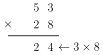
Next, we multiply the ones in by the tens in . In other words, we multiply , and write that below the under the line.
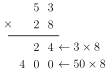
We are using an arrow to show you the calculations we made, but these are optional when you do the algorithm. You can write them to remind yourself about how you made the calculation, or you can just write the answers. We now move to the tens place in and multiply the by each of the and the from and write these below the line.
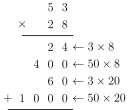
We’ve drawn a second horizontal line below the “partial products” that we have just calculated. Finally, to get the answer, we add each of these partial products and write the answer below the second line.
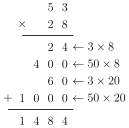
Now that we know how to use this algorithm, let’s explain why each of the steps makes sense.

Our goal is to see why adding up the separate partial products gives us the same answer as simply counting the number of squares in the array, since counting the squares in the array using the groups and objects per group is our most basic meaning of multiplication. In order to find the partial products, let’s subdivide our array into four zones: the top left will be columns with squares in each column, the bottom left will be columns with squares in each column, the top right will be columns with squares in each column, and the bottom right will be columns with squares in each column.
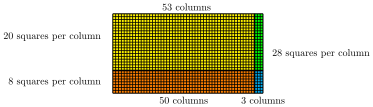
After subdividing, we have the same total number of squares that we started with, and no squares were gained or lost. So, if we combine together the amount of squares in each of the subdivisions, we will get the same total as . How can we count the number of squares in each subdivision using multiplication? Let’s stick with one group as one column, and one object as one little square.
- In the top left subdivision, we have columns with squares in each column for a total of small squares.
- In the bottom left subdivision, we have columns with squares in each column for a total of small squares.
- In the top right subdivision, we have columns with squares in each column for a total of small squares.
- In the bottom right subdivision, we have columns with squares in each column for a total of small squares.
Let’s label those totals on our diagram.
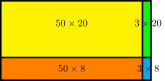
In order to count all of the squares in the diagram, we want to combine all of the subdivisions. In other words, we want to add subtract multiply something else all of the partial products together.
\[ 53 \times 28 = (50 \times 20) + (50 \times 8) + (3 \times 20) + (3 \times 8) \]
Looking back at our partial products algorithm, these are exactly the four products that we added together in order to get the total. In other words, the partial products algorithm makes sense with our meaning of multiplication.
Notice one more thing about this algorithm before we move forward: the four products that we multiplied are exactly what we would have gotten if we split apart the and the into their place value parts and used the distributive property several times.
\begin{align*} 53 \times 28 &= (50 + 3) \times (20 + 8) \\ & = (50+3) \times 20 + (50 + 3) \times 8 \\ &= 50 \times 20 + 3 \times 20 + (50+3) \times 8 \\ &= (50 \times 20) + (3 \times 20) + (50 \times 8) + (3 \times 8) \end{align*}
These calculations aren’t in the same order that we did them in the algorithm, but the commutative property says that we can add these terms in any order. However, the main idea with this calculation is that the partial products algorithm is just a fancy way to write down a version of the distributive property.
The model that we used to explain why the partial products algorithm makes sense is called an area model, which we discussed as being a version of an array model for multiplication. Fourth grade students practice using area models like these before they move on to learning the steps of the partial products algorithm. Once they have learned the algorithm, they don’t need to draw the pictures anymore, since the point of the algorithm is to calculate quickly. However, it’s good to remember what’s happening behind the scenes!
The standard multiplication algorithm
The partial products algorithm is an excellent algorithm to use because of this connection to the distributive property and the way we think about place values while we use it. However, there are many steps, and we can shorten our work if we use the standard multiplication algorithm. Let’s start by working through the algorithm on our example step-by-step. Watch the next video to be reminded of the steps in the standard algorithm.
Here is the algorithm from the video written out.
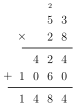
Why does this algorithm work and give us the correct answer? Let’s take a look.
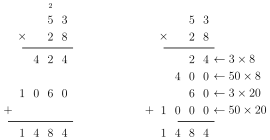
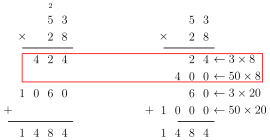
In other words, we get by adding . This is the distributive property at work again. \begin{align*} 53 \times 8 &= (50+3) \times 8 \\ & = (50 \times 8) + (3 \times 8) \end{align*}
Similarly, the second calculation in the standard algorithm, where we multiplied , is a shortcut for the third and fourth partial products in the partial products algorithm.
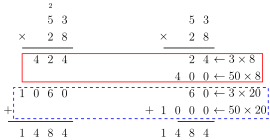
Since the algorithms are both calculating the same thing, if the partial products algorithm gives us the correct answer, the standard algorithm must as well. The standard algorithm is just a condensed version of the partial products algorithm, and the partial products algorithm is really a version of the commutative associative distributive property in disguise.
There are many other multiplication algorithms as well. If you learned a different algorithm in school, we challenge you to see if your algorithm is also just the distributive property in disguise, or if you need to justify it in a different way!
Multiplying decimal numbers
So far in this section, we have been working with whole numbers. What if we would like to multiply decimal numbers? The rule for multiplying decimal numbers is to first remove the decimal point from both numbers, keeping track of how many total places you had behind the decimal point. For instance, suppose we would like to multiply . In this case, we have three places behind the decimal point: one from and two from . Next, you multiply the two numbers with the decimal points removed, using the algorithm of your choice for whole numbers. In our example, we would get . Finally, you put the decimal point back in your number, moving the same number of places to the left as your total number of decimal places in the original numbers. In this case, our final answer would be , with the decimal point moved three places to the left.
The most common way to explain why this algorithm makes sense is to use the connection between multiplication and division, and since we haven’t talked about division yet we will save this explanation for later. Instead, let’s use our knowledge of place value to explain why this answer makes sense.

To “unbundle” this group, we need to cut each of our objects into equal pieces. We will do that in our picture with horizontal lines.
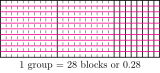
Since each of our original blocks got cut into equal pieces, the value of the smallest square in the picture is now , since the block worth was unbundled. Each horizontal cut will represent of a group. Let’s highlight of a group in our picture.
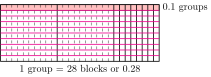
To represent of a group, we would need copies of of a group. So, we would take three copies of the highlighted strip from the previous picture.
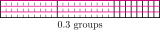
Finally, to see groups with objects in each full group, we draw full copies of and then add on this of a group that we just drew. We will stack them on top of each other in order to form an array picture for this multiplication.

We could absolutely use this array picture to calculate the answer to our original multiplication problem: how many objects total are in this picture if we consider the picture to be groups (in the array one group is one row) with objects in each group. We would find that the total value of all of the objects in the picture is , which is the exact answer we got using the algorithm above. In the picture we can see this answer because if we rearrange all of our base ten blocks and bundle them as necessary, we would have superbundle, bundles, individual blocks, and mini blocks.
In the previous example, we used base ten blocks to calculate the answer. Another strategy we could use is to reason about the size of the numbers. If we change the value of the objects in our picture and instead consider the value of the smallest block in the upper right hand corner to be , then this picture would show us groups with objects in each group. To see this more clearly, we would cut not only the group at the top, but all of the other groups as well, and see the same array we considered earlier, but with all of the blocks cut to the same size.
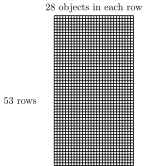
Now, we can change the value of one block to be any place value we like, and we can group or ungroup the rows in sections of to change the place value of the number of groups. In other words, when we multiply or or or any other combination of these digits, we get the same digits in our answer, just in a different place value depending on the value of the blocks and the value of the rows, because we count all the same blocks in the picture. The place value of the answer depends on the value of the individual block and the place value of the rows. So, if we want to know the answer to , we can instead multiply , and then think about how big the answer should actually be. Since is less than 6, and is less than , our answer should be less than . Also is greater than and is greater than or , so should be greater than . So if we look at the digits that we get from multiplying , the only place to put the decimal point that gives us an answer of a reasonable size is between the and the , giving .