I have 5 trout, 5 carp, and 5 tuna. How many total fish do I have? I wrote 125 letters and put 5
letters in each envelope. How many envelopes did I use? I have 5 crates. Each crate contains 5 boxes
of markers, and each box contains 5 markers. How many total markers do I have? None of these.
Activity for this section:
Properties of Powers, Integer Powers
Exponents
Recall that multiplication can be used to simplify addition. For example, if we have 3 groups with 5 objects in each group, when we have “5 objects” 3 times or


We can do a similar technique to simplify multiplication. First, consider the expression

Which of the following questions could be answered by calculating ?
You may remember that a shorter way of writing is by writing read as “5 to the power of 3” or “five to the third”.
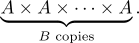
Evaluate .
Rewrite as a product.
Adding powers
Sometimes, we see addition inside a power. For example, we might see . Where does this come from? Let’s explore!
Let’s understand the meaning of . Well, is equal to and is equal to . This means that represents the total number
of objects in groups with objects in each group.

This
last product is equal to
. We ended up with 5 “4”s on the right hand side because we put together 2 “4”s and 3 “4”s. That is, we added subtracted multiplied divided
2 and 3 to find the total number of “4”s we have. In the end, we see that

As we saw above, is also equal to , and is equal to . Using the associative commutative distributive property of multiplication, we see that
Rewrite as a product.
Rewrite as a single base to one power. (Do not include “” in your answer!)
Multiplying Powers
We’ve discussed addition inside a power. What about multiplication? Why might we end up with ? Where does this come from? Let’s explore!
Let’s understand the meaning of . Again, is equal to .
Raising to the power of 3 means multiplying together copies of . That is, is equal to

According to the grouping pictured here, we have
groups with
“4”s in each group. In other words, we have
total “4”s multiplied together!
Which of the following is equal to ?
Rewrite using a single power. (Do not include “” in your answer!)
Power of 0
What if the number in the exponent is 0? For example, what is the meaning of the expression ? We’d like the “multiplication to addition” property of exponents (like the one in Definition 9) to always be true. If that’s true, then let’s explore the meaning behind .
If the “multiplication to addition” property of exponents is true, what should be equal to?
In other words, when we multiply a number by , we should just just end up with the number we started with. What special number can we multiply a starting number by so that it doesn’t change?

Integer powers
We’ve explored addition and multiplication within an exponent. What about subtraction? In particular, let’s give meaning to an expression like “”. Again, we’d like the “multiplication to addition” property of exponents (like the one in Definition 9) to always be true.
If the “multiplication to addition” property of exponents is true, what should be equal to?
And what single number is this expression equal to?
In other words, when we multiply by , we should end up with 1. Note that . Combining these two facts, how should we define ?

Rewrite as a fraction without exponents.
Rewrite as a fraction without exponents.
Rewrite using a negative exponent.
2025-08-08 20:56:33