You are about to erase your work on this activity. Are you sure you want to do this?
Updated Version Available
There is an updated version of this activity. If you update to the most recent version of this activity, then your current progress on this activity will be erased. Regardless, your record of completion will remain. How would you like to proceed?
Now that we have represented decimal numbers using bundling, paper strips, and number lines, we will use each of
these representations to decide which decimal number is larger. Throughout this section, pay attention to the ways
that each representation shows the structure of the base-ten system, and write notes on how you would connect each
representation back to the basic ideas of bundling.
2 Comparing with bundling
Let’s jump right in to see how bundling can help us determine which of two decimal numbers is larger.
Which is larger, or ?
Start by noticing that while you probably already know the answer to this question, it can be tricky for kids.
Visually looks longer because it has more digits. Does that mean it’s the larger number? Drawing pictures of
bundled objects will help us out here.
First, when we were comparing fractions, we made a big deal about how we couldn’t compare fractions until our
wholes were the same. When we compare decimals, the idea of the wholes being the same is identical to needing the
value of one stick to be the same in each picture that we draw. We can’t compare these numbers if we choose the
value of one stick to be in the first number and in the second number. Let’s choose to let the value of one stick be
in this picture, because then we can represent both numbers without having to cut our sticks into ministicks.
(There’s absolutely nothing wrong with going the other direction. Maybe you can try out that version in your
notes!)
Since we are taking one stick to be , we know that one bundle has to have the value . This is because when we
bundle our sticks, we always write the number of bundles exactly one place to the left of the number of sticks. So, to
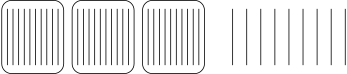
represent , we will need individual sticks and bundles.
Drawing could be a bit more confusing. But notice that we don’t have anything in the place, so we can also write
this number as . Notice that the is still in the tenths place, and the zero in the hundredths place means we
have no objects in that place, so we didn’t change the value of this number at all. When we write the
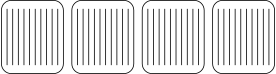
number as , we can see that in order to represent this number, we will need individual sticks and
bundles.
Now, which number is larger? Since we used the same value for the sticks in both pictures, the larger number will be
the one with more total sticks in it. One strategy we could use is to count the sticks. We see that
to represent we used sticks, and to represent we used sticks. Since , we see that is larger than
.
Alternatively, we could use the idea of one-to-one correspondence to decide which number is larger. We can line up
our two pictures by place value. The first three bundles match exactly in both pictures. But then in the picture of
we have another bundle while in the picture of we have loose sticks. We can unbundle the th bundle in and then
match up the sticks. After we match sticks in each picture, we are out of sticks in , while we still have a stick left
over in . This means that is the larger number.
In the previous example, we wrote as and claimed we didn’t change anything. Why does this make sense, but it
does not make sense to say that and are the same?
Write your thoughts here. If you aren’t sure, this is a great
question for office hours!
Perhaps you remember a rule for comparing decimal numbers that goes something like this. Start by lining up the
decimal points. Then move from left to right, comparing the digits as you go. The first number that has a larger
digit is the bigger number. For example, if we compare to we would line up the numbers like this. \begin{align*} 4292.&4873\\ 4285.&99485 \end{align*}
We start on the left side. Both numbers have a in the thousands place, so we move to the hundreds place. Then,
both numbers have a , so we move to the tens place. The top number has a where the bottom number has an , so
the bottom number is the smaller one, or . We hope that you can now see why this rule makes sense in terms
of bundled objects. When we line up the decimal points, that’s the same as drawing our picture of
bundled sticks so that the value of the stick is the same for both numbers. When we start comparing the
numbers from the left, we are using the idea of one-to-one correspondence to say whether or not we have
the same number of sticks in each place. When we reach a place where we don’t have a one-to-one
correspondence we can stop because of the structure of the bundling system. No matter what comes
after the unequal place value, those sticks and bundles will not be enough to make up a full extra
bundle. So the number with a higher value in that place is the larger number, because it will have more
total sticks. For instance, in our example, we had a in the tens place of the larger number, but only
an in the tens place of the smaller number. Even though the smaller number has more digits after
the tens place, the represented in sticks was not enough to complete the th bundle in the tens place.
So has to have more total sticks. Whenever you are working with someone who is confused about
the rules for comparing decimals, it’s always a great idea to come back to bundling and draw some
pictures.
Which number is larger: or ? Draw a picture in your notes to solve this problem.
The two numbers are equalWe cannot tell from this information
3 Comparing decimals using paper strips
Let’s see how to use paper strips to compare two decimal numbers. If you’ve forgotten how to represent decimals
using paper strips, don’t hesitate to head back to the Decimals section.
Use paper strips to show which of and is the larger decimal.
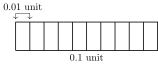
We first need to draw both of these numbers using our paper strips. In this case, let’s choose the value of our unit to
be one in the tenths place since we don’t need any place values to the left of that one. In other words, one full strip
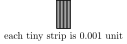
will equal . When we unbundle that strip, we’ll move one place to the right so each smaller strip will equal and then
when we unbundle that smaller strip we’ll move one place to the right again so each tiny strip will equal . Let’s draw
each of those pieces.
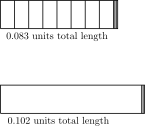
Now, we assemble our pieces to draw the strips. For , we need the following.
of the strips (because there’s a zero in the tenths place)
of the strips (because there’s an in the hundredths place)
of the strips (because there’s a in the thousandths place)
For , we need the following.
of the strips (because there’s a one in the tenths place)
of the strips (because there’s a zero in the hundredths place)
of the strips (because there’s a in the thousandths place)
Now let’s draw these two strips, lining them up on their left-hand sides.
Which number is larger? Since we used the same unit length to build each number, the longer strip is the larger
number. In this case, the strip for is longer, and so we see that
Remember that when we are comparing numbers, we have to start with the same whole. For paper strips, this
means using the same unit size for each of the strips. It’s also worthwhile to compare how we can tell which number
is larger with bundling and with the paper strips. For bundling, we were looking for the number that had more
sticks overall. We could almost think of the paper strips as lining up the sticks in a long horizontal line, and then as
long as the sticks are all the same size, the longer strip would also be the one with more sticks. So these ideas make
sense together.
Which number is larger, or ? Use paper strips to decide.
The two numbers are equalWe cannot tell from this information
4 Comparing decimals with number lines
It’s time for one last example: comparing decimals using a number line.
Use a number line to decide which of and is the larger number.
Remember that our goal is first to estimate the numbers so that we can draw them on a number line. Since we are
going to compare these numbers and want to use the same whole, we want to draw them on the same
number line. In other words, we need an estimate that works for both numbers. There are many options,
and it’s very natural to start with the whole number parts. Let’s begin there, marking the left end of
our number line as and the right end . We’ll also start with our line unbundled into tenths in the
picture.
Notice that we didn’t draw zero and one on this number line, but we can still imagine them way off to the left in
this picture because we have a specific location and the length of one unit. We could use the length of this unit to
back up units along the line, and then we would hit zero. The arrows on the end of the line remind us that the line
goes on forever in both directions.
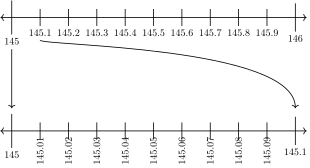
Now, we need to plot our numbers. Both of them are actually between and because both numbers have a zero in
the tenths place. So we could actually start our number line with and on either end. Let’s draw a picture to show
that we have zoomed in on that spot.
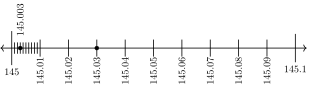
One of our numbers is already on the line, since is the same as : we don’t have to add any thousandths to this
number in order to plot it. But our other number, , needs three thousandths added on from . Notice this number has
no tenths and no hundredths. So we need to add more tick marks between and by unbundling this part of the
number line.
Each tick mark between and is one thousandth, so the first tick would be marked , then , and so on. Now, we
locate both of our numbers on the line with a dot and label them.
Which number is larger? When we draw our number lines in this way, numbers farther to the right of zero
are larger, because the position of a number on the line is its length from zero. (Notice that we are
just talking about positive numbers for now, but you can think about how you might describe what
happens with negative numbers. We’ll postpone that for a bit.) A longer distance from zero is a bigger
number. Think again about paper strips, and the fact that we said that a longer strip meant a bigger
number, and we connected this back to sticks and bundling as well. Each time we move to the right one
tick mark on the number line, that’s like adding another stick or another bundle or another object of
some kind. Using this thinking, we can see that The number is farther to the right on the number
line.
As with representing decimals, when you explain how to compare decimal numbers you should first explain how the
representation works and why it makes sense. Then, you should explain why your comparison makes sense using
these representations. We aren’t looking for you to only state the rules!
Which number is larger, or ? Use a number line to decide.
The two numbers are equalWe cannot tell from this information