You are about to erase your work on this activity. Are you sure you want to do this?
Updated Version Available
There is an updated version of this activity. If you update to the most recent version of this activity, then your current progress on this activity will be erased. Regardless, your record of completion will remain. How would you like to proceed?
Educational researchers tell us that knowing mathematics for yourself is different from knowing mathematics for
teaching. We hope this idea makes sense to you if you think back over your own experiences as a
learner and as a teacher, even if you’ve never formally taught before. When you use mathematics for
yourself, you care about finding a way to solve the problem. When you are trying to teach someone else,
it takes additional ways of understanding the mathematics. For example, knowing multiple ways of
explaining, pictures and examples that are helpful for learning, more than one way to solve the problem,
and what good thinking led to an incorrect conclusion are key aspects for teaching mathematics. We
hope you’ll explore these ideas more deeply when you take a course more focused on math teaching
methods.
Since our course is designed for people who intend to be teachers, we also aim for this deeper knowledge of
mathematics that will aid you as you help children in the future. To that end, we will not only ask you to solve
math problems, but to explain your solutions. There are many types of explanations, and many ways to write
explanations, but in this course we will ask for explanations that could help young children or other people who
have not yet learned the topic in question.
This type of explanation takes practice! In fact, previous students of our course sometimes report
that learning to write explanations is the most challenging part of the course. Know that your whole
instructional team is here to support you as you learn how to write explanations, and we want to see you
succeed!
Our goal
The purpose of this section is to give you some foundation for writing your explanations that you can return to as
many times as you need to throughout the course. You may want to bookmark this page and return to it often. We
also encourage you to take notes and refer back to them. There’s more information on this page than most people
will really grasp in one read-through!
Getting started
Before you start writing your explanation, it’s good to do some brainstorming or other work on scratch paper. Most
explanations need refinement and revision from their first draft. If you’re struggling to organize your early work,
please have a conversation with your instructor. We are here to help!
One important aspect to consider when beginning your explanations is your audience. We mentioned it
above, but for our course we would like your audience to be your own future students. This means
we don’t want your audience to be your instructor (who probably already knows how to solve the
problem) or even your classmates (who have a lot of other knowledge about mathematics). Try to use the
most basic way to describe your ideas that you can imagine so that a child could understand your
thinking.
Ideas to keep in mind
We expect you to develop your own style of explanations through the course. We aren’t looking for any magic words
or particular ways of explaining, but we do need you to explain completely. Remember that your goal for any
explanation is to demonstrate full understanding of the problem and topic at hand. However, there are some
general principles that can help. Here are four ideas to keep in mind when writing an explanation.
As often as you can, draw a picture. For most problems in this course, drawing a picture should be
our natural starting point. In your future classroom, you will sometimes use blocks or other physical
objects instead of drawing these pictures, so we would like you to think about how to represent these
physical movements when you draw pictures.
State any relevant definitions. Keep track of definitions as we go through the course, and use them as
often as you can!
Explain how the definition applies to the particular problem you are solving. Help the reader to see why
this definition is going to help us solve the problem at hand. Just stating the definition isn’t enough!
Explain what you want the reader to see in your picture. In person, a teacher might point at various
parts of the picture as part of their explanation. In your writing, look for ways that you can point to
specific aspects of your picture.
These four ideas should appear in almost all of your explanations, and you want to aim to give lots of details for
each. Remember, you are writing for someone who doesn’t yet understand, and so any detail that you think will
clarify your argument should be included!
Finishing up
Once you are finished with your explanation, re-read it yourself. We actually encourage you to read
your explanations out loud. You can often catch things that you would have missed if reading silently.
We also encourage you to get feedback from your peers and to visit office hours to talk about your
explanations. Getting another perspective on your explanation is a great way to find places where it can be
strengthened.
Let’s practice writing an explanation using a problem from the previous section.
Marisol’s baby brother got into her box of markers and took all of the caps off of them! How can
Marisol use the idea of one-to-one correspondence to figure out if any of the markers or caps have been
lost?
Use the four items above to write your own explanation for this problem. We will give you one here, but give this
your best effort before continuing. So please, pause, grab something to write on if you don’t have something handy,
and come back when you’re ready.
I’m ready!
Here is the explanation from the previous section.
The definition of a one-to-one correspondence is when we match every object of one set (in this case the markers) to
every object in another set (in this case the caps) where no objects are left out or left over. So, Marisol can make
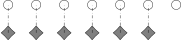
this kind of matching by putting the caps on the markers. Here’s an example drawing of her work, where the
diamonds represent the markers and the circles represent the caps. Notice that in the picture we have shown one
circle that is not matched to any square.
In our picture, the dashed lines show us the matching of one object to one object. We can see one marker (or one
diamond) connected by a dashed line to one cap (or one circle). When Marisol is finished with this matching, which
uses the idea of one-to-one correspondence according to our definition, she will know whether everything is matched
or not. In the example above, we would say that Marisol does not have a one-to-one correspondence, because
(in this example) there is an extra cap which doesn’t have a marker which matches to it. In other
words, every object in the set of caps is not matched with exactly one object in the set of markers.
So, the idea of one-to-one correspondence helped Marisol to realize that in fact she is missing one of
her markers! There are two other cases that could also be true: there could be markers with no cap,
where our drawing would show more diamonds than circles, or there could be the same number of
markers and caps, where each marker would be matched with a cap, and there would be no leftovers at
all.
Did your explanation match up with the one we gave?
Yes!No, but I’m thinking about the differences.
Take a moment to reflect on the explanation you wrote versus the one we just gave. What similarities did
you notice? What differences? What aspects of this explanation were present in your explanation?
What aspects were absent? How did your level of detail compare to the example’s level of detail? In
what ways might a child have misunderstood your explanation due to lack of detail? How did each
of the four points we mentioned above appear in the example explanation?
Enter your reflection
here!
We would like you to practice your explanations as you read as often as you can. Any time you see this box labeled
“Explanation”
Example explanations will be in boxes like this one!
it’s good to pause and write your own explanation, and then compare yours with the example as we’ve done here.
It’s also good to make notes about your explanations, or explanations you read. What details helped you to
understand the solution? What details do you think the writer could add to help make things clear? How could the
explanation be improved?
2025-08-22 01:26:42