You are about to erase your work on this activity. Are you sure you want to do this?
Updated Version Available
There is an updated version of this activity. If you update to the most recent version of this activity, then your current progress on this activity will be erased. Regardless, your record of completion will remain. How would you like to proceed?
When children start making lists of factors, they can begin to notice things. Let’s make a few lists of factors and
make observations about what we see.
Write down all the factors of .
Remember that if is a factor of , we need to find some other number so that , and then both and are factors of .
So, we’ll write these factors down in pairs that multiply to .
We got a total of factors of .
How do we know that we wrote down all of the factors of ? We did this in a systematic way by checking whether
, , , and so on were factors of , and we continued until we had checked every number. We can see
that is not a factor of , and then when we check we find that it’s already on our list of factors. We
could check that is not a factor of , but we actually don’t need to do the division if we notice that
the numbers in the left column in our example are all smaller than the numbers in the right column.
When we multiply and get , one of the numbers will be smaller than the other. Since is larger than ,
and is the smallest number in the right hand column, if it was a factor of it would already have
appeared paired with a smaller number from the left hand column. Another way to see this is to divide. \[ 24 \div 7 \approx 3.43 \]
Since the quotient is not a whole number, we know that can’t be a factor of . Since is between and ,
we also know that if was a factor, we would have already written it down between and . We can
use the same reasoning for numbers higher than , so we are confident that this is the entire list of
factors.
Let’s do another example.
Write down all the factors of .
Remember that if is a factor of , we need to find some other number so that , and then both and are factors of .
Let’s make our chart again in a systematic fashion.
We got a total of factors of .
Notice that in this example, we wrote the factor but we didn’t write anything across from it. The reason for this is
that and we only want to write the factor once in our list. While had an even number of factors (every factor had
a pair), has an odd number of factors. The difference is that with , we don’t have any whole number so that
multiplied by itself gives . But we do have such a number for . A number where we can find some whole number so
that multiplied by itself is equal to is called a square number. So, we have said that is a square
number and is not. We’ve also noticed, as children do when they are playing with factors, that square
numbers have an odd number of factors while non-square numbers (like ) have an even number of
factors.
We could still find a number so that multiplied by itself is equal to , but this number would not be a
whole number. In fact, we use special notation for this called the square root of , written . As an
example, we have \[ \sqrt{25} = 5 \] because \[ 5 \times 5 = 25. \] We could also write \[ \sqrt{24} = 4.89897\dots \] because if we took the infinitely long decimal above and
multiplied it by itself, we would get exactly . \[ 4.89897\dots \times 4.89897\dots = 24 \] There is one more thing to notice, here: the square root
gives us the “turning point” in the table where we switch from the left-hand side of the table to the
right-hand side. Notice that in our table for , the last row was and since . We know that \[ 24 \div 4 = 6. \] In this division
expression is the quotient and is the divisor, and so we can notice that the quotient is larger than the
divisor. Following our pattern, we increase the divisor by and divide again, and we get \[ 24 \div 5 = 4.8. \] Now that
the divisor is , the quotient is and we see that the quotient is smaller than the divisor. When we
divide by whole numbers starting with and increasing by each time, the square root is the place
where the quotient switches to be smaller than the divisor and we know that we are done making our
chart.
Let’s look at one more example that will bring us to the main idea of this section.
Write down all the factors of .
Remember that if is a factor of , we need to find some other number so that , and then both and are factors of .
Let’s make our chart once more in our systematic fashion. Remember that we only need to check whole numbers up
to before we know we have found them all.
In this case, we found exactly two factors: and . Numbers that have exactly two factors are special enough that we
will talk about them for the rest of this section.
A positive whole number is prime if it has exactly two factors, and itself. A number which is not prime is called
composite.
Children begin learning about prime numbers in fourth grade alongside their work on factors and multiples. Let’s
check out an application of our definition.
Using our definition, is a prime number?
Yes.No.
To be a prime number, we need to have exactly two factors. But the number only has a single factor.
So this does not fit our definition.
The number is a strange case, but our definition makes things clear. You might have seen the definition of prime
numbers before as numbers which can only be divided by and themselves. This “dividing” definition
can be confusing for number of reasons, including that it is ambiguous whether or not should be
considered prime. This is why we chose our definition using factors: we can clearly see that is not
prime.
Which of the following numbers are prime? Select all that apply.
Above, when we wrote all of the factors of , you probably divided by , , , , and and then stopped because larger
divisors would be greater than the square root. This strategy is called trial division, because we tried to divide by
all the numbers we know. This strategy is great when we are in the mindset of making a list of all of the factors of a
number, because if the number is not prime we want to make sure that we write down all of the factors. However, if
we are just trying to see whether or not a number is prime, we can take a short cut that depends on the
relationships between factors. Let’s investigate this relationship with an example and then apply it to our
example.
Suppose is a factor of a number . Is also a factor of that number?
In this question, we are not looking for all of the factors of , but instead looking at a relationship between its factors.
We know one of the factors of a number (in this case ) and we want to investigate whether another number (in this
case ) is also a factor of the same .Using our definition of factors, if is a factor of a number , we know that we can
find another number so that \[ 4 \times B = N. \] Our goal is to transform the so that we can rewrite this equation as \[ 2 \times C = N \] where we
understand how to calculate using .
To make this more concrete, let’s use . In this case, \[ 4 \times \answer [given]{20} = 80 \] and so is a factor of . To find out whether or not is a factor of ,
we need to find some number so that and we want to use the fact that is a factor of to find this . In the language
we used above, we are transforming our into this new . Remember that and let’s rewrite that in our equation. \begin{align*} 4 \times 20 &= 80 \quad \textrm{ or in general } \quad 4 \times B = N\\ (2 \times 2) \times 20 &= 80 \quad \textrm{ or in general } \quad (2 \times 2) \times B = N\\ \end{align*}
To find the from the , we can use the associative property to rearrange the parenthesis. \begin{align*} (2 \times 2) \times 20 &= 80 \quad \textrm{ or in general } \quad (2 \times 2) \times B = N\\ 2 \times (2 \times 20) &= 80 \quad \textrm{ or in general } \quad 2 \times (2 \times B) = N\\ \end{align*}
Now we can set or and see that in fact is a factor of .
We just showed that if is a factor of , then must also be a factor of . This works because is a factor of . We can use
similar equations to show if is a factor of and is a factor of , then must also be a factor of . In this example, we
showed that since is a factor of , and is a factor of , then is also a factor of . Try the next question to see another
example.
If is a factor of a number , is also a factor of ?
YesNo
Write some equations like the ones in the previous
problem to justify your work.
If we apply this idea to our example of finding whether or not is prime, remember that we divided by , , , , and in
order to determine that is prime. But we could have skipped dividing by since we already know that is not a
factor of . Based on what we just learned, if is a factor of , then would also have to be a factor of , which we
know isn’t true. Reversing this, we know that since isn’t a factor of , we cannot have as a factor of .
We can now reduce the number of calculations we need in order to determine whether a number is
prime.
The idea of using factors that we have already tested to determine whether a number is prime is also the main idea
in one of the oldest algorithms for finding prime numbers, called the Sieve of Eratosthenes. Let’s use the sieve in the
next example to find all of the prime numbers less than .
Use the Sieve of Eratosthenes to find all of the prime numbers less than .
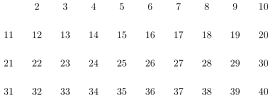
The first step is to list out all of the numbers, beginning with and ending with .
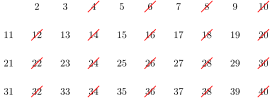
Next, we cross off all of the multiples of other than itself. These multiples of will have as a factor, and hence the
ones that are larger than are not prime.
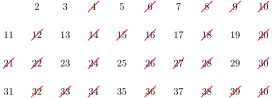
We now cross off all of the multiples of other than itself. Again, these multiples of which are larger than are not
prime.
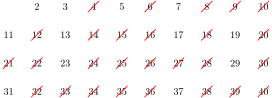
We keep repeating this process with the next uncrossed number until we have no more multiples to cross off. So, we
cross off the multiples of , then , and so forth. In the resulting chart, the numbers that are not crossed off must be
the prime numbers.
A sieve is like a filter, and so you can think about this process as filtering out the multiples and keeping only the
prime numbers.
Our examples in this section have been focused on finding all of the factors of a given number. Since factors are
related to one another (if is a factor of and is a factor of then is also a factor of as we discussed above), the most
important factors of a number are the prime factors. When we find the prime factors that multiply together to make
a given number, we call this process find a prime factorization for the number. Let’s work through such an
example.
Find the prime factorization of .
We need to find the factors of . Many people draw what is called a factor tree to help them keep track of the
factors they are finding. A factor tree starts with the number we are factoring at the top, and then branches out into
the factors below. We know that is an even number, and this means that must be a factor of this number. When
we divide we get so we record this in our factor tree by drawing two branches below , one for and the other for .
Now is a prime number, so we don’t need to factor it any more and its branch will end there. But can be factored
as , so we draw these two branches below the .
We have that is prime, so we only need to factor , which we know is . We record these numbers on branches below
the .
Now that all of the branches end in prime numbers, we know that the original number is the product of all of these
prime numbers. In other words, \[ 132 = 2 \times \answer [given]{2} \times 3 \times \answer [given]{11}. \] This is the prime factorization of .
Unique factorization
Now that we have practiced finding a prime factorization, does it matter how we begin the process of
factoring?
Let’s find another factor tree for .
This time, let’s start by factoring as . We will then need to factor both and , and we see that \[ 6 = \answer [given]{2} \times 3 \] and \[ 22 = 2 \times \answer [given]{11}. \] These are now
all prime numbers, so let’s write them on the branches in our factor tree starting with at the top.
Looking at the prime numbers at the ends of the branches, we see that \[ 132 = 2 \times 3 \times 2 \times \answer [given]{11} \] which can be rearranged using the
commutative property to be \[ 132 = 2 \times 2 \times 3 \times 11. \]
We have now factored in two different ways and we got the same prime factorization in each case.
This is an example of the Fundamental Theorem of Arithmetic.
The Fundamental Theorem of
Arithmetic Say that we have a positive integer which is greater than and the prime factorization of . Any
prime factorization of must use the same primes as any other prime factorization of , so that the
only difference between two prime factorizations of is the order in which we multiply the numbers.
This theorem is also called the Unique Factorization Theorem because it is telling us that prime factorizations
are unique. If we write the prime factorization of and then rearrange the prime factors so that they
are in order from smallest to largest, we are always going to get \[ 132 = 2 \times 2 \times 3 \times 11. \] This is the only way to factor into
primes.
The Fundamental Theorem of Arithmetic is important because it allows us to think about prime numbers as the
instructions or building blocks for any whole number. Because prime factorizations are unique, we have a specific
recipe for building each number, and we can use this recipe to answer questions about the number. It’s a common
technique for mathematicians who are asking questions about numbers to rephrase their questions in terms of prime
numbers. Let’s see an example.
Is a factor of ?
We have already seen that the prime factorization of is \[ \answer [given]{2} \times 2 \times 3 \times 11. \] We can also find the prime factorization of and write it in
order from the smallest prime to the largest. \[ 14 = \answer [given]{2} \times \answer [given]{7} \] Now, if is a factor of , then by our definition of a factor we have to be
able to find some integer so that . Remember that is also made of prime numbers, so that when we write it in
the equation below we would like to be thinking of it as a collection of primes. We need to find so
that \[ 2 \times 7 \times B = 2 \times 2 \times 3 \times 11. \] But now we see a problem. On the left hand side of this equation we have a prime factor of ,
but on the right hand side of the equation we do not. No matter what prime factors make up the
number , we will have as a prime factor of the number on the left. However, we do not have as a prime
factor of the number on the right. Since prime factorizations are unique, this means that the number
on the left must be different from the number on the right. All together, this tells us that isis
not a factor of because it’s impossible for us to choose a value of that will make our equation a true
statement.
As we work through more problems about factors and multiples, watch out for instances where making a prime
factorization will help you answer questions about numbers.
Exponents
We will wrap up this section with some notation that is very important for middle grades students to understand:
exponents. You might have already noticed some places in this section where using exponents would have shortened
our expressions, and you should feel free to use exponents in your work if you feel comfortable with them. If
you don’t feel comfortable with using them, we encourage you to practice and ask any questions you
have.
The notation means we have copies of the number multiplied together. In this expression, the number is called
the base and the number is called the exponent.
How would we write the following exponential expressions as whole numbers?
In other words, exponential notation helps us to write expressions involving repeated factors in a shorter
way. For example, we have been writing \[ 132 = 2 \times 2 \times 3 \times 11 \] but using the notation of exponents we could instead write
\[ 132 = 2^2 \times 3 \times 11. \]
There are several rules for working with exponents that are consequences of the definition.
These rules for exponents follow from our definitions, and they also can help us make sense of what we might mean
when we write zero as an exponent, a negative exponent, or a fractional exponent. Let’s explain why one of these
rules makes sense.
Let’s explain why using the example . Notice that in order to use this rule of exponents we have to have the same
base for each of the factors, and in our example the base is throughout.
We know that means that we take copies of the number and multiply them together. \[ 5^3 =5 \times 5 \times 5 \] Similarly, means that we
take copies of the number and multiply them together. \[ 5^6 =5 \times 5 \times 5 \times 5 \times 5 \times 5 \] Now, if we multiply and , we have the following. \begin{align*} 5^3 \times 5^6 &= \left ( 5 \times 5 \times 5 \right ) \times \left (5 \times 5 \times 5 \times 5 \times 5 \times 5 \right ) \\ &= 5 \times 5 \times 5 \times 5 \times 5 \times 5 \times 5 \times 5 \times 5 \end{align*}
We can find the total number of fives being multiplied together in this product by combining the fives
from the first number with the fives from the second number. In other words, the total number of
fives we have in this product is given by . We would get the same result if we used a different base
and different exponents and . Once we use our definition to write down the appropriate number of
copies of the base, we will end up combining the copies with the copies for a total of copies of the
base.
If you are up for a challenge, we encourage you to think about some of the following questions. We are happy to talk
about their answers in office hours!