- If one stick is worth , the picture would represent .
- If one stick is worth , the picture would represent .
- If one stick is worth , the picture would represent .
1 Activities for this section:
2 Decimal numbers
Remember again that we started this course with whole numbers and counting, and then talked about fractions because it’s convenient for us to be able to represent partial quantities of things by splitting up wholes into any number of parts. We can also represent partial quantities of things with decimal numbers. The underlying idea will be the same: we want to break a whole into equal pieces. Instead of cutting into any number of pieces, we will cut in ways that correspond with our bundling system.
3 Decimals and bundling
When we used the idea of bundling in order to write numbers larger than without coming up with new symbols, we also used a place value to record the number of bundles. We put the bundles place just to the left of the individuals place. When we ran out of symbols to write numbers using only sticks and bundles, we made a bundle of bundles to make a superbundle, and we recorded the number of superbundles in a place just to the left of the bundles place. When we ran out of symbols to write numbers using only sticks, bundles, and superbundles, we bundled superbundles to make a megabundle, and we recorded the number of megabundles in a place just to the left of the superbundles place. We hope you can see a pattern here: any time we bundle up any kind of object (individual, bundle, etc), we move one place value to the left.
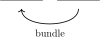
This process can go the other way as well: when we move from one place value to the next one to the right of it, we are unbundling whatever object we have. For example, if we move from the superbundles place to the bundles place, we are unbundling the superbundle in order to get bundles. If we move from the megabundles place to the superbundles place, we are unbundling the megabundles and finding superbundles inside of them.
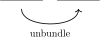
We can use this idea to write decimal numbers: if we need to write numbers that are parts of whole numbers, we’ll need to unbundle the individual sticks. In our base-ten system, we would cut it into equal pieces, which is the same as unbundling that individual stick. We could call these broken stick pieces “ministicks” (As always you can give them a name you like better. In the usual base-ten system we call them “tenths”.)
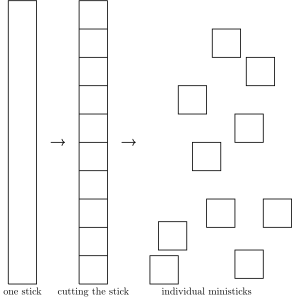
Because the individual stick was in the ones place, each ministick is one unit in the next place to the right. We use a decimal point to indicate that we have crossed from whole numbers into partial numbers, and so each ministick has a value of . Compare this to unbundling a bundle: if we start with a bundle and unbundle it into individual sticks, each stick is one unit in the place just to the right of the bundles place, which is the individuals place. So while a bundle in the tens place has a value of , unbundling it gives sticks in the ones place. We are doing the same thing, but in a different place value.
This process could continue, and we could unbundle a ministick into “microsticks”, and then unbundle the microsticks and so on. Just as we can create as many place values to the left as needed to represent our number, we can create as many place values to the right as we need.
Let’s represent the number using bundling.
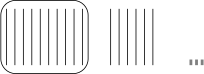
First we need to interpret the place values in the number we are given. The decimal place is always just to the right of the ones place, telling us where the ones are in our number. So, we can see that we have in the ones place and in the tens place. Next we look to the right of the decimal point and find that we have in the tenths place. Translating that into sticks and bundles, we see that we will need to draw the following.
- bundle
- individual sticks
- ministicks
Let’s do this again in a different way to give you another option for your explanations. This time, let’s let the value of one stick change to something different.
Now, we’ll represent the decimal number , but this time we will let the value of one stick be (one
tenth).
Let’s start again by using the number to tell us what kinds of objects we need to draw. Here, we’ll start with the tenths place (one to the right of the decimal point) because our individual sticks represent one tenth. We can see that we need to draw individual sticks, because that’s how many tenths we have. Then, the next place to the left must be the bundles place, so in this case we need to draw bundles for our six ones. Finally, we’ll need to draw superbundle to represent the one ten in .
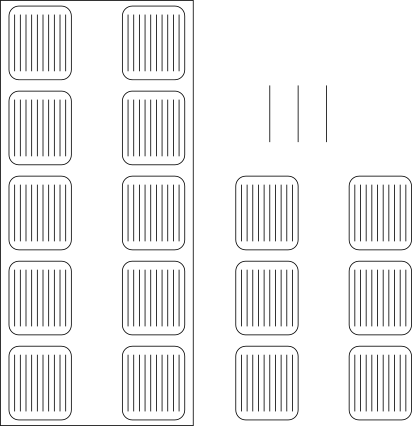
What are some other numbers that the one superbundle, six bundles, and three sticks in the picture above could
represent?
Notice that in our previous example, we said that if one stick was worth , then one bundle must be worth . This is an important point that we’d like you to include in your explanations, since it helps us to see the workings of the place value system. When we put down all of our sticks, we can start counting them like we did when the sticks were worth . When we place another stick down after the th one, we don’t have a symbol for this quantity, so we have to bundle. And when we bundle, we write the number of bundles one place to the left of our sticks. In this case, one place to the left is the ones place, so sticks together would have the value of . But you can also think about this in terms of counting up all of the values we have. If we have sticks, the value of all of them together (the value of a bundle) must be the same as what we get when we add together the values of the sticks. When we learn about multiplication, we will see that this is the same as multiplying the value of one stick by . For instance, if the value of one stick is , then the value of one bundle would be In other words, our knowledge of multiplication matches with what our ideas about bundling tell us.
We have been drawing pictures in this section using sticks, but another common representation is to use what are called base ten blocks. These are physical blocks that some teachers use to help students see the structure of the base ten system. We have found that drawing base ten blocks can sometimes help us to feel a bit less overwhelmed by the number of objects we need to draw in order to represent decimals.
In the picture below, we have drawn base ten blocks for superbundles, bundle, and individual block. If one
individual block is worth , what is the value of all of the base ten blocks in the picture? 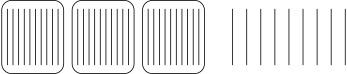
4 Decimals and paper strips
The second way we would like to represent and compare decimal numbers is by using strips of paper. While this method is different from bundling, we would like you to keep the ideas of bundling in mind, since we have used bundling to define decimal numbers.
We represent decimal numbers using paper strips by starting with drawing some unit. It’s common for this unit to be a length of one, but as with the value of one individual stick in bundling, you can choose your unit to be any size. We’ll build our numbers based on this unit.
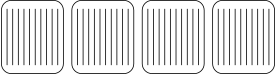
Represent the decimal number using a paper strip.


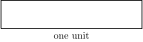

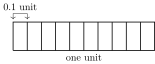

First, we’ll draw a strip which will be our unit for this problem.
Now, the whole number part of the number we are trying to represent is , which means we need two full units. We’ll draw that next.
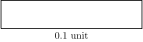
Let’s move one place value to the right. As we discussed with our pictures with sticks, that means we need to unbundle. In our base ten system, unbundling is the same thing as breaking into equal pieces, so let’s do that to our one unit.
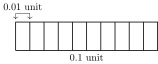
Since we unbundled our single unit, each of the new pieces is one in the place value to the right of the unit, so each of these smaller strips is of our unit. We are trying to model , so we need copies of since we have a in the tenths place. Let’s tack those on to the picture we are drawing.
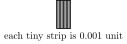
Finally, we need to move one more place to the right. We’ll take one of our strips which is units long and unbundle it into equal pieces. The picture will be harder to label since these strips are getting pretty little, but each of the tiny strips will be of our original unit since we have now unbundled the original unit twice.
Since the number we are trying to model is and it has an in the hundredths place, we need to add of these tiny strips to our picture.
Now the total length of the strip is units, because it is made up of full units, copies of unit, and copies of unit. Compare this to a bundling picture of sticks, where we might draw individual sticks, bundles of sticks, and superbundles of sticks.
If we built a strip of paper whose length was units, using a unit whose length is , what would we
draw?
- To represent the ten, we draw big unit made of ten copies of the unit.
- To represent the ones, we draw units.
- To represent the tenths, we split the unit into equal pieces and use of those strips.
- To represent the hundredths, we split the strip into equal pieces and use of these smaller strips.
Notice that while bundling and paper strips are based on many of the same ideas, we might also think of them in some ways as opposites. With bundling, we typically use the individual stick for the smallest place value that we have, and then build place values to the left by bundling. With paper strips, we typically use the unit for the largest place value that we have, and then build place values to the right by unbundling. Of course, you can certainly unbundle with sticks and make larger units with paper strips, but these are the ways we’ll most often draw and think about them together.
5 Decimals and number lines
For our third type of representation for decimal numbers, we’re going to use number lines. Be looking out for connections to both bundling and paper strips throughout this section. Remember that we draw number lines by choosing a starting point or zero and a unit length, though we don’t always have to draw either on our number line. Remember also that we use length from zero to represent numbers on the line.
We’ll plot the number on a number line.


 We “zoomed in” on just the space between and so that we could focus on the part of the number line that we
needed. If we had initially estimated that was between and , then we could have started by drawing a number line
whose ends were and instead of and . Notice that we could have written and at the ends of this number line
instead of and to add clarity, since and .
We “zoomed in” on just the space between and so that we could focus on the part of the number line that we
needed. If we had initially estimated that was between and , then we could have started by drawing a number line
whose ends were and instead of and . Notice that we could have written and at the ends of this number line
instead of and to add clarity, since and .
 Since it’s the length from zero that helps us to mark numbers on the number line, this aligns exactly with our paper
strip.
Since it’s the length from zero that helps us to mark numbers on the number line, this aligns exactly with our paper
strip.
To get started, we need to decide what kinds of marks we are going to make on our number line. One of the best ways to do this is to estimate the decimal number. In this case, we know that is between and , so let’s start by marking those two points on our number line.
We could estimate the location of on this number line, but we can also be more accurate if we “zoom in” on the number line. Essentially, we need to unbundle the space between and to help us to locate this number. Let’s do that on our number line, making equal spaces between and .
Thinking about the number , we can see that we have a in the tenths place, so if we were drawing this with a paper strip we would use copies of the strip and then add on some more smaller strips to deal with the that’s left over. This tells us that the number will be between the and the on our number line. Again, we could approximate the location of the number, or we can zoom in again on our number line to locate the number exactly. We could unbundle each of the spaces on our number line, but because we know that the number is between and , we only need to unbundle that piece of the line.
We are now ready to plot our point on the number line. Think again about our paper strip: we need to include another after the , so we need to move of these -spaces past on the number line. We’ll put a dot in the correct location.
This picture is a little bit crowded, so let’s show how we could make some more space to draw this picture.
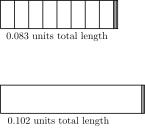
To tie everything together, let’s place a paper strip with length lined up with our number line so that the left side of the paper strip aligns with zero. To draw such a paper strip, we start with our unit of one, then cut it into tenths. We’ll need of these tenths. Then we cut one of our tenths into equal pieces to get hundredths, and we’ll need of these hundredths. We line all of these paper strips up like usual to get a total length of .
Here are two points to keep in mind when you draw your own examples. First, we drew the tick marks different sizes to help keep track of the larger and smaller place values. Please do something similar on your own lines. Second, we didn’t label every single tick mark so that our drawing isn’t too crowded. On your examples, make sure the important tick marks are labeled so we can understand how you built your drawing.
When you explain your work for any kind of decimal representation, you should be explaining how the representation works and why it makes sense. Remember that we’re working on uncovering the why behind the math, not just saying how to do it!
6 Kids learning decimals
To end our section, let’s consider why decimals can be tough for children. The first sticky point is often the names of the places. Notice that the words for the “tens” place and the “tenths” place are very similar. Teachers have to be sure to pronounce the names of the places carefully so that students can hear the difference, and children can easily be confused as to which of those places is the larger one. Furthermore, while most of the places have an “opposite”, so to speak (like “thousands” and “thousandths” or “millions” and “millionths”), there is no “oneths” place.
The second sticky point for children is often the number of rules that we ask them to memorize about working with decimal numbers. If kids don’t really understand where those rules are coming from or why they make sense, it’s easy to get very mixed up and to get the wrong answers. This is the reason we have several representations for decimal numbers, so that you can help children represent decimals in a way that makes sense to them and helps them to make sense out of the rules they might have memorized.
Finally, the role of zero in decimal numbers is complicated. Sometimes we can add zeroes without changing the number, and other times we can’t. Since kids often think about zero as meaning nothing (although a zero in a place value means we have no objects in that place), it can be tough for children to understand when it’s okay to add nothing and when it’s not actually nothing. For example, when we add a zero to the end of we get which is a different number. But adding a zero to and getting doesn’t change the value. Understanding the meanings of the places and drawing good pictures is helpful for children.
2026-07-22 02:11:32