You are about to erase your work on this activity. Are you sure you want to do this?
Updated Version Available
There is an updated version of this activity. If you update to the most recent version of this activity, then your current progress on this activity will be erased. Regardless, your record of completion will remain. How would you like to proceed?
Once we begin to find factors and multiples, there are some occasions where we would like to know whether or not
two numbers have factors in common or to find numbers that are multiples of two or more numbers. Let’s begin
with common factors.
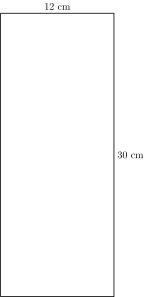
Britt is making a small house in her art class and she wants to cover the floor of the house with colorful rectangles.
If the house currently measures cm wide and cm long, what size rectangles can Britt use so that there are no partial
rectangles covering the floor?
Let’s begin by drawing the floor of the house so that we can think about how factors or multiples apply to this
situation.
Britt needs the rectangles to cover the floor exactly, using no partial rectangles. This means that we must be able to
fit a whole number of rectangles along the width and a whole number of rectangles along the length. Since we can
think of the width of each rectangle as a group of centimeters, we are looking at a multiplicationhow many
groupshow many in each group problem where we would like to have a whole number quotient with zero remainder. In other words, if we let be the
width of the small rectangle, we need to find some number of rectangles so that The width of the rectangle must be
a factormultiple of according to our definition. Similarly, the length of the rectangles must be a factormultiple of . Let’s list the factors of and of in order from smallest to largest.
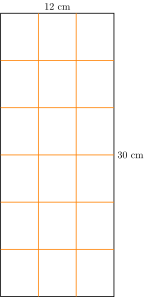
Choosing from our list of factors, we could draw a rectangle which is cm long and cm wide. Since is a factor of we
can fit rectangles along the length of the house and since is a factor of we can fit rectangles along the width of the
house. Let’s draw this on our house.
These rectangles exactly cover the floor of the house, so this is one correct answer for this question.
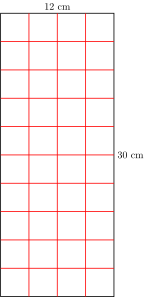
However, there are also other correct choices that we can make. We could also draw a rectangle which is cm long
and cm wide. Since is a factor of , we will be able to fit of these rectangles along the length of the house. Since is
also a factor of we can fit of these rectangles along the width of the house. Let’s draw this in our
house.
These rectangles also exactly cover the floor of the house, so this is another correct answer for this
question.
In fact, we can choose any factor of for the width of the rectangle and any factor of for the length of the rectangle
and we will be able to exactly cover the floor with these rectangles.
In the previous question, we explained that we wanted to find factors of and because the story asked for a whole
number of rectangles to fit on each side of the house. Then, we found all of the factors of both and . Remember that
prime factorization can help when you are looking for a list of all of the factors of a number! Let’s change our
question a little bit and see how our solution changes.
Britt is making a small house in her art class and she wants to cover the floor of the house with colorful squares. If
the house currently measures cm wide and cm long, what size squares can Britt use so that there are no partial
squares covering the floor?
In this problem, we are still covering the floor with shapes, but this time we are covering the floor
with squares. The big difference here is that squares have to have the same width and length while
rectangles do not. Looking back at our first explanation, we can see that we are still looking for factorsmultiples of both and , but now we need to choose the same number to be both the width and the length. As we
did in the last problem, we could choose the width and length to both be , and these squares would
cover the floor of the house exactly. However, in this example we cannot choose a width of and a
length of , because this is not a square. So, this problem has a different answer than the previous
problem.
Let’s rewrite our factors of and factors of . Since we are trying to cut out a square, we need to choose factors that
are in one or the otherbothneither lists. These are (in increasing order) In other words, Britt can make squares whose side lengths are cm, cm, cm, or
cm. Any of these squares will fit the floor exactly with no partial squares.
In the case of squares, we needed not only factors of and , but factors that they had in common. This is
because we were making squares, whose side lengths have to be the same. In some problems we will be
looking just for factors, and in other problems we will be looking for common factors. You should use
the situation of the problem to explain what you are looking for. Let’s change the problem one more
time.
Britt is making a small house in her art class and she wants to cover the floor of the house with colorful squares. If
the house currently measures cm wide and cm long, what is the largest size squares that can Britt use to cover the
floor so that there are no partial squares being used?
In this question, Britt is still looking to use squares to cover the floor, so we are looking for common factors of and ,
as we explained in the previous example. But this time, Britt is looking to use only the largest of those squares.
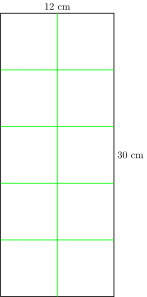
Looking back at our list of possible squares, the largest one would have side lengths which are cm. Let’s sketch that
on the floor.
In this last version of the house decorating problem, we wanted to find a single answer: the largest squares that
could be used to cover the floor. Since we wanted no partial squares, we needed factors of both and . Since we were
looking for squares and not rectangles, we needed common factors of and . And then this particular problem asked
us to find the largest such factor, so we chose the largest common factor off of our list. Choosing the
largest factor that two numbers have in common is something we do often enough that we give it a
special name.
The greatest common factor (GCF) of two whole numbers and is the largest factor
that is common to both and . We can use the notation GCF as notation for the greatest common
factor.
Let’s see how prime factorizations can help us in this situation. We can write the prime factorization of as We can
write the prime factorization of (with primes in increasing order) as What primes do these have in common? We
see that both have as a prime factor (but only one copy is common to both), and both have as a prime factor. We
get the largest possible factor of both numbers by multiplying all the primes they have in common. This
works because of the Fundamental Theorem of Arithmetic: the uniqueness of the prime factorization
means that we can build numbers from their prime factorizations, and so in order to be a common
factor of both and , the GCF can only contain prime factors common to both numbers. When we
multiply together all the primes they have in common, that’s the largest we can make a common
factor.
3 Multiples in common
Next, let’s focus on problems about multiples in common.
A music class has split into two groups to work on a rhythm. The teacher will play a steady beat on the drum. Half
of the class will clap on every fourth beat, and the other half of the class will shout on every sixth beat. Caesar
wonders: when will the clapping and shouting happen at the same time?
First, let’s take a look at the patterns. We
will use an to represent “do nothing”. On the , the teacher beats the drum but the clap does not happen.
Here is the pattern. This half of the class is clapping on every fourth beat, or we are repeating a
group of beats: , , , clap. The first clap will happen on beat , the second will happen on beat , the
third will happen on beat , and so on. This means that the claps are happening on the factorsmultiples of . The th clap will happen after groups of beats, or on beat This fits with our definition of multiples. Similarly,
the shouting half of the class will follow the following pattern. The first shout happens on beat , the second shout
on beat , the third shout on beat , and so on. In this case the shouts happen on beats which are factorsmultiples of .
Caesar is wondering about when the claps and shouts will happen at the same time. If we translate this into
the language of factors and multiples, Caesar is wondering when a beat will be one ofbothneither a multiple of (a clap) and a multiple of (a shout). Let’s take a look at the first few multiples of . Next, let’s list
the first few multiples of . Which numbers do both lists have in common? We can already see two of them: and .
We could continue this list further and observe that the next shout and clap together is beat , and after
that beat . This will continue until the teacher stops playing the drum. So we can guess that both
clapping and shouting will happen every beats. How can we use prime factorization to be sure of
this?
The prime factorization of (with primes written in increasing order) is and the prime factorization of (with primes
written in increasing order) is Remember that we are looking for a number that is a multiple of both and . Since
is a multiple of , the Fundamental Theorem of Arithmetic says it must have as a factor. Since is also a multiple of
it must have as a factor. This means that the prime factorization of has to include at least two copies of the
prime and at least one copy of the prime in order to have both and as factors. For example, we
could have or However, the smallest we could make would be Since must have as part of its prime
factorization, we see that must be a factor of , or is a multiple of . Since is then a multiple of both and
, we see that the shouting and clapping happens at the same time on beats which are multiples of
.
In this problem we were looking for multiple that both and have in common. As we did with factors, we used the
story situation to explain why we needed multiples, and then why we wanted those multiples to be common to
both and . Please make sure to do this in your own explanations! Let’s change this problem a little
bit.
A music class has split into two groups to work on a rhythm. The teacher will play a steady beat on the drum. Half
of the class will clap on every fourth beat, and the other half of the class will shout on every sixth beat. Caesar
wonders: when is the first beat on which the clapping and shouting happen at the same time?
In this case, Caesar is
still looking for common multiples of and , because he is still looking for a beat where the clap and shout both
happen. However, he has changed his question to ask when the first such beat will happen. Since we
made a list in the last problem of the beats on which the clap and shout both happen, we can use
that list to answer this question as well. We saw that the clap and shout happened on beats and the
smallest such number is . So the earliest beat on which the clap and shout will both happen is beat
.
In this last version of the music class problem, we wanted to find a single answer: the first beat on which both the
clap and shout happened. Since we wanted beats with claps and shouts, we needed multiples of both and . Since we
were looking for claps and shouts to happen at the same time, we needed common multiples of and . And then this
particular problem asked us to find the smallest such multiple, so we chose the least common multiple off of our list.
Choosing the smallest multiple that two numbers have in common is something we do often enough that we give it a
special name.
The least common multiple (LCM) of two whole numbers and is the smallest
multiple that is common to both and . We can use the notation LCM as notation for the least common
multiple.
Now that we have defined both the least common multiple and the greatest common factor of two numbers, notice
that in the problems we solved we actually explained these ideas in reverse order. First we explained why we had
factors or multiples, then we explained why the situation was asking for factors or multiples in common, and then
we discussed why the problem was asking for the least or the greatest. This is a pattern we would like you to also
follow in your own explanations!
Since least common multiples and greatest common factors are extensions of the ideas of factors and multiples,
children begin finding such values around grade six. However, we hope that you notice the way that solving these
problems builds off of kids’ prior work in multiplication and division as well as what they have learned about factors
and multiples.
If you are given two numbers and , do they have a greatest common multiple? A least common factor?
Jot down
some thoughts here, and feel free to discuss this question in office hours!