
Fraction intro, The Bake Shop, Sharing cookies, Improper fractions
The numbers we discussed in the previous section, starting with , then , and so on, are called the counting numbers, because we typically use them to count things. We will also call these numbers whole numbers, but the whole numbers also include zero. Most of the examples that you imagined in the previous section were probably about counting whole things. What if we want to take a look at parts of things instead? This is where the idea of a fraction can naturally arise.

Next, our definition says that we need to cut this rectangle into equal parts, and since we are trying to represent in this case, our is . So, let’s cut our rectangle into equal pieces.

Finally, our definition says that of this rectangle is what we get by taking one of these four equal pieces. So let’s shade one of them to really emphasize what we are looking for.

This shaded piece represents of our rectangle.
Unit fractions are not the only type of fractions we encounter, however, so we need a more general definition for fractions.

Next, we need to know what the unit fraction looks like, so we need to cut our whole into equal parts. In this case our denominator is , so we will cut our whole into equal parts.

Each of the pieces above is now of the whole rectangle. Finally, our numerator is , so our definition says that of this rectangle is what we get by taking three copies of one of these equal pieces. So let’s shade the three pieces to represent our fraction.

This shaded piece represents of our rectangle.
While we have so far looked at fractions whose numerator is smaller than the denominator, the definition of fractions works for any two numbers we can think to plug in for and . That’s part of the reason that the definition is written the way that it is, and we’ll explore this a bit more in the next section.

It’s very important to recognize the role of the whole when we are talking about fractions. Each of our definitions says that we need to begin with some whole. This whole should be a physical object, like a rectangle or a pan of brownies or all of the children in the class. Once we know what our whole is, then the denominator tells us how many equal pieces to partition our whole into. The numerator tells us how many pieces of the whole to take. In other words, there is a difference between the whole (a physical object) and the denominator (a number). When we talk about the numerator (a number), we can also use the word part to refer to the portion of the whole (a physical object) that the numerator counts. The whole and the part are physical things, while the denominator and the numerator are numbers that represent how those physical objects have been cut.
While we have discussed the numerator and the denominator separately in order to interpret a fraction, it’s very important to remember that a fraction like of some whole represents a single number, not two different numbers. This is especially important for understanding how to locate fractions on a number line. First, let’s define what we mean by a number line.

Next, let’s take a look at an example of locating a fraction on the number line.
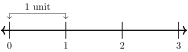
Because we are drawing of this unit, we need to cut the unit into equal pieces.
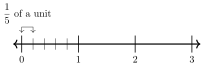
Each of these spaces represents of the unit because the unit was cut into equal pieces. Since our numerator is , we need copies of this of a unit. We could highlight pieces, but the convention on number lines is to mark our point with a dot.
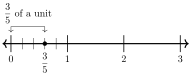
Notice that in our previous example, when we locate numbers on the line, it’s the distance from zero that tells us the number, not the number or tick marks. While we spend time drawing lots of tick marks, we are really paying attention to the spaces in between them.
Our definition of fractions is written in a way that helps us make sense of many kinds of fractions. Let’s tackle another example.
We will use a rectangle to represent one pan of brownies. When we write the whole number in front of a fraction, that whole number tells us that the part we are interested in consists of two wholes as well as a part of another whole. In other words, we will need copies of the whole in order to get started with drawing this picture.
First, we need to identify our whole, which in this case is brownie a pan of brownies 4 2 . Let’s draw three copies of our whole.

We know from the in front of our number that we need to shade full wholes, so let’s start by doing that.

We also need of another whole, so we need to take the last pan of brownies and cut it into equal pieces because our denominator is , and then we’ll need to shade of those pieces because of numerator is .

In this final picture, we’ve shaded pans of brownies.
The number in the previous example is called a mixed number.
We can also use our meaning of fractions to draw fractions whose numerator is larger than the denominator.
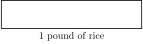
Next, our denominator tells us how many equal-sized pieces to cut our whole into. In this case, the denominator is , so let’s cut our whole in the picture into equal pieces. This means that each piece is of the whole.
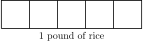
Finally, our numerator tells us how many parts to shade. In this case the numerator is , which is currently a problem since we don’t have that many pieces. However, remember that another way to write our definition is to say that the numerator tells us how many copies of one piece we need. So, in this case, we can interpret the fraction to mean that we need copies of of our whole. So, we are going to use all five of the copies we already drew, and make 3 more copies of the piece we are using. We want to shade them all.

Notice that the original five pieces making up one full pound of rice are more darkly outlined than the other pieces. That dark outline shows us that our whole didn’t change, and it is still made out of five equal pieces, even though we needed a few extra in order to make up the entire pound of rice. Since the numerator is bigger than the denominator, the part we are shading is bigger than the whole.
Some people prefer to draw the extra parts separated from the original whole so that we can see the whole a little more clearly in the picture. And some people prefer to draw more copies of the whole so that they have enough copies to shade. For instance, here is a different picture of of a pound of rice, where we have drawn two copies of our whole and then shaded of the whole.

In this second picture that it can be tempting to write that the shaded region is of the whole. However, since our whole is one pound of rice, and the one pound of rice is cut into equal pieces in the picture, we have to use as our denominator. If we changed the whole to be pounds of rice, then the denominator would be because the pounds are cut into equal pieces. What we choose and label as the whole can completely change our answer to a problem about fractions!
Fractions like are examples of improper fractions.
As a note, some textbooks don’t use this terminology and instead call them “fractions greater than one”. Please always be sure to check your future textbooks for the terminology they use!
We can also use our meaning of fractions to convert back and forth between improper fractions and mixed numbers.

In our picture, we drew 2 pounds of rice. One of them was entirely filled in, and the second one was only partially filled in. The whole number part of a mixed number indicates how many full wholes we need, so in this case the whole number part would be . The fraction part of a mixed number tells us the fraction of the last whole that we have. In this case, the second whole is shaded. Putting this together, we can see that

Write your answer as a mixed number:
Write your answer as an improper fraction: