Activities for this section:
What is a Percent, Calculations with Percents
Percent
You have probably seen percents in your every-day life. They are common when we talk about things like “there is a 50% chance of snow tomorrow” or a“33% discount”.
While each of these examples might bring different kinds of calculations to mind, in this course we want to primarily think about percents as a specific type of fraction.
So, for example, if we are talking about of the girls in the class, we also want to be thinking about of the girls in the class.
of all species of butterflies
of the cookies in a jar
Notice now that since percents are special cases of fractions, they always have some whole associated with them. Make it a habit to look for what the percent is of , even if the word “of” doesn’t occur near the fraction. Correctly interpreting and solving percent problems depends on correctly identifying the whole, just like other types of fraction problems. Also, watch out for times when the same physical object is interpreted with a different percent depending on what part of the physical object the whole is taken to be.
Second, notice that unlike the fractions we worked with in the previous section, we’re now considering fractions where the numerator isn’t necessarily a whole number. We’ll talk about decimals in the next section, so for now we will keep our numerators mostly whole numbers.
At this point, you might be asking yourself, “why do we need percents when we already have fractions?” That’s a great question, and the answer is related to comparing fractions. We spent a lot of time in that section trying to write fractions in ways where either their numerators or their denominators were the same so that we knew how to compare them. When we work with percents, the denominators are always , so if we have the same whole we know it’s being cut into the same number of equal-sized pieces and we can compare the numerators only.
Now that we understand why we might want percents, let’s turn to representing them and solving problems.

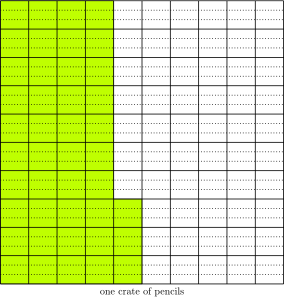
Since the denominator of our fraction tells us how many equal pieces to cut our whole into, and the denominator in this case is , we cut our whole into equal-sized pieces.

Finally, since the numerator of our fraction tells us how many equal pieces we want to shade, we shade in of the equal pieces in our whole.

Now the shaded region represents of the crate of pencils.
We don’t know how many pencils there are in this particular crate, but we can still cut the entire crate of pencils into equal pieces. However, if we had more information about this crate of pencils, we could also include that in our picture and use it to solve problems. Let’s tackle such an example.
Let’s work through one more example to see how the meaning of fractions can help us solve percent problems.

Next, we know that we need to shade of this whole, but I’d rather not cut it into equal pieces. Instead, let’s use an equivalent fraction. (Remember to think about how you could show that these fractions are equivalent with a picture!)
\[ \frac{40}{100} = \frac{\answer [given]{2}}{5} \]
In other words, if we want to shade of all the flour, we can instead shade of all the flour. So, let’s use the meaning of fractions. The denominator tells us to cut our whole into equal pieces, and the numerator tells us to shade of those pieces. Let’s go ahead and do that in our picture.

The problem tells us that Ebony’s cups of flour is the same as the of all of the flour, so that means that in this case it’s the shaded region in the picture which represents those cups. In other words, if we distribute those cups of flour equally into the two shaded pieces and count how many cups are in each piece, there will be cups of flour per piece. Let’s add that information to our picture by writing cups of flour in each box.

However, we know that each of the pieces in the picture are equal, so if each of the shaded pieces are cups, each of the non-shaded pieces must also be cups. Let’s add that information to our picture as well.

You have probably solved percent problems using other strategies. For now, we want to focus on strategies like these, where we use a picture and the meaning of both percents and fractions in order to solve problems. Later, after we talk about operations, we’ll return to percents and make sense of some other methods as well.
2025-07-29 04:42:31