- (a)
- \(\vec {v}\dotp \vec {w} <0\)
- (b)
- \(\vec {v}\dotp \vec {w} =0\)
- (c)
- \(\vec {v}\dotp \vec {w} >0\)
Working with the dot product and cross product.
Work in groups of 3–4, writing your answers on a separate sheet of paper.
Draw and label two vectors \(\vec {v}\) and \(\vec {w}\) such that
Give three explanations (one algebraic, one geometric, one using trigonometry)
why
\[ \proj _{\vec {a}}(\vec {b}) = \vec {0} \]
if \(\vec {a}\dotp \vec {b} = 0\). Give two explanations (one algebraic and one geometric) that shows that
\[ \vec {b} - \proj _{\vec {a}}(\vec {b}) \quad \text {is orthogonal to}\quad \vec {a} \]
Let \(\vec {r}\) be a random (nonzero) vector in \(\R ^2\). Compute:
\[ \proj _\vecj \left (\proj _\veci (\vec {r})\right ) \]
Explain your reasoning.
Let \(\vec {r}\) be a random (nonzero) vector in \(\R ^2\). Could there be a vector \(\vec {v}\) such that one
expects
\[ \proj _\vecj \left (\proj _{\vec {v}}\left (\proj _\veci (\vec {r})\right )\right )\ne \vec {0}? \]
Explain your reasoning. Consider three vectors in \(\R ^3\):
\[ \vec {a} = \vector {a_1,a_2,a_3}\quad \vec {b} = \vector {b_1,b_2,b_3}\quad \vec {c} = \vector {c_1,c_2,c_3} \]
We claim: \[ \det \begin{bmatrix} a_1 & a_2 & a_3\\ b_1 & b_2 & b_3\\ c_1 & c_2 & c_3 \end{bmatrix} = \vec {a}\dotp (\vec {b}\cross \vec {c}) = (\vec {a}\cross \vec {b})\dotp \vec {c} \]
Give an algebraic verification of this
claim. For your information, \((\vec {a}\cross \vec {b})\dotp \vec {c}\) is commonly called the scalar triple product.
Use the diagram
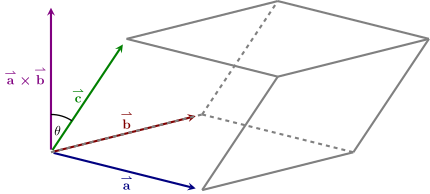
and recall that the volume of a parallelpiped is given by
\[ \text {area of the base}\times \text {height} \]
to answer the
following:
- First, explain what \(\vec {a}\dotp (\vec {b}\cross \vec {c})\) and \((\vec {a}\cross \vec {b})\dotp \vec {c}\) mean geometrically and how they must be equal. There is a basic reason regarding computing volumes at play here, so you should not appeal to Problem 6 in this part).
-
Second, explain why it then follows that
\[ \left |\det \begin{bmatrix} a_1 & a_2 & a_3\\ b_1 & b_2 & b_3\\ c_1 & c_2 & c_3 \end{bmatrix}\right | \]is the volume of the parallelepiped spanned by vectors \(\vec {a}\), \(\vec {b}\), and \(\vec {c}\). You may use Problem 6 on this part.