We investigate quadric surfaces.

Work in groups of 3–4, writing your answers on a separate sheet of paper.

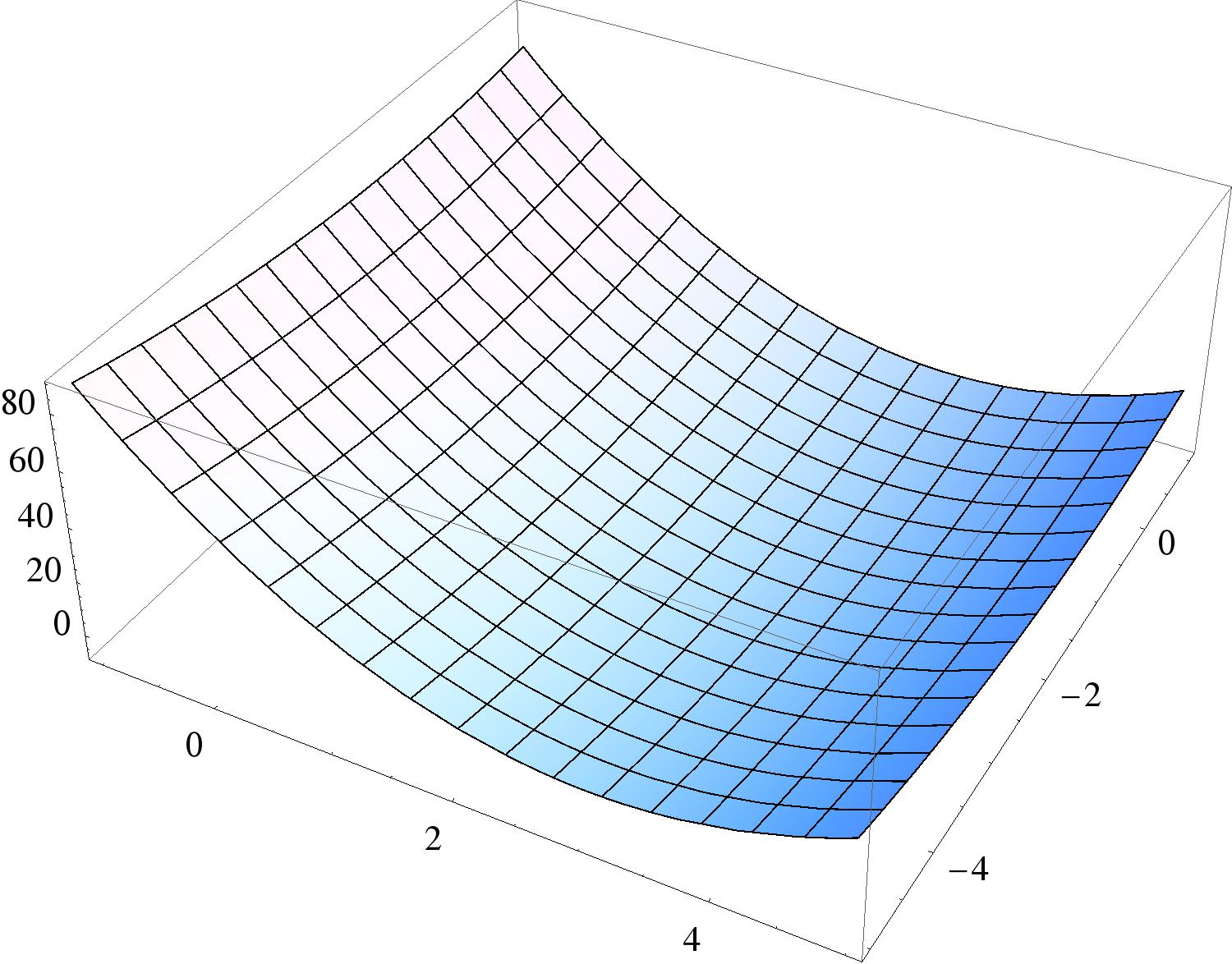
Consider \(F(x,y)= 39 - 30 x + 5 x^2 + 2 y + y^2\). Here is a plot of the quadric surface \(z=F(x,y)\):

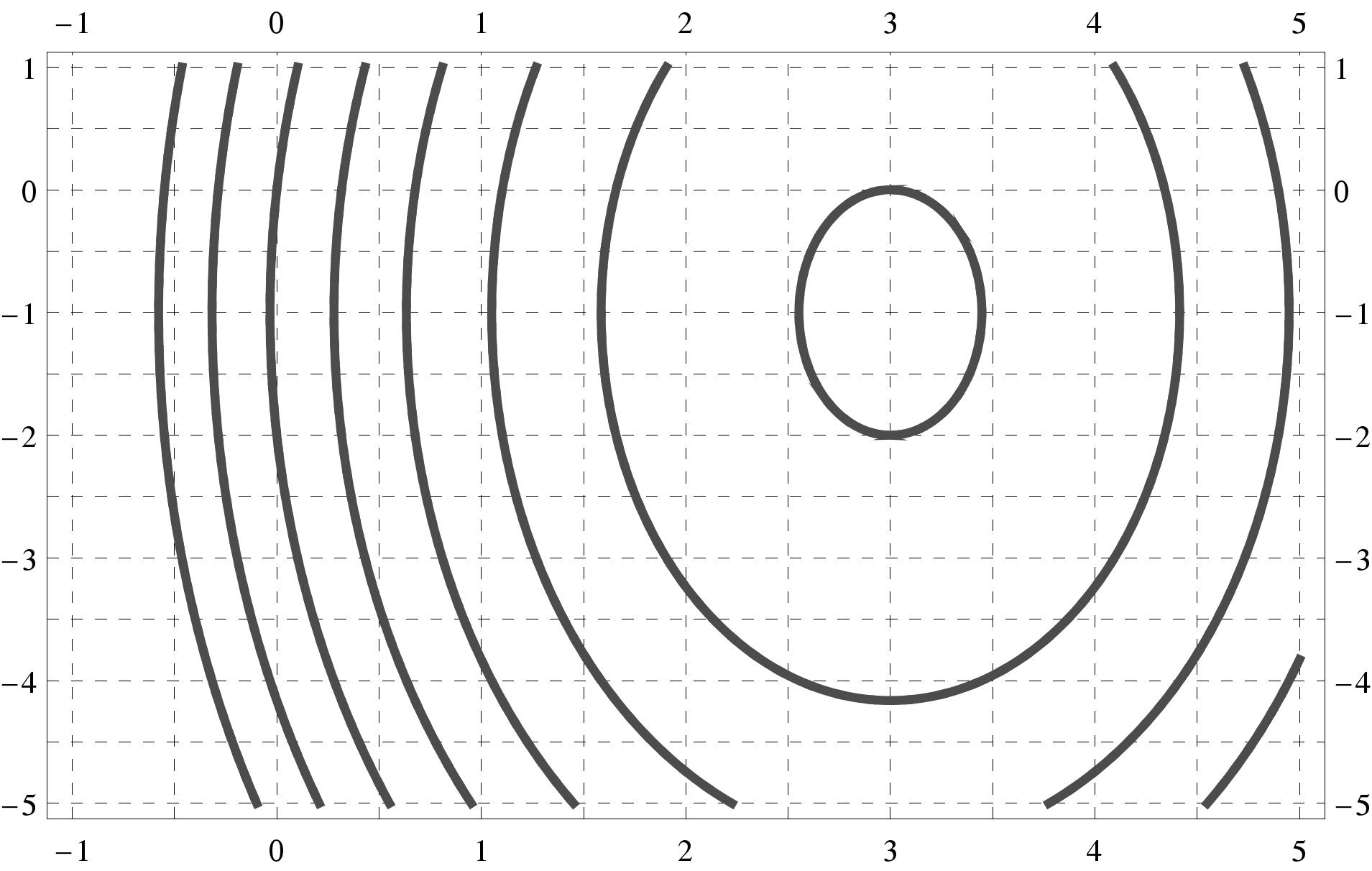
Here we see a contour plot for \(z = F(x,y)\) with the same domain:

Here we see a table of values for \(z= F(x,y)\) with the same domain:
\[ \renewcommand *{\arraystretch }{1.5} \begin{array}{c|c|c|c|c|c|c|c|}\hline \rule {.5cm}{0cm} & 77 & 42 & 17 & 2 & -3 & 2 & 17 \\ \hline & 74 & 39 & 14 & -1 & -6 & -1 & 14 \\ \hline & 73 & 38 & 13 & -2 & -7 & -2 & 13 \\ \hline & 74 & 39 & 14 & -1 & -6 & -1 & 14 \\ \hline & 77 & 42 & 17 & 2 & -3 & 2 & 17 \\ \hline & 82 & 47 & 22 & 7 & 2 & 7 & 22 \\ \hline & 89 & 54 & 29 & 14 & 9 & 14 & 29 \\ \hline & & & & & & & \end{array} \]
The \(x\)-coordinates should run along the bottom of this table and the \(y\) coordinates should run along the left-hand side. Fill them in.
Estimate the height of each of the level curves in the contour plot for \(F(x,y)\) above. Write the heights directly on the contour plot.
Pencil-in some gradient vectors on your set of level curves.
Where is the magnitude of the gradient vector large? Where is the magnitude of the gradient small?
Find \((x,y)\) such that \(\grad F(x,y) = \vec {0}\). Mark this position on the contour plot and on the table above.

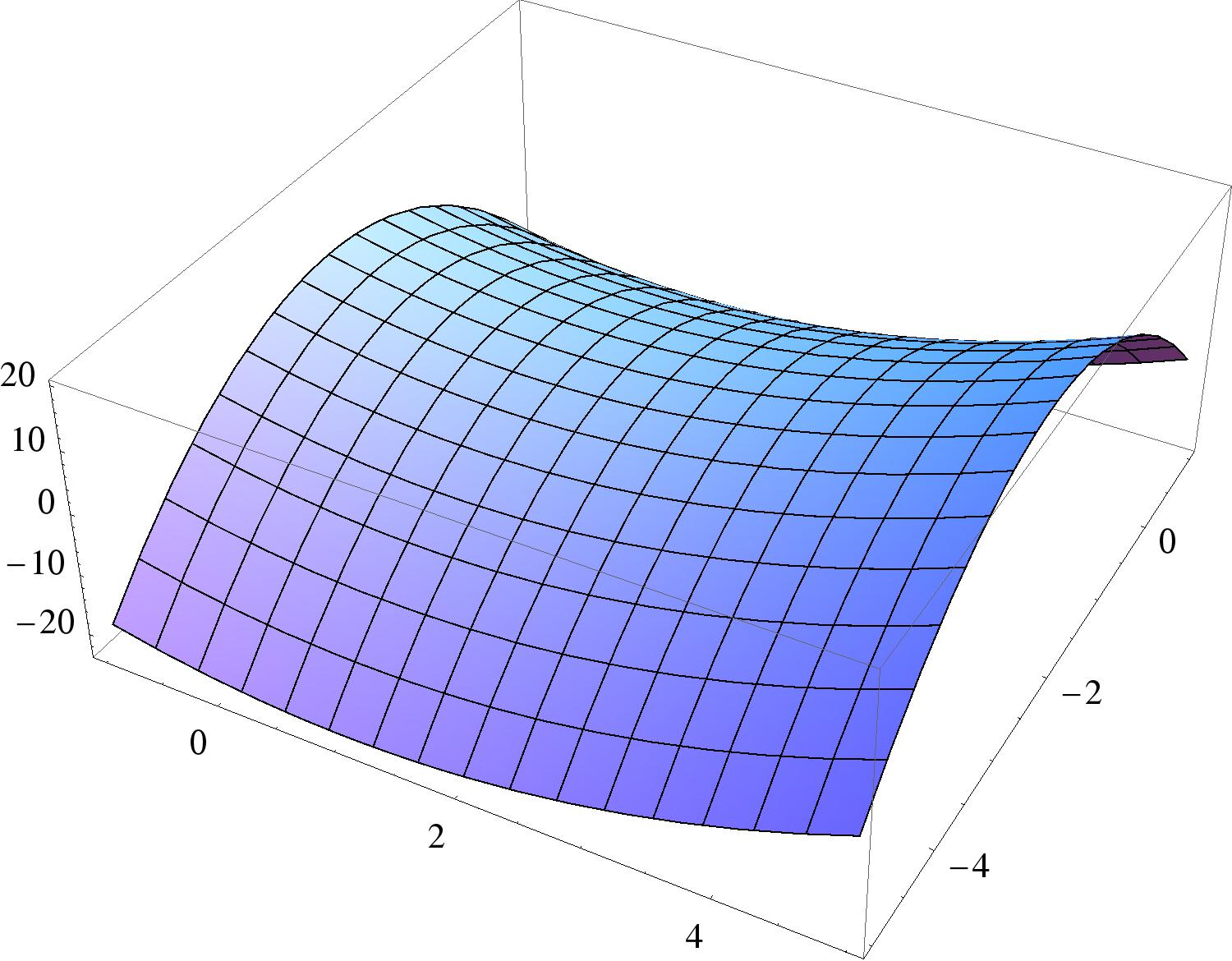
Consider \(G(x,y)= -7 - 2 x + x^2 - 12 y - 3 y^2\). Here is a plot of the quadric surface \(z=G(x,y)\):

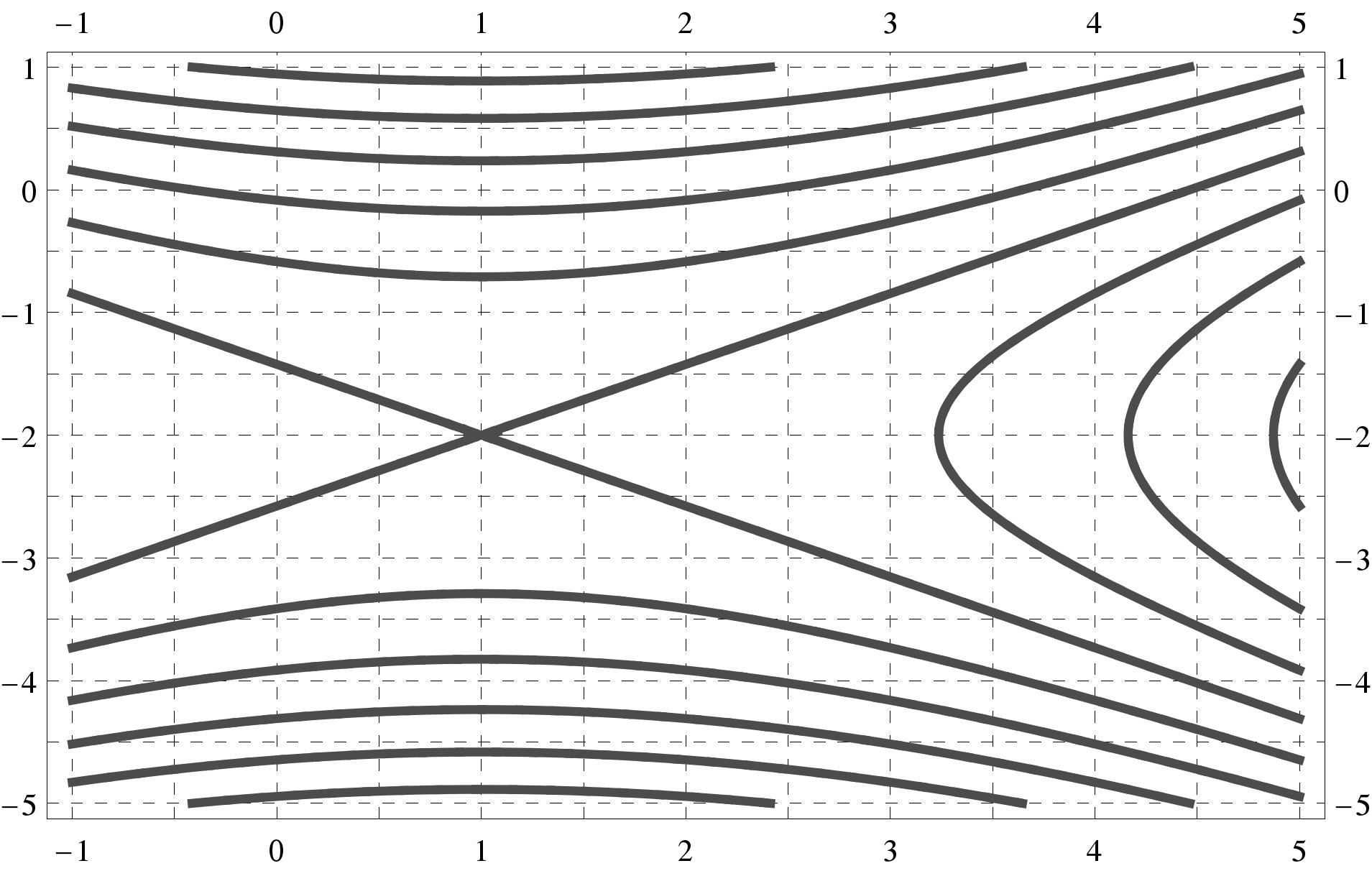
Here we see a contour plot for \(z = G(x,y)\) with the same domain:

Here we see a table of values for \(z= G(x,y)\) with the same domain:
\[ \renewcommand *{\arraystretch }{1.5} \begin{array}{c|c|c|c|c|c|c|c|}\hline \rule {.5cm}{0cm}& -19 & -22 & -23 & -22 & -19 & -14 & -7 \\\hline & -4 & -7 & -8 & -7 & -4 & 1 & 8 \\\hline & 5 & 2 & 1 & 2 & 5 & 10 & 17 \\\hline & 8 & 5 & 4 & 5 & 8 & 13 & 20 \\\hline & 5 & 2 & 1 & 2 & 5 & 10 & 17 \\\hline & -4 & -7 & -8 & -7 & -4 & 1 & 8 \\\hline & -19 & -22 & -23 & -22 & -19 & -14 & -7 \\\hline & & & & & & & \end{array} \]

The \(x\)-coordinates should run along the bottom of this table and the \(y\) coordinates should run along the left-hand side. Fill them in.

Estimate the height of each of the level curves in the contour plot for \(G(x,y)\) above. Write the heights directly on the contour plot.
Pencil-in some gradient vectors on your set of level curves.
Where is the magnitude of the gradient vector large? Where is the magnitude of the gradient small?
Find \((x,y)\) such that \(\grad G(x,y) = \vec {0}\). Mark this position on the contour plot and on the table above.