We work some examples of line integrals and vector fields.

Work in groups of 3–4, writing your answers on a separate sheet of paper.

Carefully sketch the following vector fields:
(a)
\(\vec {F}(x,y) = \vector {1,1}\)
(b)
\(\vec {G}(x,y) = \vector {x,y}\)
(c)
\(\vec {H}(x,y) = \vector {y,-x}\)
(d)
\(\vec {I}(x,y) = \vector {x,-y}\)
Let \(C\) be the circle of radius \(1\), centered at the origin, drawn once in a counterclockwise direction. Using the fields above, compute:
(a)
\(\int _C \vec {F}\dotp \d \vec {p}\)
(b)
\(\int _C \vec {G}\dotp \d \vec {p}\)
(c)
\(\int _C \vec {H}\dotp \d \vec {p}\)
(d)
\(\int _C \vec {I}\dotp \d \vec {p}\)
Let \(T\) be the triangle with vertices at \((-2,-1)\), \((2,-1)\), and \((0,2)\) drawn once in a counterclockwise direction. Using the fields above, compute:
(a)
\(\int _T \vec {F}\dotp \d \vec {p}\)
(b)
\(\int _T \vec {G}\dotp \d \vec {p}\)
(c)
\(\int _T \vec {H}\dotp \d \vec {p}\)
(d)
\(\int _T \vec {I}\dotp \d \vec {p}\)
Let \(A\) be the path connecting \((-2,-1)\) to \((2,-1)\) to \((0,2)\). Note, this is not a closed path. Using the fields above, compute:
(a)
\(\int _A \vec {F}\dotp \d \vec {p}\)
(b)
\(\int _A \vec {G}\dotp \d \vec {p}\)
(c)
\(\int _A \vec {H}\dotp \d \vec {p}\)
(d)
\(\int _A \vec {I}\dotp \d \vec {p}\)
A raindrop of mass \(0.001\unit {kg}\) slides from the top of a flat windshield to the bottom. If the windshield is \(\frac {1}{2} \unit {m}\) high and \(\frac {1}{2}\unit {m}\) deep, how much work is done by gravity? (Assume that the acceleration due to gravity is \(10 \unit {m}/\unit {s}^2\).)
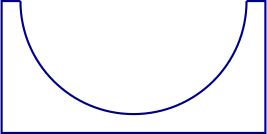
A skateboarder of mass \(70\unit {kg}\) rolls from the left side of a circular half-pipe of radius \(3\unit {m}\) to the right side. How much work is done by gravity?