We think about surfaces in different ways.
Work in groups of 3–4, writing your answers on a separate sheet of paper.
1 Considering tables
Let \(F:\R ^2\to \R \) be a differentiable function that is roughly described by the following table of values:
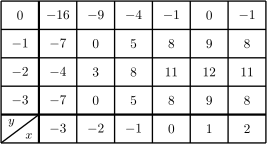
Write the value of \(F(-2,-1)\).
Estimate \(F^{(1,0)}(-2,-1)\).
Estimate \(F^{(0,1)}(-2,-1)\).
Estimate \(\grad F(-2,-1)\).
If you were to leave the point \((-2,-1)\) in the direction of the gradient, what value would
you find? Explain why this makes sense.
Use your computations above to estimate the formula for a plane tangent to \(F(x,y)\) at the
point \((-2,-1)\).
Sketch the level curve \(F(x,y) = 1\) on the table above.
2 Considering level sets
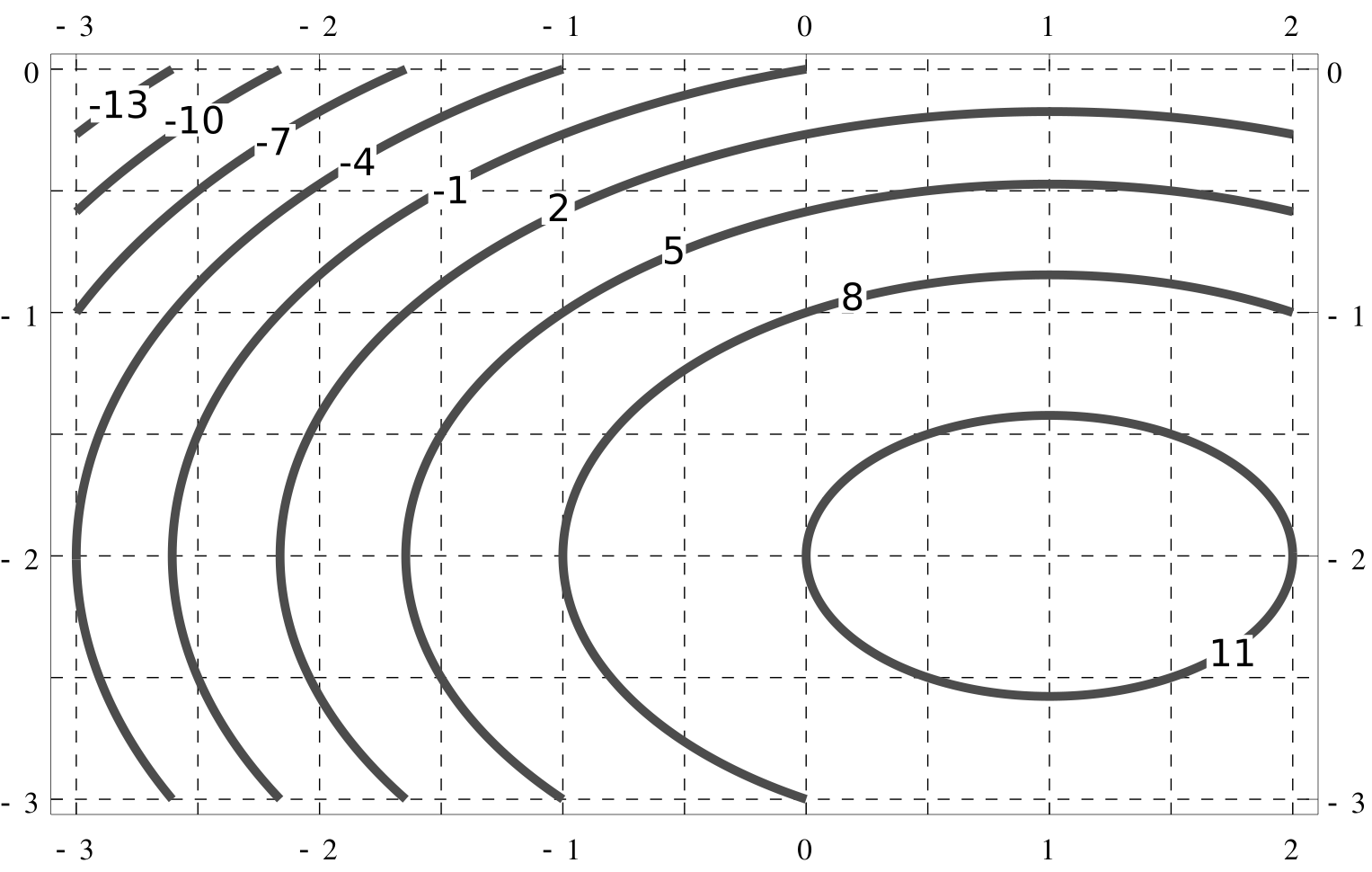
Consider the following contour plot for \(z=G(x,y)\):
What does a contour plot like this represent? Circle one:
- A subset of \(\R ^2\)
- A subset of \(\R ^3\)
Estimate the value of \(G(0,-1)\).
Estimate \(G^{(1,0)}(0,-1)\).
Estimate \(G^{(0,1)}(0,-1)\).
Estimate \(\grad G(0,-1)\).
If you were to leave the point \((0,-1)\) in the direction of the gradient, what value would
you find? Explain why this makes sense.
Use your computations above to estimate the formula for a plane tangent to \(G(x,y)\) at the
point \((0,-1)\).
3 Considering algebra
Let \(H:\R ^2\to \R \) be described by:
\[ H(x,y) = -1 + 2 x - x^2 - 12 y - 3 y^2 \]
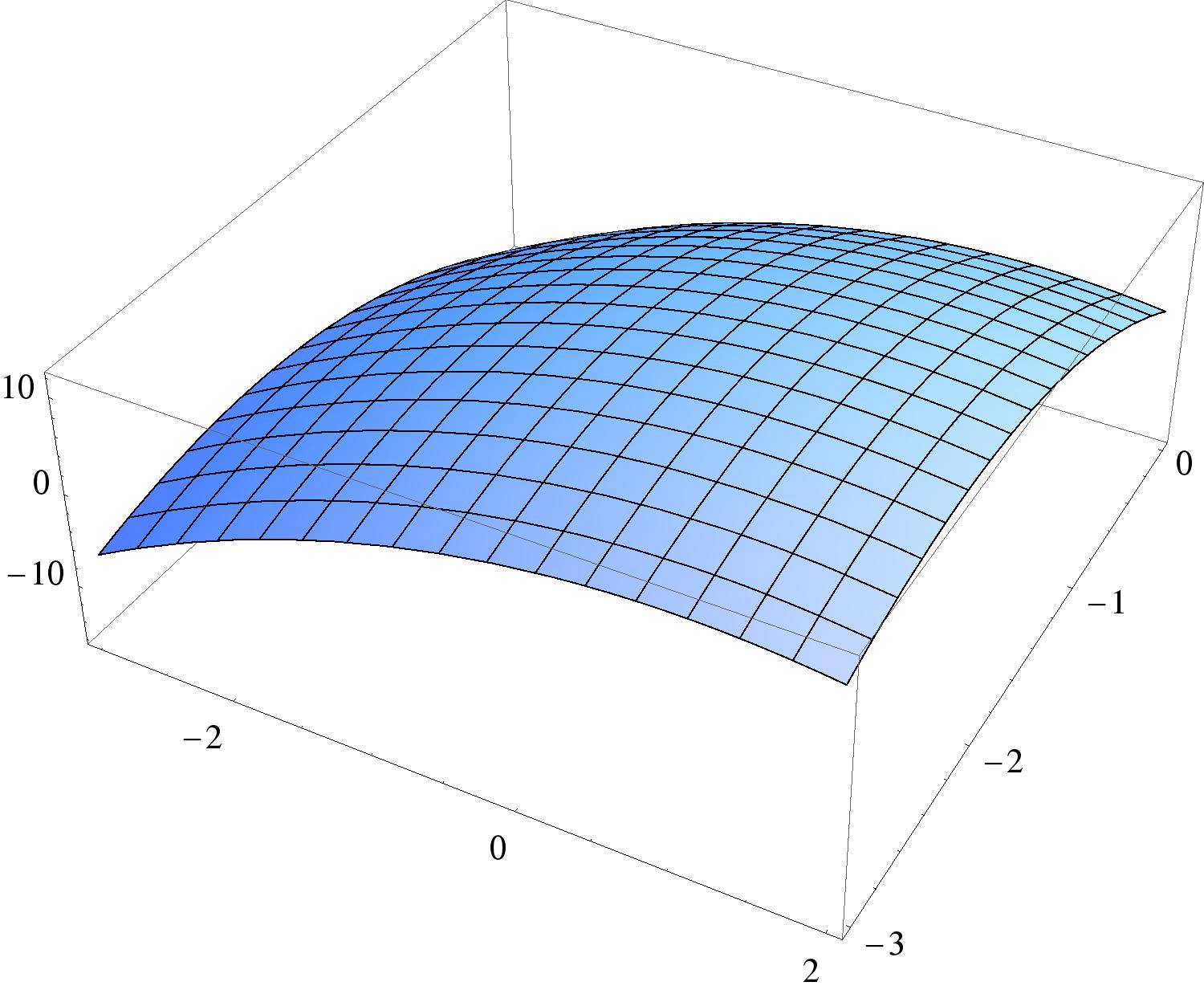
As a gesture of friendship, we have included a graph \(z = H(x,y)\):
Compute:
- (a)
- \(H(-2,-1)\)
- (b)
- \(H(0,-1)\)
Compute:
- (a)
- \(H^{(1,0)}(-2,-1)\)
- (b)
- \(H^{(0,1)}(-2,-1)\)
- (c)
- \(H^{(1,0)}(0,-1)\)
- (d)
- \(H^{(0,1)}(0,-1)\)
Compare and contrast the functions \(F\), \(G\), and \(H\). Discuss.