You are about to erase your work on this activity. Are you sure you want to do this?
Updated Version Available
There is an updated version of this activity. If you update to the most recent version of this activity, then your current progress on this activity will be erased. Regardless, your record of completion will remain. How would you like to proceed?
Mathematical Expression Editor
We introduce Stokes’ theorem.
Our final fundamental theorem of calculus is Stokes’ theorem. Historically
speaking, Stokes’ theorem was discovered after both Green’s theorem and the
divergence theorem. Its application is probably the most obscure, with the
primary applications being rooted in electricity-and-magnetism and fluid
dynamics.
Nevertheless, once we know Stokes’ theorem, we can view it as a direct generalization
of Green’s theorem.
Stokes’ Theorem If the components of \(\vec {F}:\R ^3\to \R ^3\) have continuous partial derivatives and \(\partial R\) is a
boundary of a closed surface \(R\) and \(\vec {p}(t)\) parameterizes \(\partial R\) in a counterclockwise direction
with the interior on the left, then:
\[ \iint _R \vector {-1,-3,2}\dotp \vector {0,0,1}\d S = \answer [given]{2}\iint _R \d S \]
but
\[ \iint _R \d S = \answer [given]{\pi } \]
Hence
\[ \oint _C (x-y)\d x +(x-2y+z) \d y + (3x+z) \d z =\answer [given]{2\pi }. \]
2 Swapping surfaces
Since Stokes’ theorem says that if we want to evaluate the circulation along a surface,
we need only look at the boundary, and we can sometimes be very clever and swap
one surface for another, provided that they have the same boundary! Consider the
pictures below:
Above we see a region \(R\) on the left and a region \(D\) on the right. In the middle is the
boundary of both regions. Since both regions \(R\) and \(D\) have the same boundary, we
can effectively swap surfaces by using Stokes’ Theorem. Check out the next
example.
Consider the surface integral
\[ \iint _R (\curl \vec {F})\dotp \uvec {n}\d S \]
where
\[ \vec {F}(x,y,z) = \vector {-y,0,z^2} \]
and \(R\) is the upper hemisphere of the sphere:
\[ x^2 + y^2 + z^2 = 9 \]
Compute this integral using Stokes’ theorem.
Note that the boundary of the sphere is
identical to the boundary of the disk
By Stokes’ theorem this is equal to the integral we desire.
3 Our final fundamental theorem of calculus
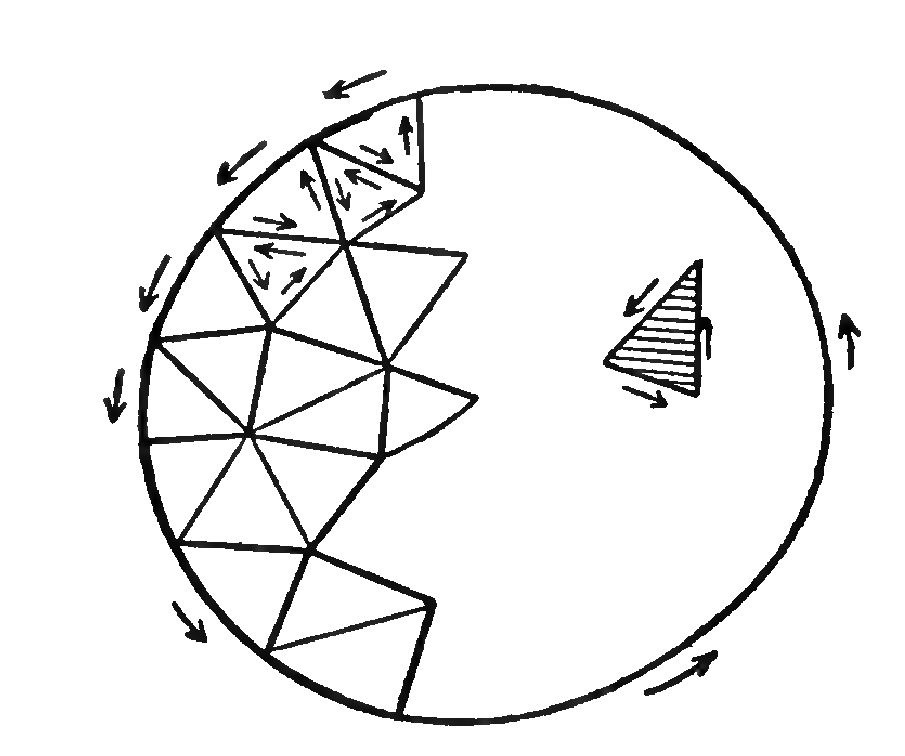
How is Stokes’ Theorem a fundamental theorem of calculus? Well consider this:
Are there no more fundamental theorems of calculus? Well, there are, but as you will
see if you continue your study of mathematics, they are all generalizations of the
theorems we already know.
![[Picture]](digInStokesTheorem.online-9b949f62ce166dd34574d7565f6f6f7c.svg)
![[Picture]](digInStokesTheorem.online-846148ace3e2da0853617c286588f2c6.svg)