You are about to erase your work on this activity. Are you sure you want to do this?
Updated Version Available
There is an updated version of this activity. If you update to the most recent version of this activity, then your current progress on this activity will be erased. Regardless, your record of completion will remain. How would you like to proceed?
Mathematical Expression Editor
Learn how to draw a torus.
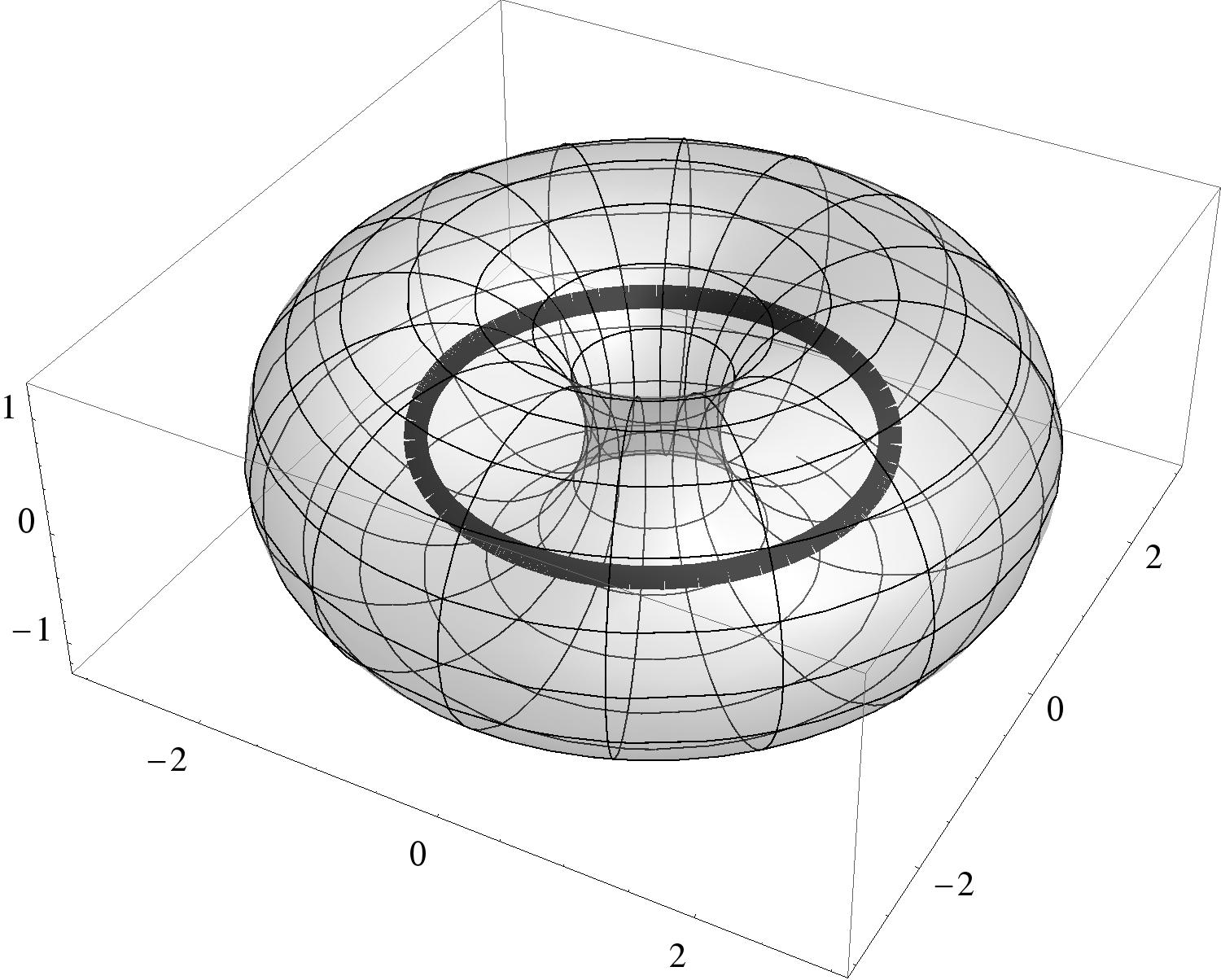
A common shape studied in mathematics is a torus or donut. To
draw a torus by-hand like a pro is easy. Start by drawing an ellipse:
Now make that ellipse smile!
Finally, add in an upside down arc:
And like magic, we have drawn a torus! On the other hand, if you want to use a
computer to draw a torus, perhaps you should use the parametric formula:
where \(R\) is the radius from the center of the torus to the center of the “tube,” \(r\) is the
radius of the “tube,” \(0\le \theta <2\pi \), and \(0\le \phi <2\pi \). However, listen, you could have derived a parametric
formula using the techniques you’ve learned. Let’s do it.
Use unit tangent vectors and unit normal vectors to derive a parametric formula for a
torus.
Imagine a circular curve in \(\R ^3\) that runs through the donut, shown in the
diagram from the previous problem by the two “dots.”
Give a formula for a
vector-valued function \(\vec {p}(\theta )\) that will draw a circle in the \((x,y)\)-plane, centered at
the origin, of radius \(R\), as \(\theta \) runs from \(0\) to \(2\pi \).
And done. We’ve given a parametric formula for a torus.
If you’re paying attention, you may notice that we now have a very similar formula
to the one given above, except that we have some minus signs where before we had
plus signs. What happened here?
We made a mistake in our work in the example
above. We lied to you when we give the initial parametric formula for the torus. We just broke math. Everybody wins. Both formulas draw a torus.
Both formulas
are correct, the first one we gave was derived using “outward” pointing normal
vectors. The second one we gave was derived using “inward” pointing normal vectors.
![[Picture]](digInDrawingATorus.online-2731c9a21272936505b0b6a65c15db60.svg)
![[Picture]](digInDrawingATorus.online-0278667bb66578acf62e3ffa88560752.svg)
![[Picture]](digInDrawingATorus.online-0fdcc645190fa7cb5bffa26117562843.svg)