- Inside function, and outside function,
- Inside function, and outside function,
- Inside function, and outside function,
We compute the derivative of a composition.
1 Compositions
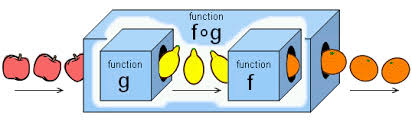
Composition is an operation that is unique to functions. It involves taking the output of one function and using it as the input of another function. The composition of two functions and is the function defined by We refer to as the “inside” function and as the “outside” function.
example 1 Identify the inside and the outside functions in these compositions:
- (a)
- The function is the composition of the inside function and the outside function .
- (b)
- The function is the composition of the inside function and the outside function .
- (c)
- The function is the composition of the inside function and the outside
function .
Note that the inside function is the one that acts first on and the outside function is the one that acts last on .
(problem 1) Identify the inside and the outside functions in these compositions:
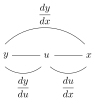
A composition can be written as a chain of variables: if , then we can introduce a new variable, and we can write where .
example 2 Write the following compositions as a
chain of variables:
- (a)
- The function can be written as where .
- (b)
- The function can be written as where .
- (c)
- The function can be written as where .
(problem 2) Write the following compositions as a chain of variables:
- (a)
- The single equation can be written as where
- (b)
- The single equation ; can be written as where
- (c)
- The single equation ; can be written as where
2 The Chain Rule in Prime Notation
The chain rule is the formula for computing the derivative of a composition.
The formula can be expressed by saying that the derivative of a composition is “the derivative of the outside times the derivative of the inside.” It must be noted that the derivative of the outside function is evaluated at the inside function.example 3 Find .
The function is a composition with inside and outside. To find the derivative of the composite function we need to use the chain rule. The chain rule formula requires both and . The second is simpler, so we start there: . To find we first find and then substitute for . We have, We can now conclude using the chain rule that
Here is a video solution of problem 3a: The function is a composition with inside and outside. To find the derivative of the composite function we need to use the chain rule. The chain rule formula requires both and . The second is simpler, so we start there: . To find we first find and then substitute for . We have, We can now conclude using the chain rule that
_
example 4 Find .
The function is a composition with inside and outside. To find the derivative of the composite function we need to use the chain rule. The chain rule formula requires both and . The second is simpler, so we start there: . To find we first find and then substitute for . We have, We can now conclude using the chain rule that
The function is a composition with inside and outside. To find the derivative of the composite function we need to use the chain rule. The chain rule formula requires both and . The second is simpler, so we start there: . To find we first find and then substitute for . We have, We can now conclude using the chain rule that
example 5 Find the values of where the tangent line to the graph of is
horizontal.
The tangent line is horizontal where the derivative is zero. We write as a composition: with To find we need and . We have, By the chain rule, The derivative is zero when . Since is never zero, we need to solve . We can factor out to get . The only solution is .
The tangent line is horizontal where the derivative is zero. We write as a composition: with To find we need and . We have, By the chain rule, The derivative is zero when . Since is never zero, we need to solve . We can factor out to get . The only solution is .
(problem 5) Find the values of where the tangent line to the graph of is
horizontal.
First we find the derivative:
In increasing order, the -values where the tangent line is horizontal are ,, .
First we find the derivative:
In increasing order, the -values where the tangent line is horizontal are ,, .
3 Leibniz Notation for the Chain Rule
The chain rule can also be expressed in Leibniz notation. A composition can be written using a chain of variables as: where . Observe that and . Thus, the chain rule in Leibniz notation is given by the elegant formula: In this format, the chain rule expresses the fact that “rates of change multiply.” To see this, consider a small change in the variable . This produces a change in which in turn produces a change in . The chain rule states that the rate of change of with respect to is the rate of change of with respect to times the rate of change of with respect to . For example, if is changing three times faster than and is changing four times faster than , then is changing times faster than .
example 6 Find if .
We unravel the composition by substituting for leading to the following chain of variables: Then the derivatives are Finally, the chain rule says to multiply these derivatives:
We unravel the composition by substituting for leading to the following chain of variables: Then the derivatives are Finally, the chain rule says to multiply these derivatives:
(problem 6) Find if and simplify the answer.
We unravel the composition by substituting for leading to the following chain of variables: Then the derivatives are Finally, the chain rule says to multiply these derivatives: which can be simplified to .
We unravel the composition by substituting for leading to the following chain of variables: Then the derivatives are Finally, the chain rule says to multiply these derivatives: which can be simplified to .
example 7 Find the second derivative of .
We unravel the composition by substituting for leading to the following chain of variables: Then the derivatives are Finally, the chain rule says to multiply these derivatives: Note that the function that we differentiated in this example is already the derivative of . Hence, we found that the second derivative of is .
We unravel the composition by substituting for leading to the following chain of variables: Then the derivatives are Finally, the chain rule says to multiply these derivatives: Note that the function that we differentiated in this example is already the derivative of . Hence, we found that the second derivative of is .
(problem 7) Find the derivative of .
We unravel the composition by substituting for leading to the following chain of variables: Then the derivatives are Finally, the chain rule says to multiply these derivatives:
We unravel the composition by substituting for leading to the following chain of variables: Then the derivatives are Finally, the chain rule says to multiply these derivatives:
example 8 After years, the amount of carbon 14 left from a sample of 10 grams is
given by the function Find the rate at which carbon 14 is decaying after 1000
years.
We write as a composition: with To find we need and . We have, By the chain rule, After 1000 years, the rate of decay is This is a negative value, indicating that the amount of carbon 14 is decreasing over time.
We write as a composition: with To find we need and . We have, By the chain rule, After 1000 years, the rate of decay is This is a negative value, indicating that the amount of carbon 14 is decreasing over time.
(problem 8) After million years, the amount of uranium 235 left from a sample of 20
grams is given by the function Find the rate at which uranium 235 is decaying after
2 million years.
We write as a composition: with To find we need and . We have, By the chain rule, After 2 million years, the rate of decay is This is a negative value, indicating that the amount of uranium 235 is decreasing over time.
We write as a composition: with To find we need and . We have, By the chain rule, After 2 million years, the rate of decay is This is a negative value, indicating that the amount of uranium 235 is decreasing over time.
4 Additional Examples and Problems
example 9 Find if .
We write as a composition: with To find we need and . We have, By the chain rule,
We write as a composition: with To find we need and . We have, By the chain rule,
Here is a video of example 9:
_
example 10
Find if .
We write as a composition: with To find we need and . We have, By the chain
rule,
Here is a video of example 10:
_
example 11
Find if .
We write as a composition: with To find we need and . We have, By the chain
rule, \begin{align*} h'(x) &= f'(g(x))g'(x)\\ &= \frac{1}{2\sqrt{x^2 + 4}}\cdot 2x\\ &= \frac{2x}{2\sqrt{x^2 + 4}}\\ =\frac{x}{\sqrt{x^2 + 4}}. \end{align*}
Here is a video of example 11:
_
example 12
Find if .
We write as a composition: with To find we need and . We have, By the chain
rule,
Here is a video of example 12:
_
example 13 Find if .
We write as a composition: with To find we need and . We have, By the chain rule,
We write as a composition: with To find we need and . We have, By the chain rule,
Here is a video of example 13:
_
example 14 Find if .
We write as a composition: with To find we need and . We have, By the chain rule,
We write as a composition: with To find we need and . We have, By the chain rule,
example 15 Find if .
We write as a composition: with To find we need and . We have, By the chain rule,
We write as a composition: with To find we need and . We have, By the chain rule,
Here is a video of example 15:
_
example 16 Find if .
We write as a composition: with To find we need and . We have, By the chain rule,
We write as a composition: with To find we need and . We have, By the chain rule,
Here is a video of example 16:
_
example 17 Find if .
We write as a composition: with To find we need and . We have, By the chain rule,
We write as a composition: with To find we need and . We have, By the chain rule,
Here is a video of example 17:
_
example 18 Find if .
We write as a composition: with To find we need and . We have, By the chain rule,
We write as a composition: with To find we need and . We have, By the chain rule,
Here is a video of example 18:
_
example 20 Find if .
We write as a composition: with To find we need and . We have, By the chain rule,
We write as a composition: with To find we need and . We have, By the chain rule,
Here is a video of example 20:
_
We now create a general chain rule formula for the natural logarithm function. With as the inside function, and we obtain the following formula for the derivative of :
The above formula is both useful and important. We will see it again in the Logarithmic Differentiation section.
Here is a video of example 21
_
5 Chain Rule Formulas
6 Proof of the Chain Rule
The chain rule is a consequence of the limit definition of the derivative. We give a proof of the chain rule here.
- Proof
- We start with the limit definition of the derivative: We multiply and divide by to get By the limit laws, this is equal to The second limit is by the definition of the derivative. To find the first limit, we let . By the continuity of , we have as . Thus, the first limit is Putting this all together, we have Note that in this proof, we had to assume that for close to .
Here are some detailed, lecture style videos on the chain rule:
_
_
_