- (a)
- (b)
- (c)
- (d)
- (e)
For each of the following, find the total without writing anything down, and without
using a calculator or other tool. You can write down your answer so that you don’t
forget it!
I asked Copilot (an AI) to use a mental math strategy to solve and illustrate its
answer. Here is the output, with the illustration first and then the description.
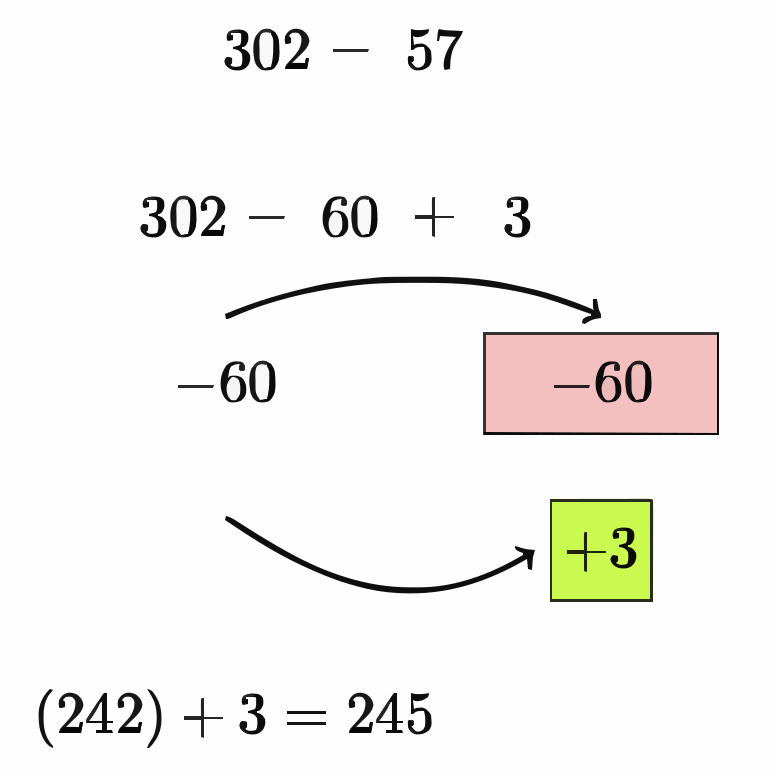
Here’s a clear mental-math strategy for solving and an explanation of the picture you received.
Mental Math Strategy: Break Apart the Subtraction
Instead of subtracting all at once, break it into friendlier numbers:
- 1.
- Rewrite 57 as 60 3
This works because:
- 2.
- Use the expression
- 3.
- Apply the “add the opposite” idea
Subtracting is the same as:
- 4.
- Now it’s easy to do mentally
Final Answer:
The image shows:
- Starting with
- Rewriting it as
- A curved arrow showing the step
- A second arrow showing adding back
- Ending at
This matches the mental-math breakdown strategy above. If you’d like, I can also create a number line version, a base-ten block version, or a bar model to help students visualize it!
Answer the following questions about Copilot’s work.
- (a)
- Does Copilot get the correct answer using a valid strategy? Explain the strategy in your own words. Was it the same or different as your strategy earlier?
- (b)
- Does Copilot’s picture illustrate its method? (Did it draw what you would consider a picture?) How would you improve the picture or adjust it to better model the method?
- (c)
- What would children need to already know to understand Copilot’s solution? Could you make its explanation more basic for a younger child? Could you make it more appropriate for an older child?
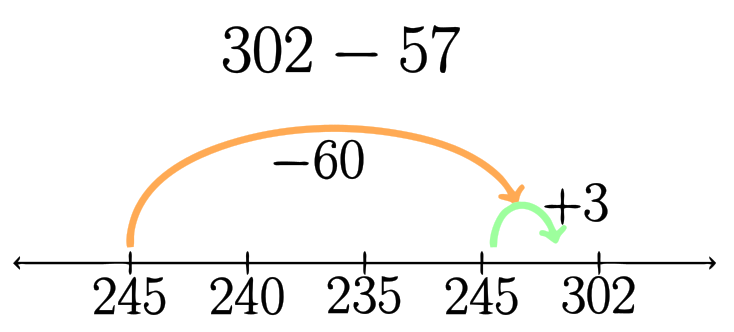
Copilot gave me the option to model its work from the previous problem on a
number line. Here is the output, with the illustration first followed by the
description.
2026-10-19 20:56:07
Here’s your number line version of the mental-math strategy for !
The drawing shows:
- Start at
- Make a big jump back (because )
this lands at - Then jump forward (because we subtracted too much)
final answer
Answer the following questions about Copilot’s work.
- (a)
- Does it model the same solution in the number line as it used in the previous problem? How can you tell?
- (b)
- How would you improve this number line? Modify Copilot’s work or draw your own number line.
- (c)
- Do you think a number line was a good suggestion to model this strategy? Why or why not? What other options should Copilot suggest if I want more information about this problem?