You are about to erase your work on this activity. Are you sure you want to do this?
Updated Version Available
There is an updated version of this activity. If you update to the most recent version of this activity, then your current progress on this activity will be erased. Regardless, your record of completion will remain. How would you like to proceed?
Mathematical Expression Editor
Two proofs.
Adapted from Ohio’s 2017 Geometry released item 13.
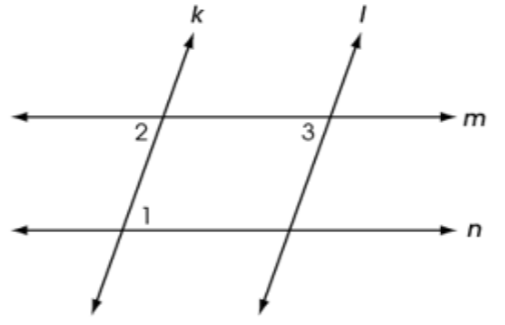
Two pairs of parallel lines intersect to form a parallelogram as shown.
Complete the following proof that opposite angles of a parallelogram are
congruent:
(a)
as opposite anglesalternate interior anglescorresponding angles for parallel lines and and .
(b)
as opposite anglesalternate interior anglescorresponding anglesfor parallel lines and and .
(c)
Then because they are both congruent to .
Adapted from Ohio’s 2018 Geometry released item 21.
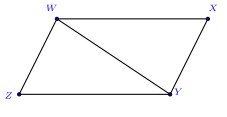
Given the parallelogram , prove that .
Fix note: It really would help to have an online environment that allows students to
mark diagrams.
-
Complete the proof below:
(a)
as alternate interior anglescorresponding anglesopposite angles for parallel segments and and .
(b)
for the same reason, this time for parallel segments and and
.
(c)
because a segment is congruent to itself.
(d)
by SASASASSS.
(e)
Then as corresponding parts of congruent triangles.
Fix note: Maybe number the angles.
-
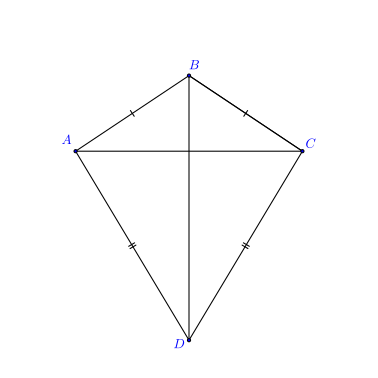
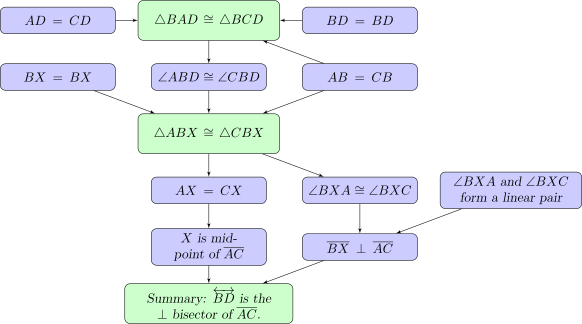
Quadrilateral is a kite as marked. Prove that is the perpendicular bisector of
.
Key theorem: The points on a perpendicular bisector are exactly those that are
equidistant from the endpoints of a segment.
Proof: Because and are each from and , they each must lie on the perpendicular
bisector of segment , which implies that is its perpendicular bisector.
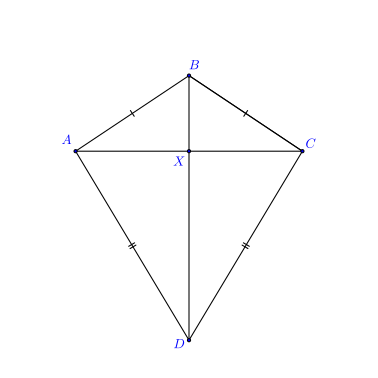
Quadrilateral is a kite as marked. Prove that is the perpendicular bisector of
.
A proof that makes use of triangle congruence:
Fix note: Do we need a step about and being the same line?