You are about to erase your work on this activity. Are you sure you want to do this?
Updated Version Available
There is an updated version of this activity. If you update to the most recent version of this activity, then your current progress on this activity will be erased. Regardless, your record of completion will remain. How would you like to proceed?
Mathematical Expression Editor
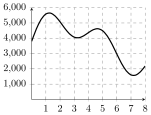
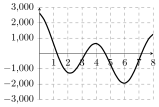
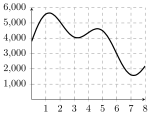
In the gondola of a hot air balloon, two instruments monitor the balloon’s
course over the course of a -minute period. An altimeter shows the balloon’s
height and a rate-of-climb meter shows how fast the balloon rises or falls.
Here are the resultant graphs (Heights change a lot due to updrafts and
downdrafts).
Altitude (ft) vs. time (min)
Vertical velocity (ft/min) vs. time (min)
(a)
Find when the balloon is going up (height increasing) and going down
(height decreasing). Look at each graph separately to answer the question.
(b)
At what time is the velocity of the balloon zero? What is happening to
the balloon at those times? Look at each graph separately to answer the
question.
(c)
Use the second graph to answer when the balloon is rising the fastest and
when it is falling the fastest. What does the first graph do at those times?
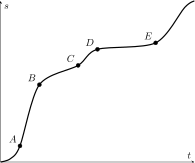
The graph below shows the position function of a car as it goes to work. Answer the
following questions:
\[ \begin{tikzpicture} \begin{axis}[ axis lines =middle, clip=false, every axis y label/.style={at=(current axis.above origin),anchor=south}, every axis x label/.style={at=(current axis.right of origin),anchor=west}, ticks=none, axis lines =middle, xlabel=$t$, ylabel=$s$, ] \addplot [very thick, smooth] coordinates{ (0,0) (.5,.1) (1,.5) (2,2.4) (4,3) (5,3.5) (8,3.7) (9.5,4.8) (10,5) }; \node at (axis cs:1,.5) [anchor=south east]{$A$}; \node at (axis cs:2,2.4) [anchor=south east]{$B$}; \node at (axis cs:4,3) [anchor=south east]{$C$}; \node at (axis cs:5,3.5) [anchor=south east]{$D$}; \node at (axis cs:8,3.7) [anchor=south east]{$E$}; \addplot [color=black,fill=black,only marks,mark=*] coordinates{(1,.5)}; \addplot [color=black,fill=black,only marks,mark=*] coordinates{(2,2.4)}; \addplot [color=black,fill=black,only marks,mark=*] coordinates{(4,3)}; \addplot [color=black,fill=black,only marks,mark=*] coordinates{(5,3.5)}; \addplot [color=black,fill=black,only marks,mark=*] coordinates{(8,3.7)}; \end{axis} \end{tikzpicture} \]
(a)
What was the initial velocity of the car?
(b)
Was the car going faster at or at ?
(c)
Was the car slowing down or speeding up at , , and ?
(d)
What happened between and ?
(e)
At what times did the car turn back for home?
For (a)-(c), suppose an object can move only along the positive -axis. Sketch
the graph of the object’s position vs. time graph and its velocity vs. time
graph.
(a)
The object is standing still.
(b)
The object is moving away from the origin at a constant velocity.
(c)
The object is moving toward the origin at a steadily increasing speed.
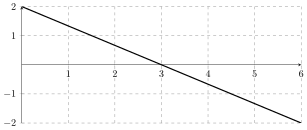
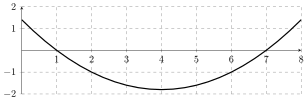
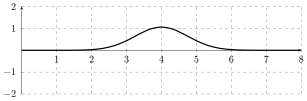
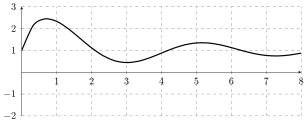
For each of the following, given the graph of the function, graph its derivative.