You are about to erase your work on this activity. Are you sure you want to do this?
Updated Version Available
There is an updated version of this activity. If you update to the most recent version of this activity, then your current progress on this activity will be erased. Regardless, your record of completion will remain. How would you like to proceed?
Mathematical Expression Editor
A graph is just one of the three major representations (formula, table, graphing) of a
relationship between variables. That is, it is one way to tell the tale of how one
variable changes when the other increases. We are going to see how calculus can help
us to pinpoint when certain “important events” occur on a graph and for the
function in general.
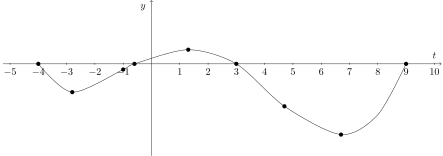
For example, here is a graph of Harry’s position (in miles) from home (positive =
east, negative = west) as he travels along an east-west road throughout the day
(i.e., as time increases). Assume noon is when hours. We can call Harry’s
position function . Although we have no formula for , everything we will do
here will correspond to algebraic methods we would do if we had a formula
for his position (don’t worry- you’ll do these things with a formula soon
enough!).
After each part, catch your breath and stop for a whole class discussion of the
exciting things you’ve found.
For what times is Harry’s position east of home? West of home? What did you look
for on the graph to answer those questions? What special thing happens at the
demarcation times? If we had a formula for , what would you do with the formula to
determine those demarcation times? If you did not have the graph of and only had
the answers to the initial questions to this paragraph, what would you know and not
know about the graph?
Now let’s examine Harry’s motion, not just where he is. For what times is Harry
moving eastward? Moving westward? What did you look for on the graph to answer
those questions? What special thing happens at the demarcation times? If we had a
formula for , what would you do with the formula to determine those demarcation
times? If you did not have the graph of and only had the answers to the initial
questions to this and the previous exploration, what would you now know and not
know about the graph?
Now let’s precisely examine Harry’s acceleration. When Harry is moving eastward,
for what times is his speed increasing? For what times is his eastward speed
decreasing? What did you look for on the graph to answer those questions? What
special thing happens at the demarcation times? If we had a formula for ,
what would you do with the formula to determine those demarcation times?
When Harry is moving westward, for what times is his speed increasing? For what
times is his speed decreasing? What did you look for on the graph to answer those
questions? What special thing happens at the demarcation times? If we had a
formula for , what would you do with the formula to determine those demarcation
times?
Classify the four basic shapes of any part of a graph of a function by describing each
shape in terms of what you found in the second, third, and fourth exploration..
Now do the following:
Sketch a graph of with as much detail as possible given the following sign
information about , , and . Be sure to describe how you interpreted the information
(e.g., what does knowing the sign of on an interval tell you about the graph of on
that interval?).
Up To x=
-3
1
4
5
7
9
10
Higher
f(x)
Neg
Pos
Pos
Pos
Neg
Neg
Pos
Pos
f’(x)
Pos
Pos
Neg
Neg
Neg
Pos
Pos
Pos
f”(x)
Neg
Neg
(Neg)
Pos
Pos
Pos
Pos
Neg
This just in: Other Fun Facts: , ,
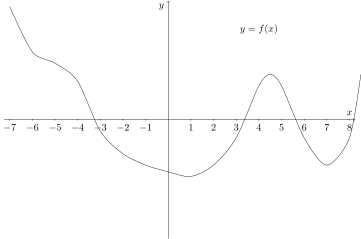
For the graph of below, make a sign chart for , , and (similar in form to that in
).
Determine whether the following properties can be satisfied by a function (of which
you could draw the entire graph without lifting your pencil- which we call
continuous). If such a function is possible, sketch a graph of that function. If such a
function is not possible, explain why.
(a)
A function is concave down and positive everywhere.
(b)
A function is increasing and concave down everywhere.
(c)
A function has exactly two extrema (i.e., mins and/or maxes) and three
inflection points.
(d)
A function has exactly four roots and two extrema (i.e., mins and/or
maxes).
You are told that for all . Which of the following must be true about the graph of
?:
(a)
The graph is a straight line.
(b)
The graph crosses the -axis at most once.
(c)
The graph is concave down.
(d)
The graph crosses the -axis more than once.
(e)
The graph is concave up.
You are told that for all . Which of the following must be true about the maximum
value of on the domain ?
(a)
Some critical value strictly between and .
(b)
Either or .
(c)
There is a maximum, but not enough information is given.