(Problem 1a) Find the domain of the function .
In this section we describe functions of two or more variables.
A function of two variables has the form The independent variables are and and
the dependent variable is . In section 1.8, we saw elliptic paraboloids like In this
equation, we can view as a function of and .
The area of a rectangle is length times width, so we can express area as a function of
two variables: The price of a good is a function of supply and demand, so we may be
able to write The depth of the ocean is a function of the location on its surface,
leading to The domain of is the set of coordinate pairs in for which is a valid
mathematical expression.
Example 1 Find the domain of the function .
The square root leads to a meaningful expression only if . This is equivalent to Points in satisfying this inequality are either inside or on the unit circle. The domain is thus the closed unit disk. 
The square root leads to a meaningful expression only if . This is equivalent to Points in satisfying this inequality are either inside or on the unit circle. The domain is thus the closed unit disk.
The graph of a function of two variables is the set of points in of the form and the graph is called a surface.
Example 2 Describe the graph of the function in .
As mentioned in example 1, the domain of is the set of all points in such that which is the closed unit disc, i.e, the unit circle together with its interior.
To recognize the surface, square both sides of the equation to get which is equivalent to This is the unit sphere in . In the original function, since is defined using a positive square root. Hence, the graph of is the “northern” hemisphere of the unit sphere (including the equator).
As mentioned in example 1, the domain of is the set of all points in such that which is the closed unit disc, i.e, the unit circle together with its interior.
To recognize the surface, square both sides of the equation to get which is equivalent to This is the unit sphere in . In the original function, since is defined using a positive square root. Hence, the graph of is the “northern” hemisphere of the unit sphere (including the equator).
1 Level Curves
A level curve for the surface is the curve in the -plane given by for some real
number .
Level curves are the basis for topographical maps like the one below.

When several level curves of are sketched in the same -plane, the figure is called a contour map.
Example 3 Describe the level curves of the function and sketch a contour map
consisting of at least 3 level curves.
The level curves have the form for some constant, . Note that if then the graph is the empty set.
To recognize the curve in the -plane, square both sides and rearrange to get: If this is a circle in the -plane with center at the origin and radius .
If , this is just the single point and
if then the graph is the empty set.
In the figure below, the chosen values for are: and . The corresponding radii of the circles are: and . 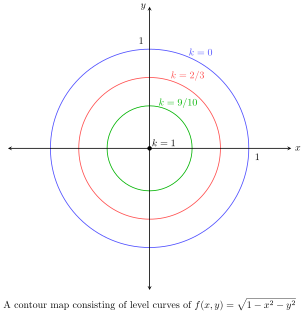
The level curves have the form for some constant, . Note that if then the graph is the empty set.
To recognize the curve in the -plane, square both sides and rearrange to get: If this is a circle in the -plane with center at the origin and radius .
If , this is just the single point and
if then the graph is the empty set.
In the figure below, the chosen values for are: and . The corresponding radii of the circles are: and .
(Problem 3a) Describe the level curves of the function and sketch a contour map
consisting of at least 3 level curves.
(Problem 3b) Describe the level curves of the function and sketch a contour map
consisting of at least 3 level curves.
(Problem 3c) Describe the level curves of the function and sketch a contour map
consisting of at least 3 level curves.
(Problem 3d) Describe the level curves of the function and sketch a contour map
consisting of at least 3 level curves.
Here is a video solution of problem 3, parts a, b and c:
_
The graph of a function of one variable, can be thought of as the level curve of the
function of two variables given by corresponding to .
2 Functions of Three Variables
The volume of a rectangular solid is length width height, so we can think of the volume as a function of three variables: In general a function of three variables looks like . The graph of such a function consists of the set of points in of the form . Our humanity limits us to three dimensions or fewer, so we are unable to produce the graph of a function of three variables. However, we can consider their level surfaces.
Example 4 Describe the level surfaces of the function .
The level surfaces are produced by the equation for constants, .
In this example, the corresponding equation is which is an ellipsoid for , and just the single point for . For , the level surface is the empty set.
The level surfaces are produced by the equation for constants, .
In this example, the corresponding equation is which is an ellipsoid for , and just the single point for . For , the level surface is the empty set.
The graph of a function of two variables, can be thought of as the level surface of the
function of three variables given by corresponding to .
2025-03-20 20:05:54