Where was Eye? (part 2)
In this part of the activity, you will take your own photos from a known height to test the formula you had developed in Part 1.
Directions
In groups of two or three, you will use a phone to take photos of a long desk, a sheet of paper or a hallway while holding your phone at a known height.
- Make sure that the camera is located in the center of the hallway/desk/paper
so that the triangle formed by the edges is isosceles.
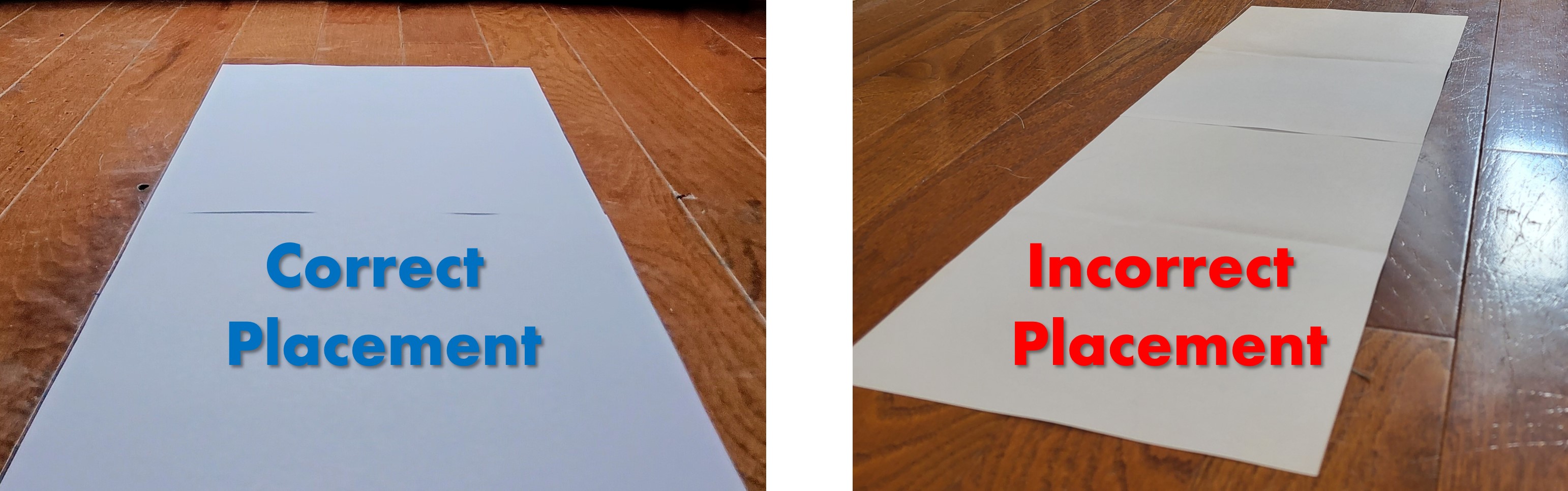
- To keep track of the camera height, hold or tape the phone to a meter stick or a ruler. Have one group member record the vertical distance from the surface (hallway floor/desktop/paper) to the camera lens for every shot. Remember to measure the distance to the camera lens (not the bottom or the top of the phone).
- Below are two methods for drawing and measuring the triangle.
- (a)
- Method 1. If you have a touch-screen computer, import your photos
into PowerPoint (left) or OneNote (right). Use the ruler tool (under
”Draw”) to outline the edges of the hallway/desk/paper in each photo.
Form a triangle with the vanishing point as the top vertex, as shown
below.
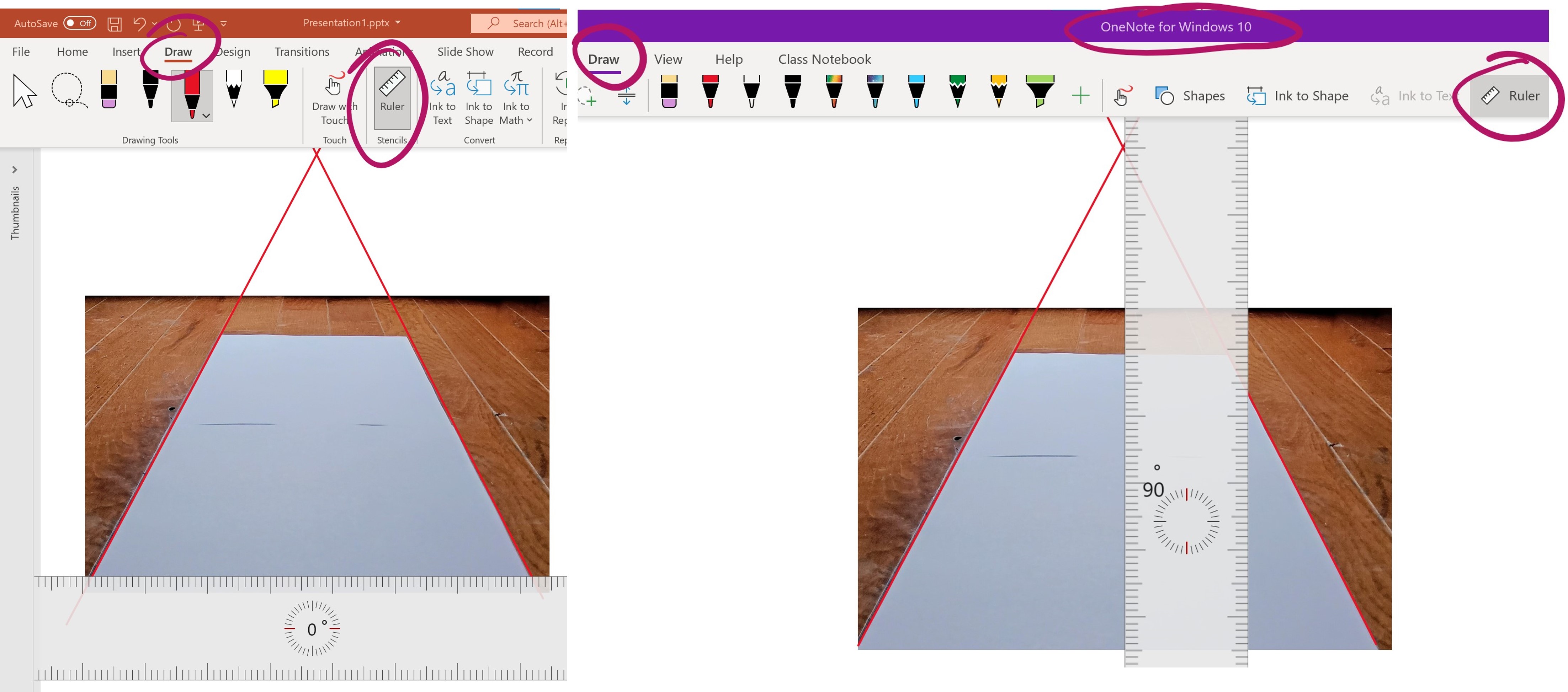
Measure the length of the base, and the height of the triangle and record your measurements.
- (b)
- Method 2. You can draw the triangle directly on your phone photo
by overlaying a piece of Plexiglass over your photo and using
a dry-erase marker and a ruler to trace and extend the edges
of the hallway/desk/paper to form a triangle, as shown below
(left).
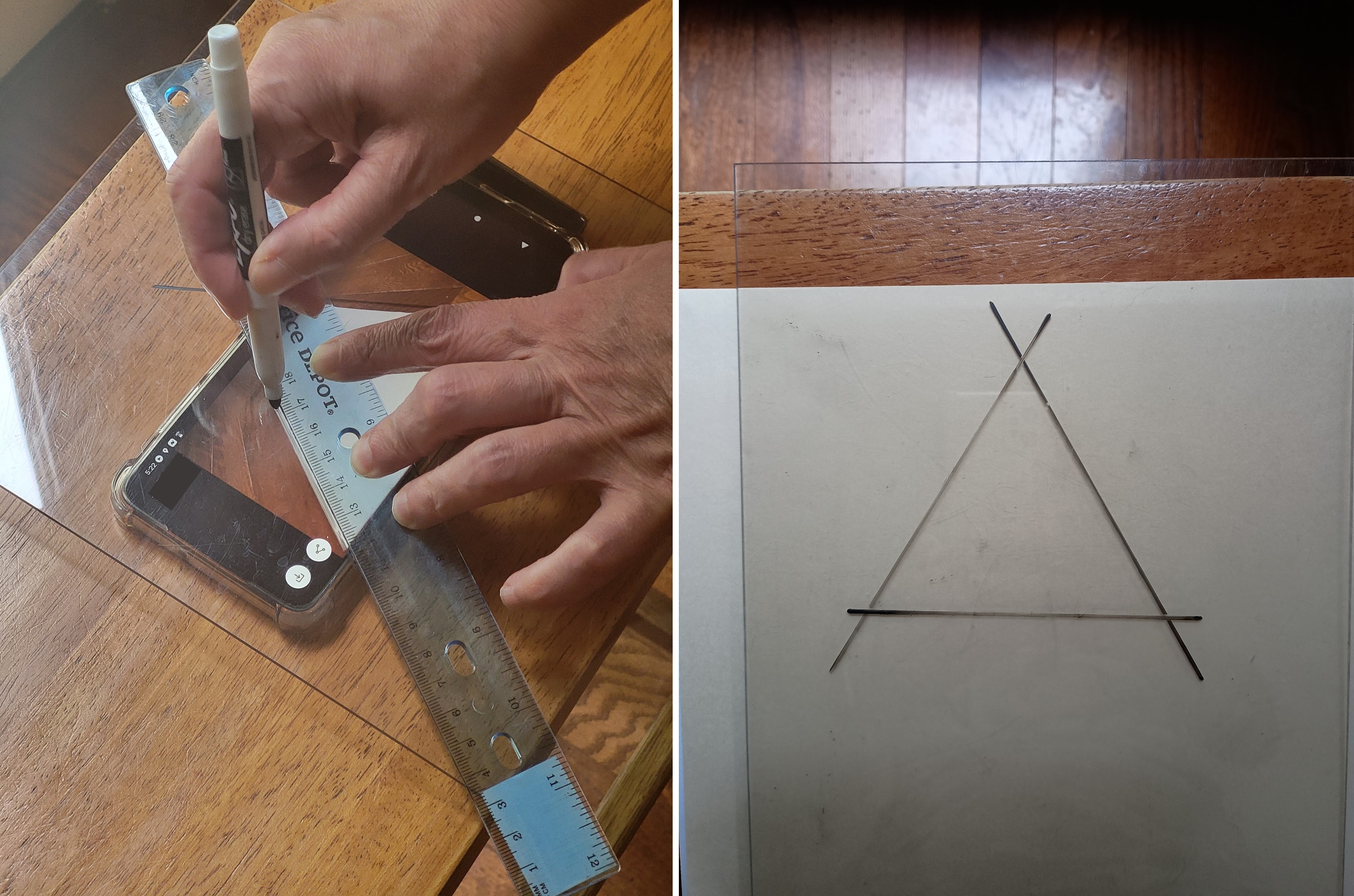
You can now do your measurements on the tracing (right).
- Follow the procedure you developed in Part 1 to find the height of the camera using ratios. Compare your computed height to your measured height. How close did you get?
- Did you set up your ratios correctly? Did you solve the equation correctly?
- Is your triangle nearly isosceles?
- Did you measure the vertical distance to the actual camera lens? (It is a common mistake to measure the distance to the bottom or the top of the phone.)
- When measuring the vertical distance, was the ruler perpendicular to the surface (floor/desktop/paper)? (It is a common mistake to tilt the ruler while measuring.)
How many examples does it take to prove that our method works in general? While our examples may be convincing, even a large number of examples is not sufficient to prove that this method works. What we need to do is develop a theoretical foundation for our method. This is what we will do in the next part of the activity.
2024-08-05 16:44:26