You are about to erase your work on this activity. Are you sure you want to do this?
Updated Version Available
There is an updated version of this activity. If you update to the most recent version of this activity, then your current progress on this activity will be erased. Regardless, your record of completion will remain. How would you like to proceed?
Mathematical Expression Editor
Where was Eye? (part 1)
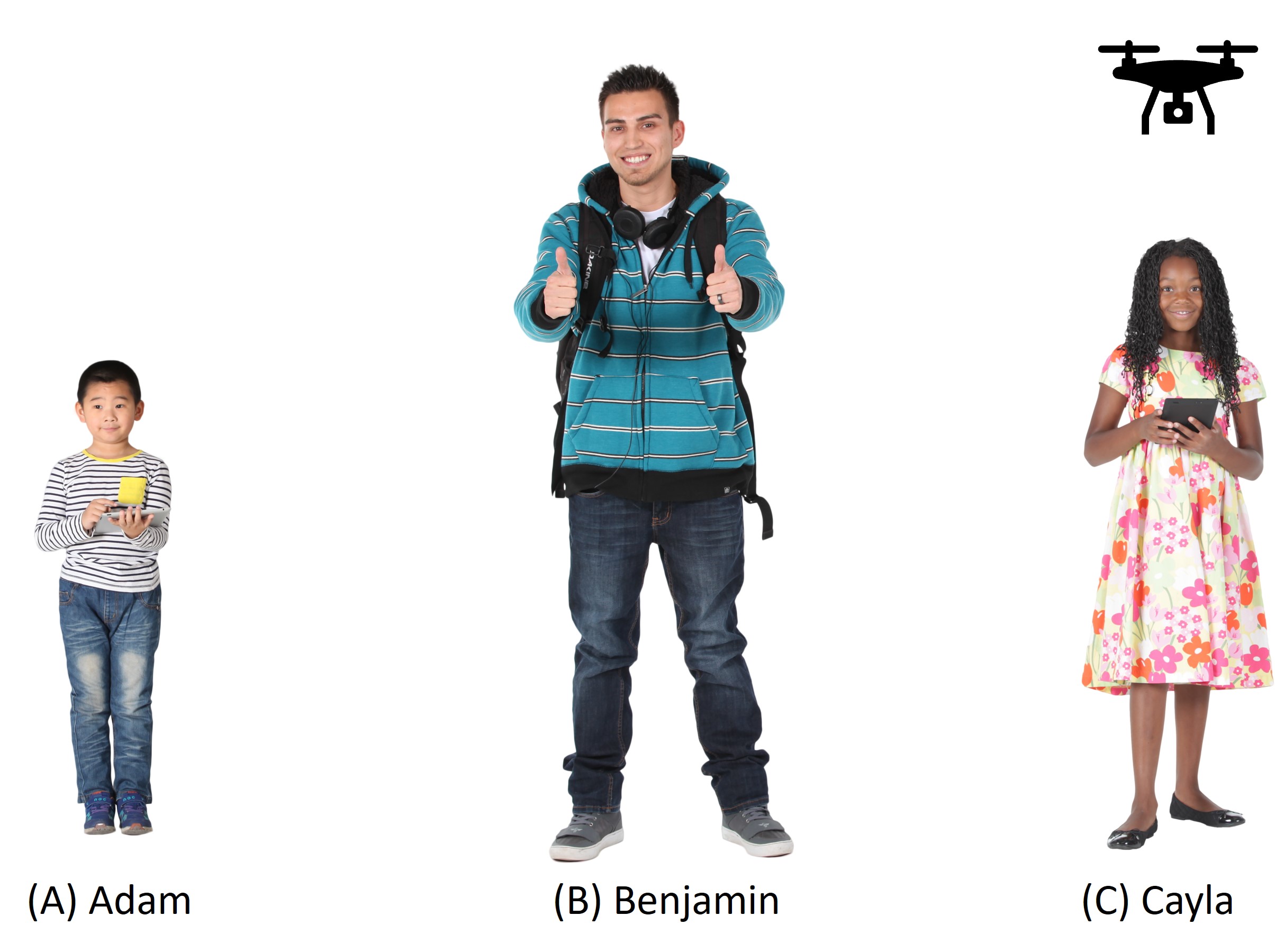
Three students, Adam, Benjamin, and Cayla, took part in a photography
competition. All three submitted photos of railroad tracks. Adam and Benjamin took
photos from their natural height; Cayla flew a drone high above her head to take a
picture.
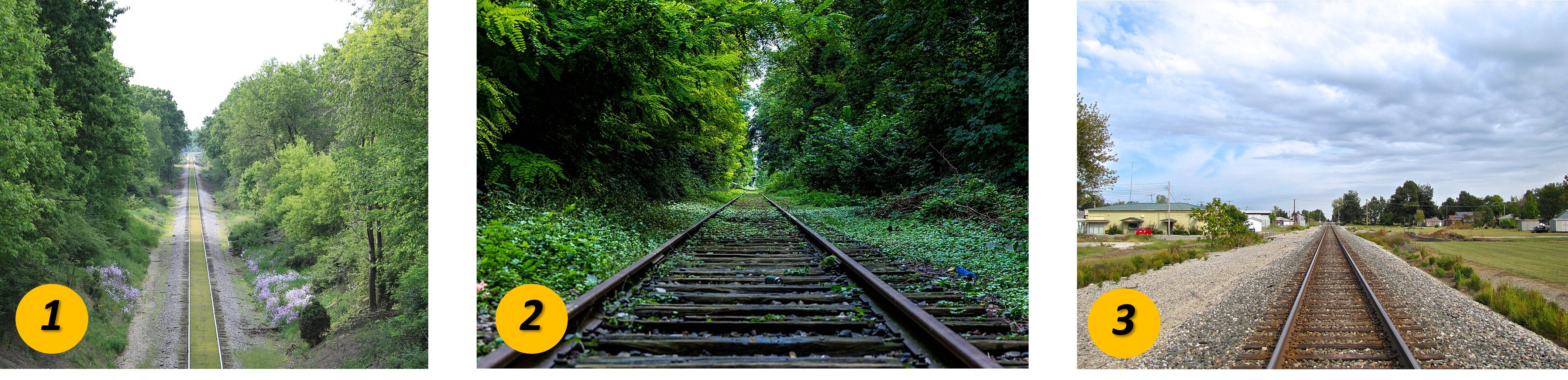
The images Adam, Benjamin, and Cayla took appear below (in no particular order).
Match each image with the photographer who took it.
Photo 1 was taken by
AdamBenjaminCayla
Photo 2 was taken by
AdamBenjaminCayla
Photo 3 was taken by
AdamBenjaminCayla
Group Discussion Prompt:Discuss the reasons for your choices. Do you think it
is possible to use these photographs to estimate the height of the camera that took each
photo?
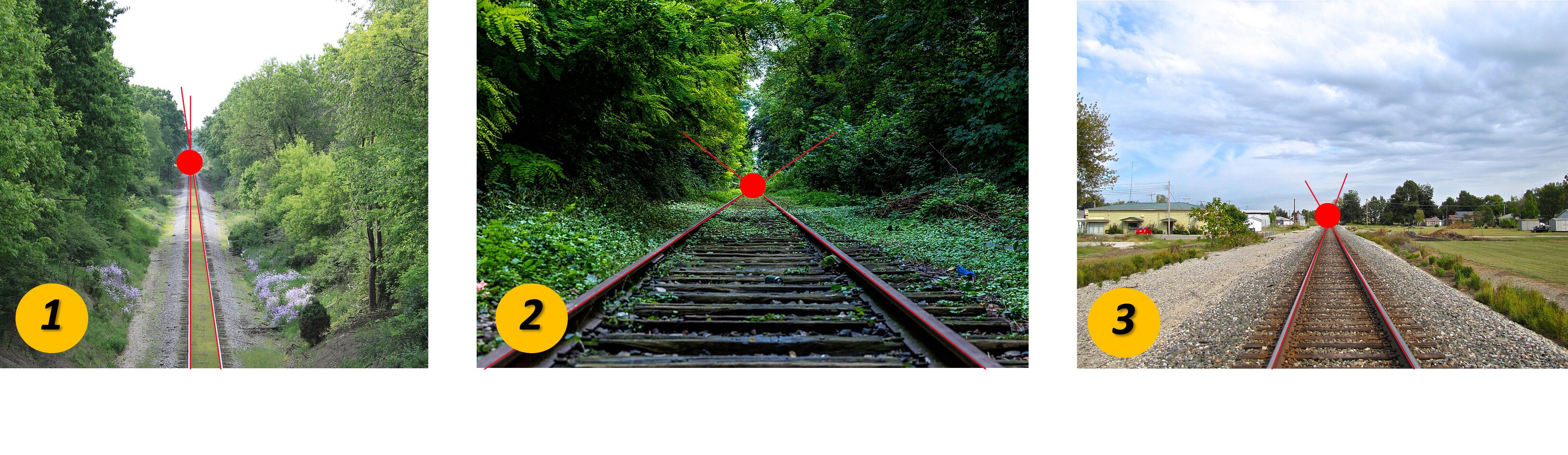
Let’s look at the three photos geometrically.
The rails appear to meet at a single point. Do you know what this point is called?
Center pointVanishing pointVertexEnd point
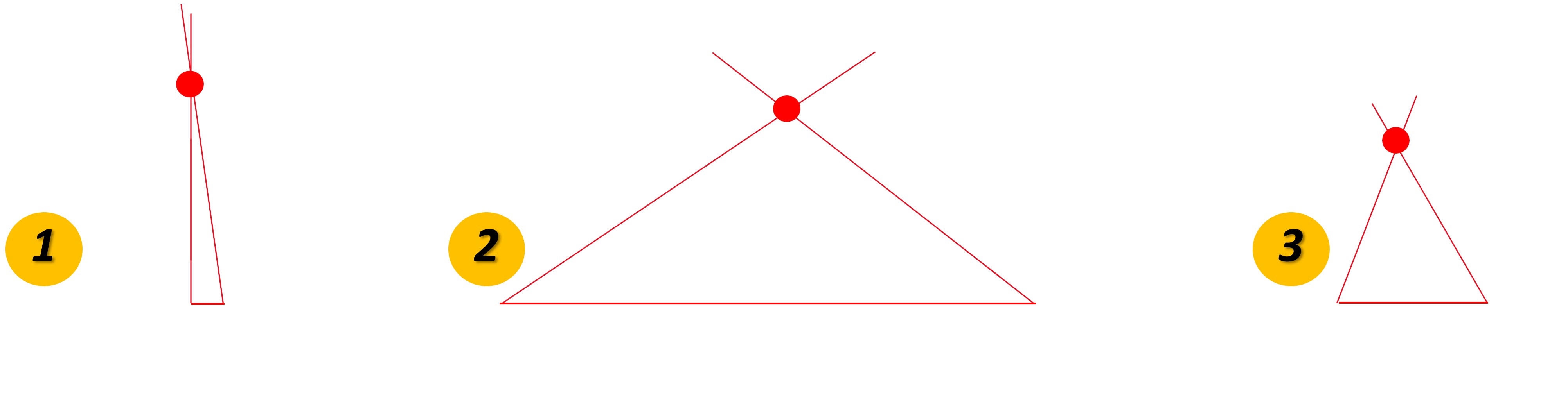
The rails, together with the bottom of each photo, form triangles.
You might describe the first triangle as tall and narrow, and the second triangle as
short and wide. These descriptions refer to the proportions of these triangles. To
really see the difference in the proportions, we can make the bases of the triangles the
same size. This makes sense to do because railroad tracks have the same width
everywhere in the U.S.
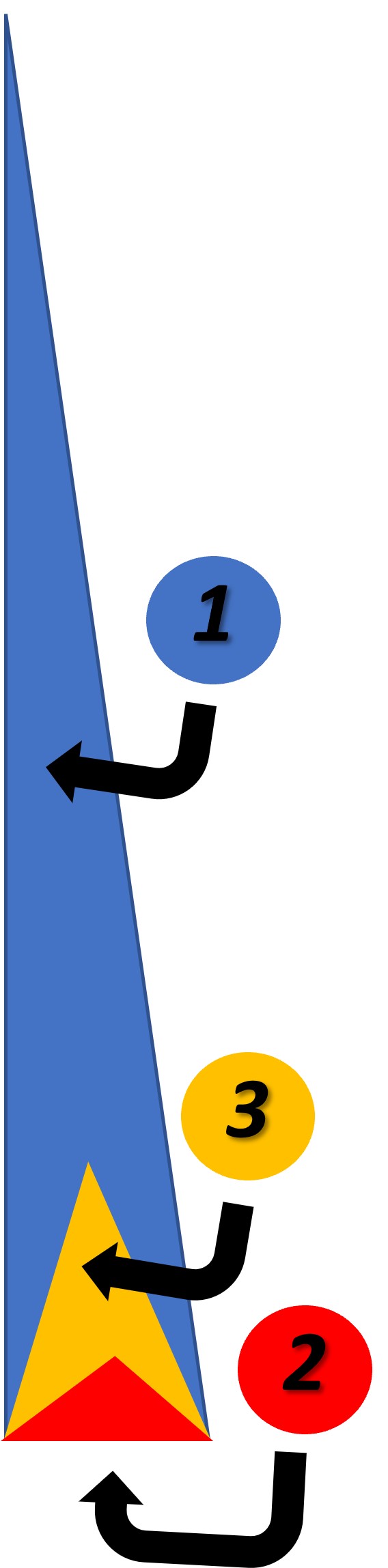
Group Discussion Prompt:In the previous exploration, you figured out who took
what photo. Discuss the relationship between the height of the camera and the height
of the triangles. Click on the arrow (below, right) for a hint.
Note that Cayla’s triangle (triangle 1) is the tallest, while Adam’s triangle (triangle
2) is the shortest. Recall that Cayla used a drone to take her photo from high above
her head.
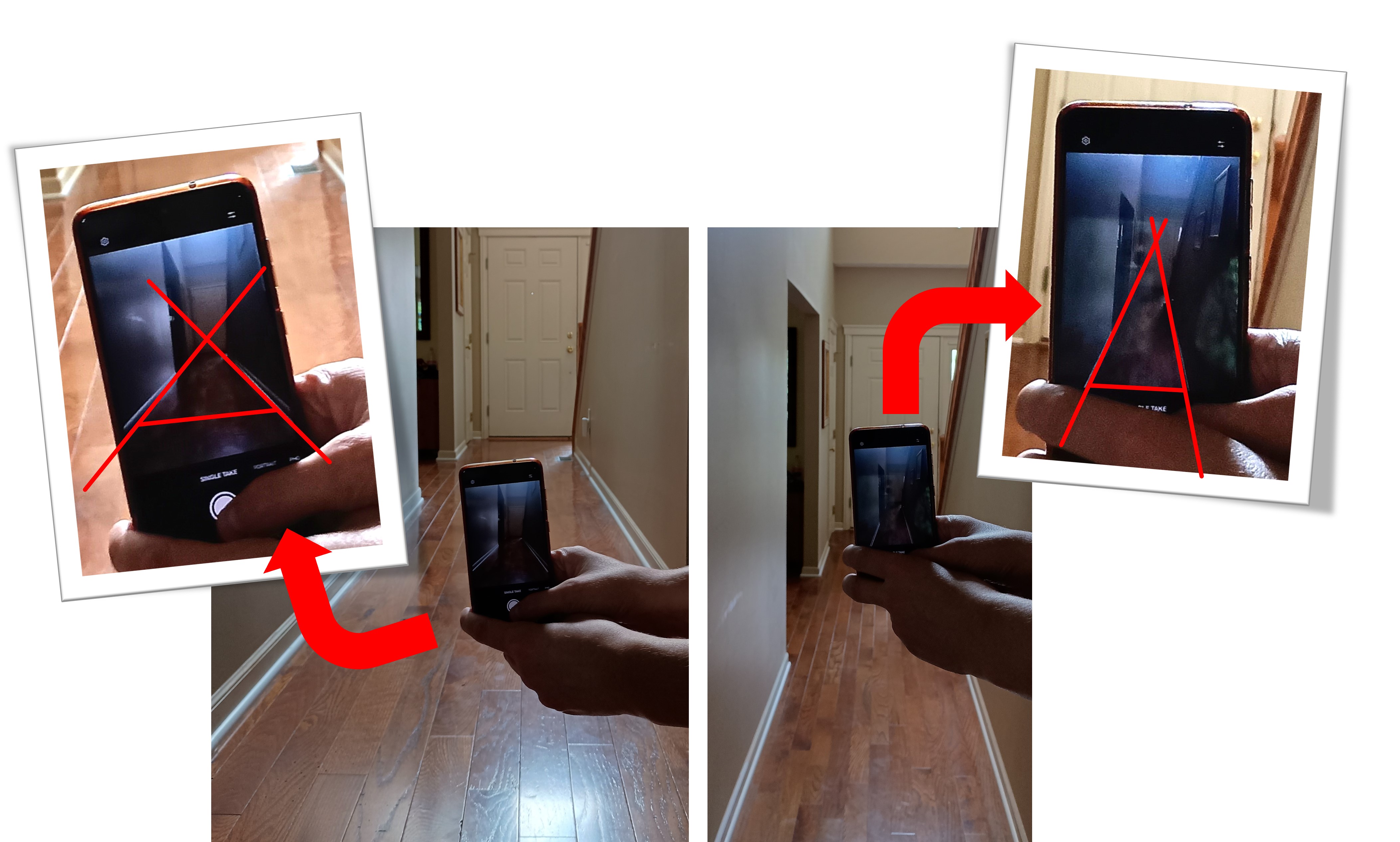
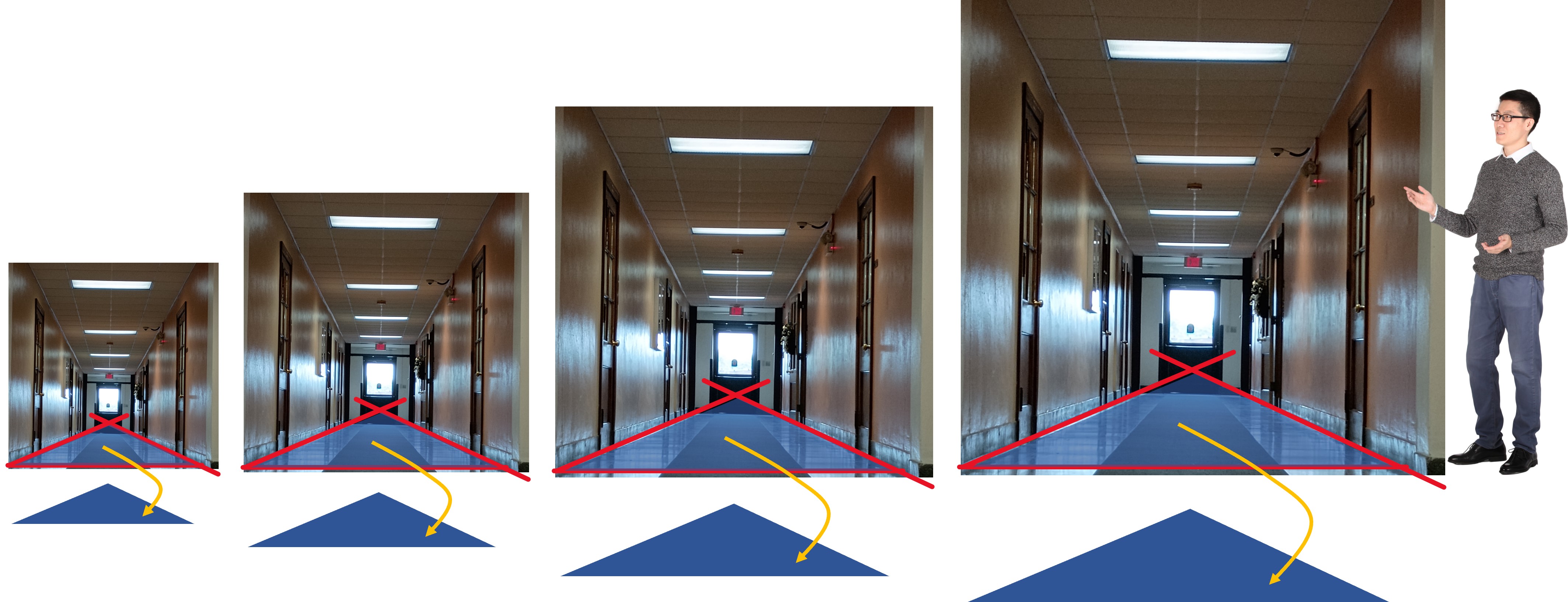
To see the change in the height of the triangle as the camera height changes, you can
use your own phone camera. Find a long hallway or a long table. Position your
camera in the middle of the hallway (table). Move the camera up and down observing
how the edges of the hallway (table) create taller and shorter triangles, as shown in
the photos below.
As the camera lowers, the triangle becomes proportionally shorter.As the
camera lowers, the triangle becomes proportionally taller.As the camera lowers,
the triangle’s proportions do not change.
So far, we have established that there is a relationship between the proportions of
the triangle formed by rails (or edges of a hallway), and the height of the
camera that took the photo. Next, we will look at a photo for which the
measurements of the real-life hallway, and the height of the camera are known. We
will numerically relate the proportions of the triangle to the height of the
camera.
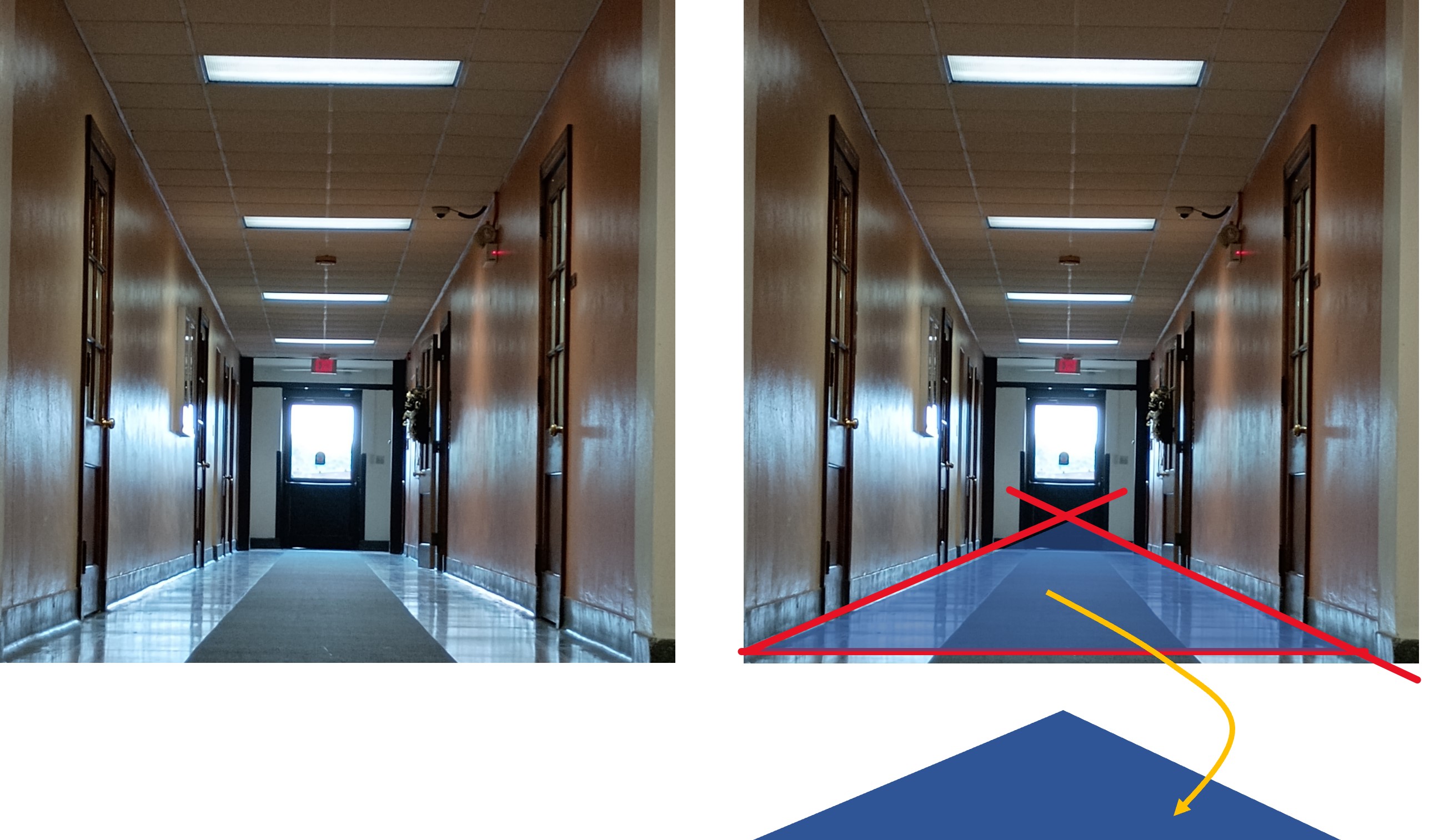
The following photo shows a -inch wide hallway. The photo was taken with the
camera lens inches above the floor.
Observe that the resulting triangle is nearly isosceles. We achieved this by placing the
camera as close to the middle of the hallway as we could.
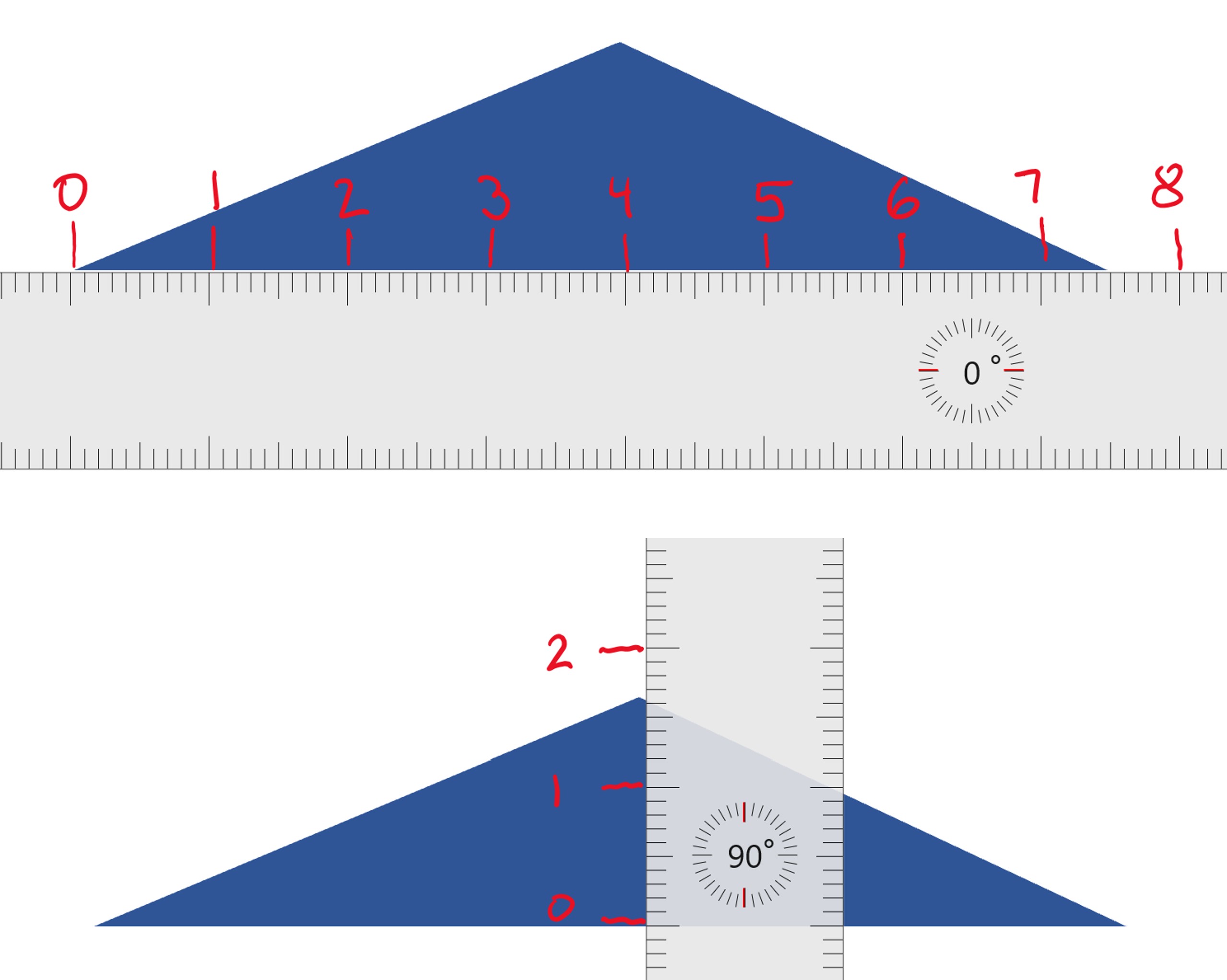
We will now look at the ratio of the height of the triangle to the length of the
base.
Group Discussion Prompt:Note that our calculations omitted units. Do units
matter in this case? If we were to do our measurements using different units, would
the ratio still be the same?
Next, we will try to figure out what to do with this ratio to find an estimate for
the height of the camera. To do this, suppose we made four prints of our
photo. The first print is the size of a small poster, the last print is life-sized.
The resulting triangles are clearly of different sizes, but they have the same
proportions! Such triangles are called congruentequilateralsimilarobtuse
Since the last ”print” in the above graphic is life-sized, and the width of the real-life
hallway is inches, we can conclude that the base of the last triangle is
inches. Set up and solve a proportion to find the height of the last blue
triangle.
Compare your answer to the height of the camera given at the start of the problem.
The numbers are very close! Do you think this is a coincidence?
Group Discussion Prompt:Formulate a rule for finding the height of the
camera for photos with the same set up. How would you verify that your rule
works for ALL such photos? Discuss this with your classmates and your
teacher.
Group Discussion Prompt:The rule you stated in the previous discussion
question is a theoretical rule. In practice, the height of the camera above the floor was
given to be inches, but the computed height of the triangle was not exactly . What do
you think accounts for the difference?
Group Discussion Prompt:Railroads in the U.S. are built so that the distance
between the rails is the same everywhere in the country. The distance between the
rails is call the gauge. You can learn more about railroad gaugeshere. Discuss how
you can use this information to find the actual heights that Adam, Benjamin, and
Cayla took their pictures from.
In the next two parts of this activity, you will get to perform a photo experiment
yourself, and develop the theoretical underpinnings for the rule you discovered
here.
Photo Credits
Railroad track photos used in this activity were downloaded from WikiMedia
Commons.
Photo 1: Dwight Burdette, CC BY 3.0 ¡https://creativecommons.org/licenses/by/3.0¿,
via Wikimedia Commons
Photo 2: Antoine Beauvillain, CC0, via Wikimedia Commons
Photo 3: Brian Stansberry, CC BY 4.0 ¡https://creativecommons.org/licenses/by/4.0¿,
via Wikimedia Commons