- (a)
- \(\begin{bmatrix}1\\2\end{bmatrix}\) and \(\begin{bmatrix}-3\\-1\end{bmatrix}\).
Answer: \(\theta =\answer {135}^\circ \)
- (b)
- \(\begin{bmatrix}-1\\2\\4\end{bmatrix}\) and \(\begin{bmatrix}-2\\1\\-1\end{bmatrix}\)
Answer: \(\theta =\answer {90}^\circ \)
- (c)
- \(\begin{bmatrix}0\\-3\\1\end{bmatrix}\) and \(\begin{bmatrix}-5\\-2\\4\end{bmatrix}\)
Answer: \(\theta =\answer [tolerance=0.1]{61.9}^\circ \)
Dot Product and Angle
Given two vectors \(\vec {u}\) and \(\vec {v}\), let \(\theta \) be the angle between them such that \(0\leq \theta \leq \pi \). We will refer to \(\theta \) as the included angle.
![[Picture]](main.online-6712e348fb5912d9b063f66fd662e528.svg)
The following theorem establishes a relationship between the dot product and the included angle.
Let \(\vec {u}\) and \(\vec {v}\) be vectors in \(\RR ^n\), and let \(\theta \) be the included angle. Then
\begin{equation*} \label {matlintrans} \vec {u}\dotp \vec {v}=\norm {\vec {u}}\norm {\vec {v}}\cos \theta \end{equation*}
Consider the triangle formed by \(\vec {u}\), \(\vec {v}\) and \(\vec {u}-\vec {v}\).
![[Picture]](main.online-fd2bbd59780cb0bd27190bf5b8448c69.svg)
By the Law of Cosines we have:
\begin{align*} \norm {\vec {u}-\vec {v}}^2=\norm {\vec {u}}^2+\norm {\vec {v}}^2-2\norm {\vec {u}}\norm {\vec {v}}\cos \theta \end{align*}
By Theorem th:dotproductpropertiesitem:norm of Dot Product and its Properties
\begin{align*} (\vec {u}-\vec {v})\dotp (\vec {u}-\vec {v})=&\vec {u}\dotp \vec {u}+\vec {v}\dotp \vec {v}-2\norm {\vec {u}}\norm {\vec {v}}\cos \theta \end{align*}
By Theorem th:dotproductpropertiesitem:distributive-again of Dot Product and its Properties
\begin{align*} (\vec {u}-\vec {v})\dotp \vec {u}-(\vec {u}-\vec {v})\dotp \vec {v}=&\vec {u}\dotp \vec {u}+\vec {v}\dotp \vec {v}-2\norm {\vec {u}}\norm {\vec {v}}\cos \theta \end{align*}
By Theorem th:dotproductpropertiesitem:distributive of Dot Product and its Properties
\begin{align*} \vec {u}\dotp \vec {u}-\vec {v}\dotp \vec {u}-\vec {u}\dotp \vec {v}+\vec {v}\dotp \vec {v}=&\vec {u}\dotp \vec {u}+\vec {v}\dotp \vec {v}-2\norm {\vec {u}}\norm {\vec {v}}\cos \theta \end{align*}
By Theorem th:dotproductpropertiesitem:commutative of Dot Product and its Properties
\begin{align*} -2(\vec {u}\dotp \vec {v})=&-2\norm {\vec {u}}\norm {\vec {v}}\cos \theta \\ \vec {u}\dotp \vec {v}=&\norm {\vec {u}}\norm {\vec {v}}\cos \theta \end{align*}
Find the included angle between vectors \(\vec {u}=\begin{bmatrix}2\\-1\\4\end{bmatrix}\) and \(\vec {v}=\begin{bmatrix}1\\2\\-3\end{bmatrix}\).
By Theorem th:dotproductcosine, \(\cos \theta =\frac {\vec {u}\dotp \vec {v}}{\norm {\vec {u}}\norm {\vec {v}}}\).
\[\vec {u}\dotp \vec {v}=2-2-12=-12\]
\[\norm {\vec {u}}=\sqrt {4+1+16}=\sqrt {21}\]
\[\norm {\vec {v}}=\sqrt {1+4+9}=\sqrt {14}\]
\[\cos \theta =\frac {-12}{\sqrt {21}\sqrt {14}}\]
\[\theta \approx 134.4^{\circ } \]
Orthogonal Vectors
Let \(\vec {u}\) and \(\vec {v}\) be vectors in \(\RR ^n\). We say \(\vec {u}\) and \(\vec {v}\) are orthogonal if \(\vec {u}\dotp \vec {v}=0\).
We can use Theorem 1 to show that two non-zero orthogonal vectors of \(\RR ^n\) are simply perpendicular vectors (the included angle is \(90^{\circ }\)). To see this, suppose that \(\vec {u}\dotp \vec {v}=0\) for nonzero vectors \(\vec {u},\vec {v}\). Then from Theorem 1 we have
\[0=\norm {\vec {u}}\norm {\vec {v}}\cos \theta .\]
Since \(\vec {u},\vec {v}\) are nonzero vectors, we have \(0=\cos \theta \), which implies \(\theta =90^{\circ }\). The converse also holds. If \(\theta =90^{\circ }\), then the dot product is clearly 0.
The reason we prefer the term “orthogonal" to “perpendicular" in this course is because \(\RR ^n\) is only one example of a vector space, and the dot product is only one example of a more general product, called an inner product. For vectors in \(\RR ^n\) a zero dot product happens to coincide with the geometric idea of perpendicularity, but there are many vector spaces that do not possess the visual geometry of \(\RR ^n\). (Later in the text, you will encounter vector spaces whose vectors are polynomial functions!) In these more abstract settings, a zero inner product still signals a special relationship between vectors. The term orthogonal captures this relationship.
By our definition, the zero vector is orthogonal to any vector. However, we will not
use the word perpendicular when the zero vector is involved, as it is not possible to
talk about an “included angle”.
Practice Problems
Find the degree measure of the included angle, \(\theta \) for each pair of vectors. Round
your answers to the nearest tenth.
Find all values of \(a\) so that \(\begin{bmatrix}a^2\\2a\\1\end{bmatrix}\) is orthogonal to \(\begin{bmatrix}1\\2\\3\end{bmatrix}\). List your answers in increasing
order.
Answer: \(\answer {-3}, \answer {-1}\).
Find the value of \(x\) for which the vector \(\begin{bmatrix}x\\-4\end{bmatrix}\) is parallel to the vector \(\begin{bmatrix}3\\2\end{bmatrix}\). What is the
measure of the included angle, \(\theta \)? Find the measure of the included angle using
Theorem 3. Do the two results agree?
Answer:
\[x=\answer {-6}\]
\[\theta =\answer {180}^\circ \]
Prove that if \(\vec {u}_1\) and \(\vec {u}_2\) are unit vectors, then \(-1\leq \vec {u}_1\dotp \vec {u}_2\leq 1\). In what cases are the extreme values of 1
and \(-1\) attained?
Imagine a clock with hands represented by vectors \(\vec {m}\) and \(\vec {h}\), as shown below. At what
whole hour will \(\vec {m}\dotp \vec {h}\) attain its maximum value? At what whole hour will \(\vec {m}\dotp \vec {h}\) be as small as
possible?
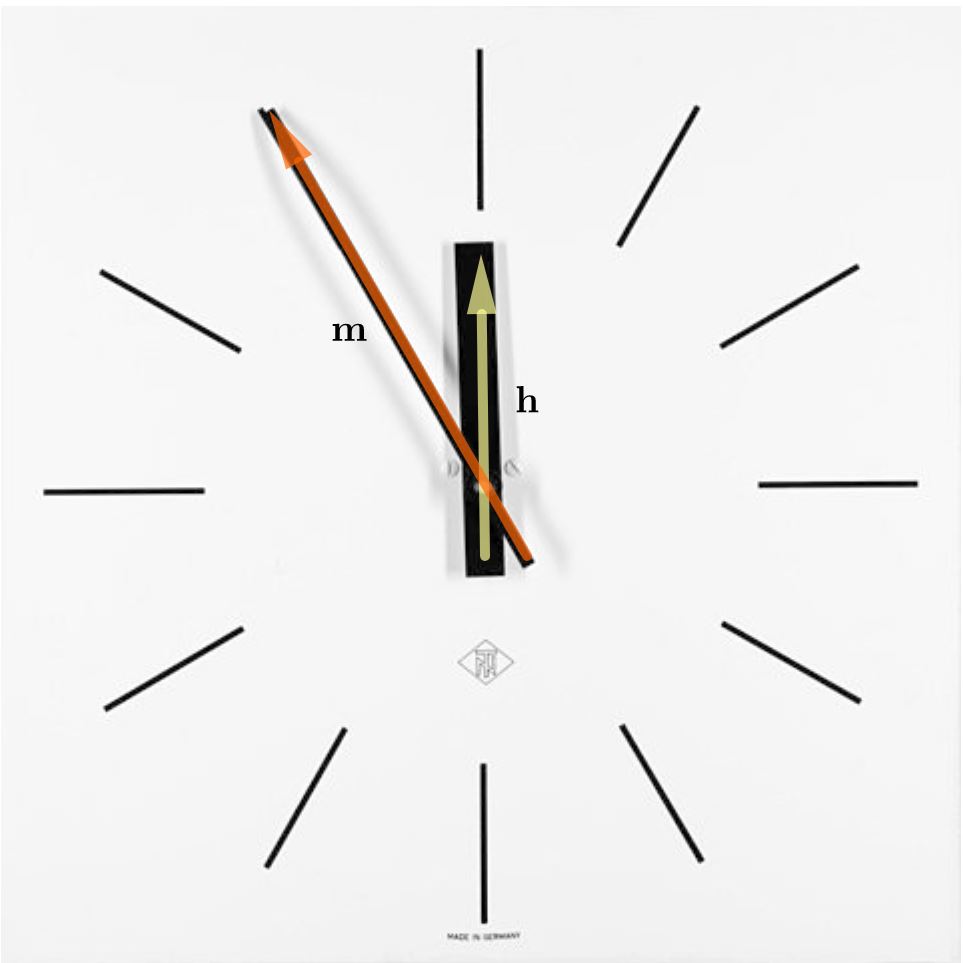
Answer:
\[\vec {m}\dotp \vec {h}\text { is greatest at }\answer {12}:00 \text { o'clock}\]
\[\vec {m}\dotp \vec {h}\text { is smallest at }\answer {6}:00 \text { o'clock}\]
Photo Credits
The following images are courtesy of Wikimedia Commons
Hannes Grobe, Wall clock manufactured by Telefonbau & Normalzeit. CC-BY 3.0