Calculus 1 Lab 5
An Application of Integration - Arc Length
In this lab, we will explore how we can calculate arc length using a definite integral.
This lab corresponds to section 6.3 in our physical textbook, so feel free to use the
textbook as a resource while completing this lab.
Unless stated otherwise, input answers in exact form on this lab.
What is arc length and how can it be approximated?
In the last few weeks of math 160, you will learn about using definite integrals to
calculate the areas of 2D regions and volumes of 3D regions. Integrals can also be
used to evaluate the arc length of a function. Consider the function on the interval
which is graphed below.
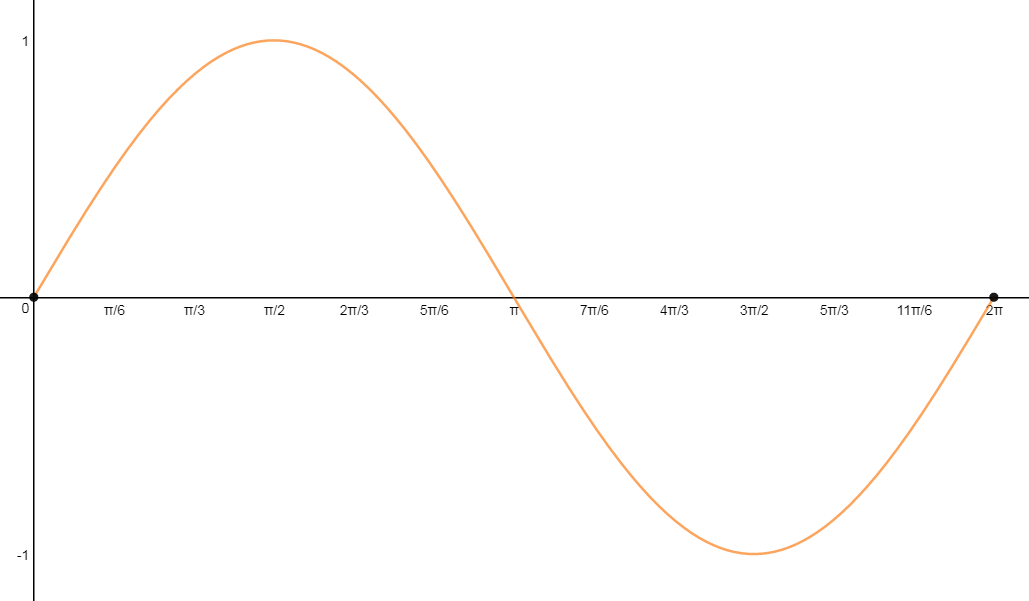
Imagine laying a string over . What length of string would you need in order for the
string to exactly lay on top of on the interval ? This length is called the ‘arc length’
of the function on the interval , and the goal of this lab is to determine how to
calculate this length exactly.
At some point in your math education, you probably learned how to calculate the length of an arc on a circle. The idea of the arc length of a curve is actually the same, except now we would like to calculate the length of any curve, not just circular ones. Aside from circles, you also have the tools to calculate the arc length of a linear function on a particular interval. For example, consider the function graphed below. Let’s find this function’s arc length on a few intervals.
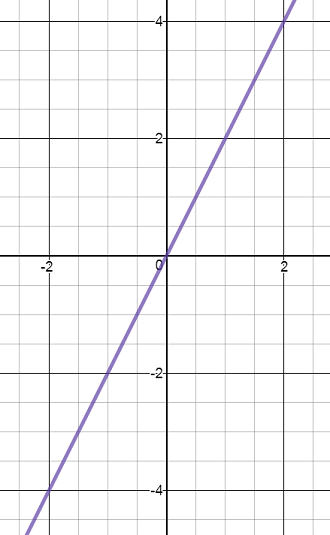
The endpoints of this line segment are and so the -distance between these endpoints is and the -distance between these endpoints is Notice that a right triangle can be formed with this line segment as a hypotenuse and legs with lengths and , respectively. Now that we have formed a right triangle, the the Pythagorean Theorem tells us that the length of this line segment and therefore the arc length of on the interval is
In a similar fashion, the Pythagorean Theorem could be used to calculate the arc
length of any linear function on a specific sub-interval and therefore the length of any
line segment. Let’s use the fact that we can find the length of any line segment in
order to approximate the arc length of the function on the interval . Just like we
used rectangles to approximate area, let’s use line segments to approximate arc
length. For this example, let’s use line segments. Now, we can partition into 4 equal
length sub-intervals, , , , and , and draw a line segment to approximate the arc
length on each sub-interval, as shown below. Finally, to approximate arc
length, we must add up the length of these 4 line segments. Let’s do it!
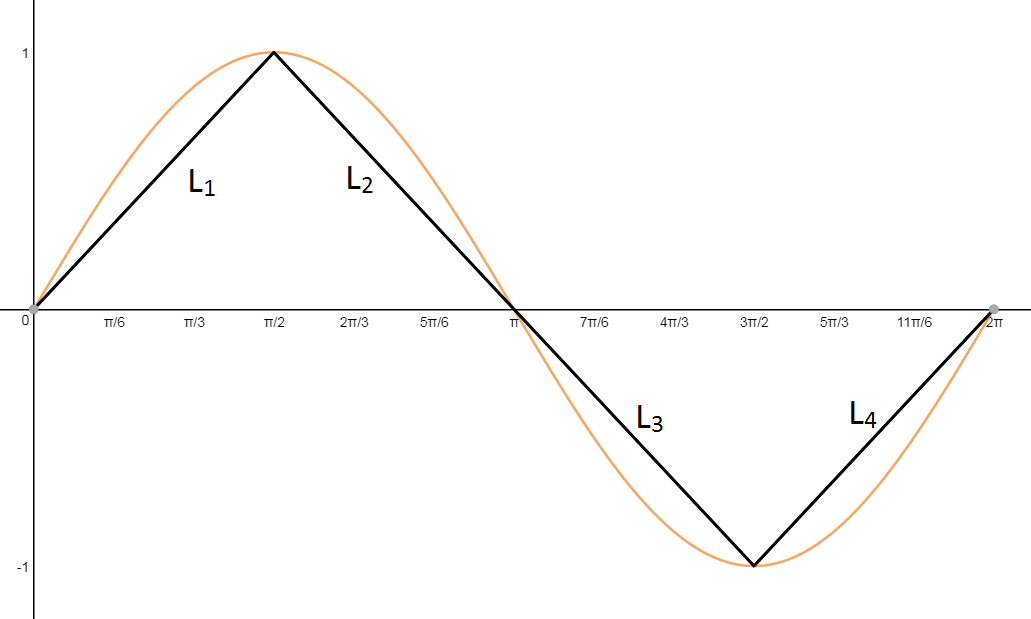
So the approximate arc length of on to 2 decimal places is =
Of course, this is only an approximation of the arc length. In order to get the exact arc length of on , we need to take a limit as the number of line segments used () tends to infinity, just as we did with Riemann sums to calculate exact areas. To visualize what would happen to the approximation for the arc length of on the interval as the number of line segments used increases, click on this link and drag the slider for . Notice that as increases, the sum of the lengths of the line segments is a much better approximation for the desired arc length.
Because an approximation with line segments will give an approximate arc length of
we can conclude that the exact arc length of on is given by
Unfortunately, we can’t evaluate this limit in its current form, so we’ll need to write
this in another form before we can evaluate this limit and arrive at a formula for the
exact arc length.
Deriving a formula for arc length
Let’s move away from for a bit and try to find a formula for the arc length of any function on the interval As with the sine example, we can partition the interval into equal length sub-intervals, We will calculate the length of the corresponding line segment that approximates the arc length of on the kth sub-interval, using the picture below as a guide.
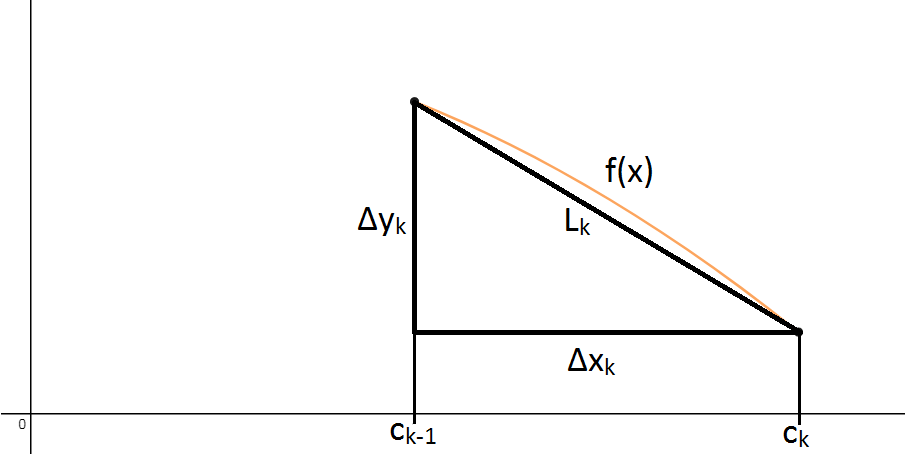
The kth line segment being used to approximate the arc length has length . Let’s find a way to re-write this length using the Pythagorean Theorem in hopes that this will help us evaluate the previous limit. Similarly to before, let’s denote the -distance between the endpoints of the line segment as and the -distance between these endpoints as . With this notation, . Therefore,
However, we still cannot take the limit of this sum as . Before we can take the limit, we need to re-write this sum once again, this time using the Mean Value Theorem (for derivatives) applied to the kth subinterval. Recall that this theorem gives a condition under which the average rate of change of a function is equal to the instantaneous rate of change of a function.
Solving for , we can now say that on every sub-interval (all of them), there exists a in such that
which allows us to re-write our previous arc length formula as follows:
Finally, we have a summation that is similar to the Riemann sums we’ve calculated in the past in that there is a multiplicative relationship between and . This multiplicative relationship signals that the limit of this sum as is equal to a definite integral! Therefore, the arc length of on is given by
What types of functions will this formula apply to? Well, in order to arrive at this formula for arc length, we had to apply the Mean Value Theorem (for derivatives) to each sub-interval, which required that is continuous on and differentiable on Additionally, must be integrable or we cannot necessarily evaluate the above integral, so one way to guarantee integrability is to require that is continuous, which occurs precisely when is continuous. Therefore, the above arc length formula applies when is continuous on . In summary, this formula will apply when
- is continuous on
- is differentiable on and
- is continuous on .
However, the condition that be continuous on implies all of the others, so this is the only condition we need. This is a very common condition to assume a function satisfies, so functions that satisfy this conditions are given a name.
The reason we call such function smooth is because if is continuous, then the graph of will have no discontinuities, corners, or cusps. If continuous function are considered nice functions, then smooth functions are very nice functions - after all, not having to worry about corners or cusps in makes our lives much, much easier. If you continue learning calculus, you are likely to see smoothness as a hypothesis of many more theorems to come, starting with the following theorem.
Be aware that this is the same formula, just written using a different notation for the derivative. In fact, if you take calculus II, you will return to calculating arc lengths, and you are more likely to see this version of the arc length formula.
Practice calculating arc lengths
Now that we have derived a formula for the arc length of a curve on a particular interval, let’s use this formula to determine the exact arc length of on the interval . Of course, before using this formula, we must verify that is smooth on .
Determine the arc length of on the interval
Therefore is
smoothnot smooth on because f(x) is continuous f’(x) is continuous f(x) is not continuous f’(x) is not continuous on .Finally, we can write an integral to evaluate the arc length of the curve on the specified interval and evaluate it using technology. Our original approximation of this arc length with line segments was 7.45, which turns out to be pretty close to the exact value.
Arc Length = (Evaluate the arc length to 2 decimal places with technology)
Let’s try calculating the arc length of another function. This time, you will be able to evaluate the resulting integral for arc length by hand using the techniques we’ve learned in class.
Find the exact arc length of from to . First, we determine if is smooth on the x-interval .
so is
smoothnot smooth on because y is continuous y’ is continuous y is not continuous y’ is not continuous on .The formula for arc length that we derived earlier also applies to functions of as long as one integrates with respect to y, rather than x.
Here’s an example.
so is
smoothnot smooth on the y-interval .Sometimes even if a function is not smooth, there are still ways to use the arc length formula we derived, as the last few examples will illustrate.
As usual, let’s check if is smooth on to determine if the arc length formula applies.
Therefore, is
smoothnot smooth on because y is continuous y’ is continuous y is not continuous y’ is not continuous on .Written as a function of , becomes and the -interval that corresponds with the -interval is .
Let’s try one last arc length problem involving a non-smooth function. Let’s determine the exact arc length of on the interval , the graph of which is displayed below.
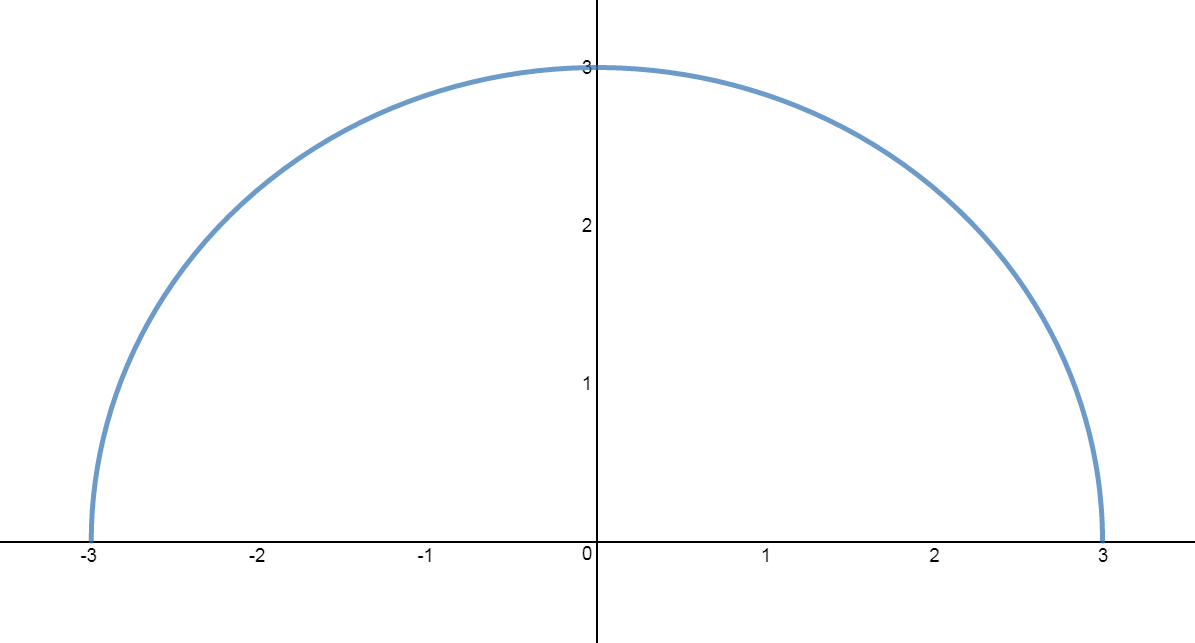
Since isn’t smooth on , the arc length formula does not apply. Why not? Well, , so if the arc length formula did apply, we would need to evaluate
The integrand of the above integral has the following graph on the interval
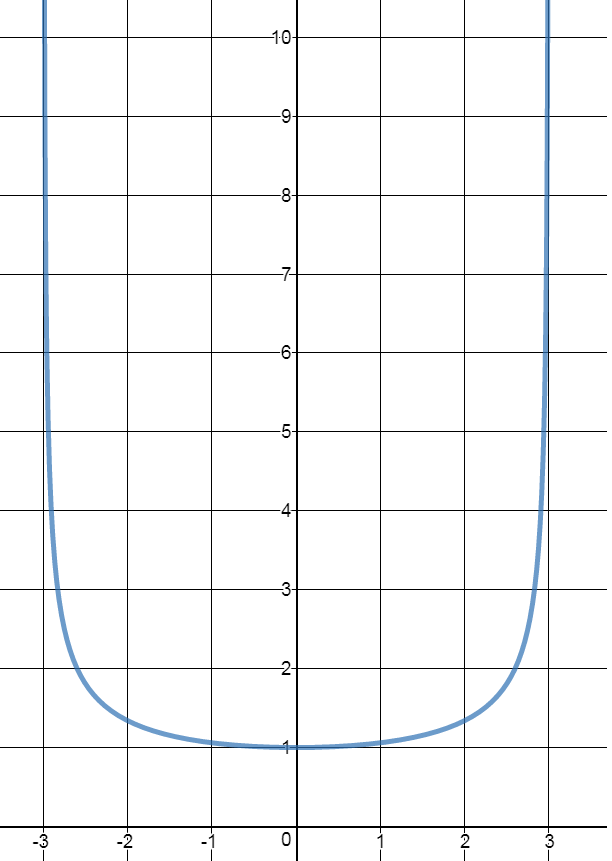
Notice that this integrand has vertical asymptotes at and , so there is no guarantee that the area bounded between and the -axis will converge to a particular number. In other words, it’s possible that this integral cannot be evaluated, despite the fact that the arc length of can certainly be calculated - is the graph of a semi-circle after all. This is one instance of why the arc length formula can only be applied when is smooth on . Luckily, because is semi-circular, we do not need calculus to find its arc length.