Problems about systematic counting.
Easy counting problems are easy. But in challenging counting problems, it becomes
very important to use a systematic method for listing all of the possibilities. Without
a systematic approach, it is to easy to miss some possibilities or to list other
possibilities more than once (or both).
Here are some strategies that are very useful when solving such problems:
- Fix one choice, and systematically change the other parts through all
possibilities. Change the first choice to the next option, and repeat.
- List the possibilities in dictionary or numerical order, either forward or
backward.
These strategies can be combined. And a “road map” can help you manage the
process.
Some examples are given below.
A wedding planner offers three different entrées (Beef, Chicken, and Vegetarian),
four different sides (Fruit, Hummus, Pasta, and Salad), and two desserts (Ice cream
and Tiramisù). List all of the dinner possibilities.
-
Solution:
- List them in dictionary order: Note that the entrée is fixed first at Beef Chicken Vegetarian
with all of the possible side and dessert combinations, in dictionary order.
Good work! Note also that the structure of this listing can help explain
why there
are possible meals.
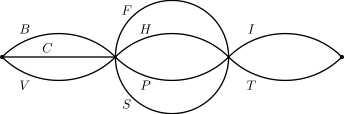
Here is a road map that can help you imagine the above list as a process of
systematically traveling all possible roads:

List all right-rectangular prisms of volume and whole-number sides. Assume the
three dimensions are distinguishable.
-
Solution:
- In the solution, note that when the length has been fixed, the
width and height are systematically varied in order of increasing . Then, after
all of the width-height combinations have been exhausted, the is changed to
the next allowable value and “refixed,” and the width and height are again
systematically varied.

Some readers may complain that the above list of volume- prisms contains much
duplication. And this would be true if we consider, for example, a prism to be the
same as a prism.
Again, list all right-rectangular prisms of volume and whole-number sides. This time,
assume the three dimensions are not distinguishable.
-
Solution:
- To prevent overcounting, require that . How do we know we are done?
The next entry with a length of would be , which is already listed—or which violates
the condition that .
The next length possibility would be , and the first entry in such a row would be ,
which is already listed.

In the red/green light context, list all combinations of red lights from among
lights.
-
Solution:
- List in dictionary order: In the solution, note the separations
demonstrating that once the position of the first red light is chosen, the red
light systematically varies among all possible remaining positions, in dictionary
order.