An arithmetic series is the of consecutive terms from a(n) (two words).
A geometric series is the of consecutive terms from a(n) (two words).
More problems about series. Mostly geometric.
An arithmetic series is the of consecutive terms from a(n) (two words).
A geometric series is the of consecutive terms from a(n) (two words).
In the series there are terms, so the sum is .
Here is picture that can help explain why this particular series works out so nicely:
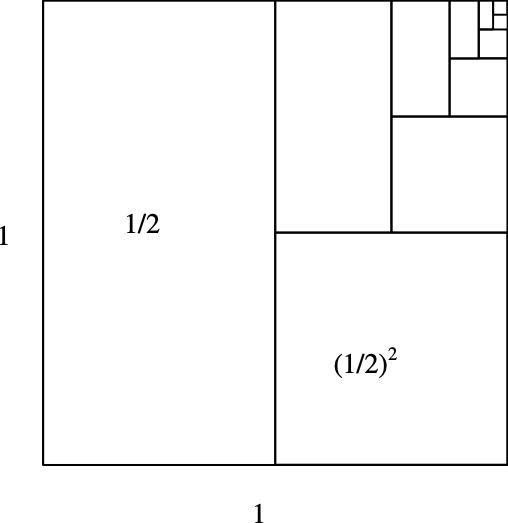
Begin with a unit square, and then shade an area equal to each term. At each step in the process, the area remaining unshaded is exactly equal to the area of the region last shaded. For example, after shading and then , remains unshaded.
Furthermore, it appears that as more and more terms are added, the sum should get closer and closer to .
Here is GeoGebra sketch that allows you to explore similar series:
The following problems demonstrate a general technique for geometric series.
First express as geometric series. The series is geometric because the between consecutive terms is constant. It equals .
The series is infinite because to be equal to , we need to sum an infinite number of terms. Any finite number of terms will be only a(n) .
First, let Note that this is the finite decimal , with exactly copies of the two repeating digits.
We multiply this equation by the common ratio and place the two equations above/below one another so that identical terms align.