You are about to erase your work on this activity. Are you sure you want to do this?
Updated Version Available
There is an updated version of this activity. If you update to the most recent version of this activity, then your current progress on this activity will be erased. Regardless, your record of completion will remain. How would you like to proceed?
Mathematical Expression Editor
Problems about functions and sequences.
A sequence is a function with a domain that is a subset of the .
An arithmetic sequence has a constant between consecutive terms.
An arithmetic sequence is a(n) function.
An geometric sequence has a constant between consecutive terms.
A geometric sequence is a(n) function.
Consider a sequence that begins .
(a)
Continue the sequence so that it is an arithmetic sequence:
(b)
Assuming that , write a recursive formula for the sequence:
(c)
Assuming that , write an explicit formula for the sequence:
Consider a sequence that begins .
(a)
Continue the sequence so that it is an geometric sequence:
(b)
Assuming that , write a recursive formula for the sequence:
(c)
Assuming that , write an explicit formula for the sequence:
The problem involves integer sequences defined as follows: Start with any positive
integer. Then, if the current term is even, the next term is one half of the current
term. If the current term is odd, the next term is times the current term plus
.
Suppose the first term is 3. Find the next several terms.
Note that once the sequence reaches , it cycles back to 1 repeatedly.
If we use
function notation to describe the sequence, then the recursive rule may be stated as
follows:
If is even, then .
If is odd, then .
And given , it follows that , , and so on.
Is there an explicit formula for this function, ?
Yes, it is linear.Yes, it is
quadratic.Yes, it is exponential.Yes, it is trigonometric.Probably not.
Claim: No matter the initial (positive integer) value, the sequence
will always reach 1.
This claim is often called the Collatz Conjecture, in honor of Lothar Collatz, who
introduced the idea in 1937. As of 2020, the conjecture has been checked by computer
for all starting values up to . The statement is still a conjecture (rather than a
theorem) because no one has been able to prove that it holds for all possible initial
values. For more information, see Wikipedia.
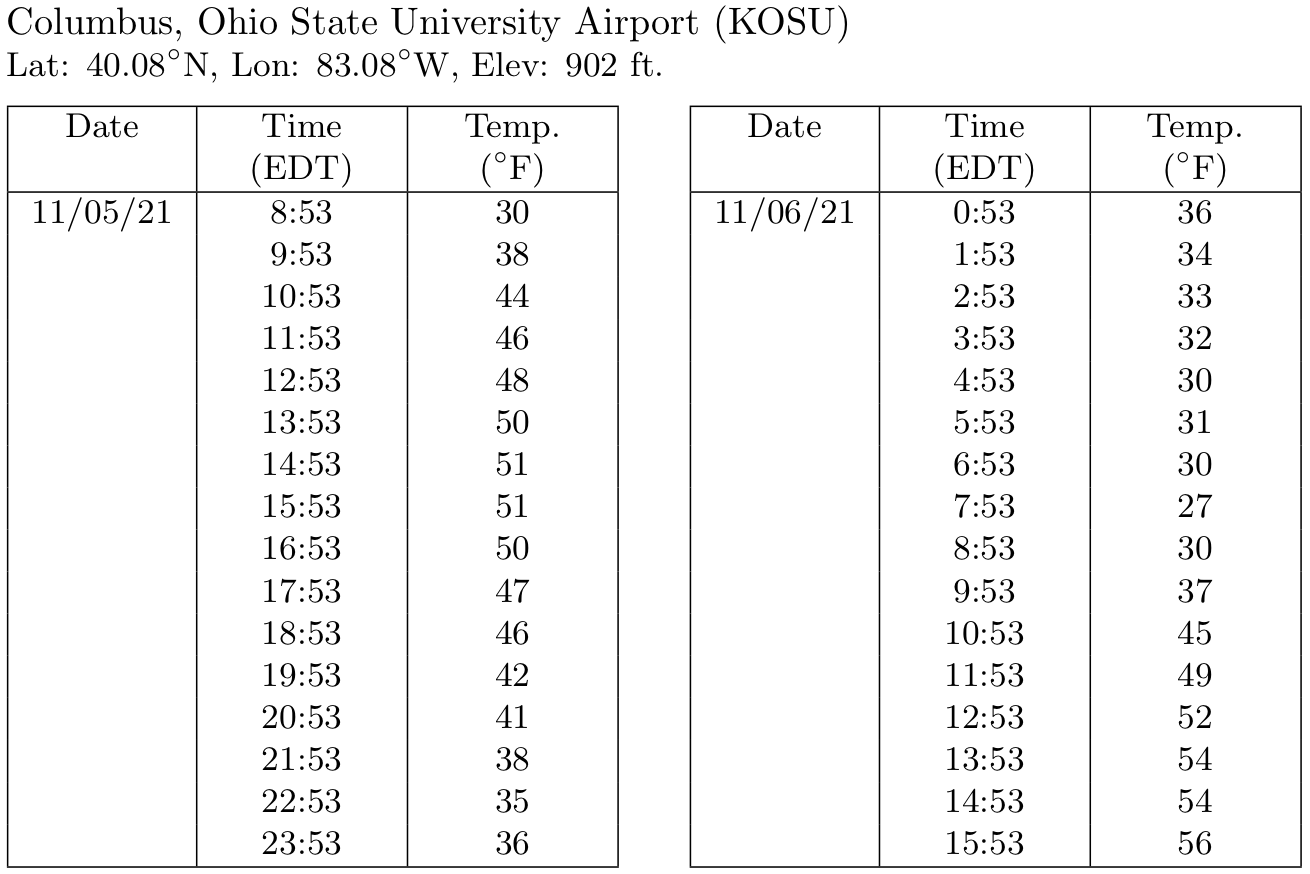
The following table shows historical data collected by the National Weather Service.
Let denote the actual or predicted temperature (in degrees Fahrenheit) hours after
the start (at midnight) of November 6, 2021.
(a)
Note that the hourly readings all occur at minutes after the hour. For
ease of entry, we are going to take 53 minutes as 0.9 hours (though, in
fact, 0.9 hours is exactly minutes). This minor simplification, allows us
to write, for example,
(b)
Negative values of time occur on November or earlier, counting hours
backwards from midnight. For example,
(c)
From real-world data, it is often reasonable to estimate values that are
not directly available. In particular, to interpolate is to estimate between
available data values, and to extrapolate is to estimate beyond available
values. From this data, for example, we can estimate the following:
From this table, is it reasonable to estimate ?
Yes, use the formula.Yes, just
continue the trend.Probably not.
With this small data set, it is not reasonable to extrapolate more than a few hours
beyond the available data. Meteorologists (weather forecasters) use enormous data
sets about nearby and historical weather to develop sophisticated models that are
usually pretty accurate a few days into the future and somewhat accurate up to ten
days.
Is there an explicit formula for this function, ?
Yes, it is linear.Yes, it is
quadratic.Yes, it is exponential.Yes, it is trigonometric.Probably not.