Problems about ratios.
A certain punch is made by mixing cups of fruit juice with cups of sparkling water.
Fill in the table below to find how many cups of fruit juice you will need to mix with
cups of sparkling water to get a punch in the same recipe.
A contractor usually mixes kilograms of sand with kilograms of rocks to make a
parking area for equipment. How many kilograms of sand should the contractor mix
with kilograms of rocks in order to make the same mixture, but for a larger parking
area? Fill out the table below to answer this question.
Jenny mixes of a cup of water with of a cup of insect repellent concentrate to spray
around her yard. How much water and insect repellent will Jenny need in
order to make cups of this mixture? Fill out the table below to answer this
question.
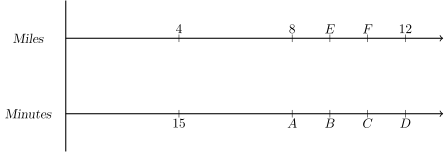
A bike is traveling at a constant rate of miles every minutes. How far does the bike
travel in minutes? We will use the double number line below to answer this
question.
- (a)
- What is the value we should mark on the line at point ?
- (b)
- What is the value we should mark on the line at point ?
- (c)
- Which point on the line corresponds to minutes?
- (d)
- How far did the bike travel in minutes? miles
If yards of yarn weighs grams, how much does yards of the same yarn weigh? Fill
in the missing values on the double number line below, and then solve the
problem.
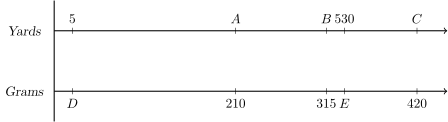
We have , , and .
We also have , and .
Finally, yards of the yarn weighs grams.
We mix red and blue paint in a ratio to make a lovely shade of violet paint. How
many liters of each paint do we need to make liters of paint total?
Suzi solves the above problem using the following picture.

- (a)
- Explain what Suzi has drawn, and how it relates to the problem. Suzi has drawn the 21 liters of paint to be made, one box for each liter. She then colors the boxes in the pattern red, blue, until she has fewer than 6 boxes remaining. At the end, she splits up the remaining boxes into six equal parts so that she can color two of the remaining parts red, and four blue.
- (b)
- Use Suzi’s picture to answer the original question. We should use liters of red paint and liters of blue paint.
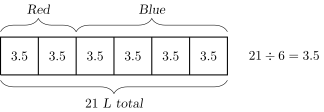
We mix red and blue paint in a ratio to make a lovely shade of violet paint. How
many liters of each paint do we need to make liters of paint total?
Marc solves the above problem using the following picture.
- (a)
- Explain what Marc has drawn, and how it relates to the problem.
- (b)
- Use Marc’s picture to answer the original question. We should use liters of red paint and liters of blue paint.
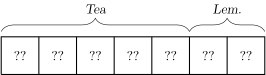
We mix parts iced tea with parts lemonade to make a refreshing summer beverage.
How much lemonade should we mix with cups of iced tea to make just one serving of
this refreshing beverage? Use a method similar to Marc’s method of the previous
problem to answer this question.
- (a)
- What value should go in each box in this case? cups
- (b)
- How much lemonade should we mix with cups of iced tea? cups
A certain shade of green paint is made by mixing parts of yellow paint with
parts of blue paint. How many parts of yellow paint would you need to
mix with part blue paint? For fun, try to use a new method to solve this
problem!
You would use parts yellow paint.
A certain shade of green paint is made by mixing parts of yellow paint
with parts of blue paint. How many parts of blue paint would you need to
mix with part yellow paint? For fun, try to use a new method to solve this
problem!
You would use parts blue paint.
Two kayakers are traveling at a constant speed. Doug travels meters in minutes,
while Phil travels meters in minutes. Who is traveling faster?
Phil travels faster, because he covers about meters per minute. Doug travels
faster, because he covers about meters per minute. Phil travels faster, because he
travels farther. Doug travels faster, because he travels for fewer minutes.
Vi is making biscuits. Her recipe calls for teaspoons of baking powder and cups of
flour. She got a bit mixed up and instead added teaspoons of baking powder to her
bowl with cups of flour. How much more flour should she add to the bowl in order to
still be using the same recipe?
Vi should add of a cup of flour to the bowl.
Three snails are moving at a constant rate.
- Snail travels inches in minutes.
- Snail travels inches in minutes.
- Snail travels inches in minutes.
How fast does each snail travel one inch? Select all correct answers below.
Snail
travels inches in minute. Snail travels inches in minute. Snail travels inches
in minute. We do not know how far Snail travels in minute. Snail ’s
information is impossible. Snail ’s information is impossible. Snail ’s information
is impossible. We do not know how far Snail travels in minute. We do not know
how far Snail travels in minute. We do not know how far Snail travels in
minute.
We have different issues finding the distances traveled by two of the snails in one
minute. Explain how the two problems are different.
With Snail , the snail is not
using any time to cover the distance. In this case, we have an impossible situation:
movement without using time. With Snail , however, as no time elapses, the snail
does not move. This could mean essentially anything - after 1 minute, the snail could
have moved essentially any distance. We do not have enough information to answer
this question!
How is the previous problem related to division with zero?
One way to solve the
problem is to find the rate at which the snails move. In order to find this rate, we
divide the distance by the number of minutes. Snail ’s speed is inches per minute,
Snail ’s rate is inches per minute (which is undefined), and Snail ’s rate is inches per
minute. Look again at the previous problem and think about what you know about
versus !