Problems about integers.
Give some examples of contexts we might use to describe integers. What relevant
properties should your context have?
For the next few problems, identify which operation should be used to solve the
problem.
Alison has head bands. April has headbands. How many more headbands does
April have? The problem above is an example of:
Addition. Take-away
subtraction. Comparison subtraction. Missing-addend subtraction.
Gabe has a bank balance of . After he spends , what will Gabe’s balance be? The
problem above is an example of:
Addition. Take-away subtraction. Comparison
subtraction. Missing-addend subtraction.
Yesterday, Ollie was miles west of home. Today, Ollie is miles east of home. How
far did Ollie travel overnight? The problem above is an example of:
Addition. Take-away subtraction. Comparison subtraction. Missing-addend subtraction.
Last week, the average temperature was degrees Celsius. This week, the
average temperature is degrees warmer. What is the average temperature
this week? The problem above is an example of:
Addition. Take-away
subtraction. Comparison subtraction. Missing-addend subtraction.
The next few problems use the red and black chips we discussed for modeling integers.

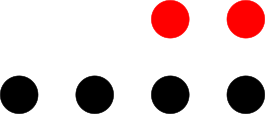
Suppose you would like to use chips to represent a total value of . Which of the
following combinations of chips would give you this value?
Suppose you would like to use chips to represent a total value of . Which of the
following combinations of chips would give you this value?
You are working on the subtraction problem , and you would like to solve this
problem using red and black chips from a take-away perspective. First, you put your
chips down on the table. What chips will you need?
You need to model a total value of using the chips. You will need at least red chips in your model so that you have enough to take away.
You are working on the subtraction problem , and you would like to solve this
problem using red and black chips from a take-away perspective. First, you put your
chips down on the table. What chips will you need?
You need to model a total value of using the chips. You will need at least red chips in your model so that you have enough to take away.
You are working on the subtraction problem , and you would like to solve this
problem using red and black chips from a missing-addend perspective. First,
you change your problem into the related addition problem. What is the
result?
The related addition problem is .
You are working on the subtraction problem , and you would like to solve this
problem using red and black chips from a missing-addend perspective. First,
you change your problem into the related addition problem. What is the
result?
The related addition problem is .
In the picture below, use our definition of multiplication to find the total value of
the chips.

The total value of the chips is .
Imagine using a number line like the one below to solve the subtraction problem
.

We begin by standing on the number line at the tick marked with . Since we are subtracting, we face towards the right left . We will move spaces forward backward , since is positive. Where on the number line are we now?
We are located at the tick labeled .
Imagine using a number line like the one below to solve the subtraction problem
.

We begin by standing on the number line at the tick marked with . Since we are subtracting, we face towards the right left . We will move spaces forward backward , since is negative. Where on the number line are we now?
We are located at the tick labeled .
In your own words, what is the difference between subtraction and negation?
Subtraction is an operation, requiring two numbers. With subtraction, we have two
quantities that we are trying to relate. With our models, subtraction requires some
movement: removing chips, adding chips, or walking on the number line. Negation, on
the other hand, only requires a single value. With negation, we are essentially just
asking, “What is the opposite?” With our models, this is essentially a switching
rather than a moving: we switch from black chips to red, or we face backward instead
of forward.