Problems about polynomials.
Explain what is meant by a
polynomial in a variable .
Informally: A polynomial in
is an algebraic expression that can be written as a sum of terms, each of which is a
whole-number power of multiplied by some real number.
Formally: For a whole number , a polynomial (in ) of degree is an expression that
can be written in the form
where the ’s are real numbers and . A polynomial function of degree is a function
that can be defined by a polynomial.
Indicate the degree of the following polynomials. For expressions that are not
polynomials, type NP.
Given: Find , , , , , , , .
Answer: , , , , , , , .
Given: Find , , , , , .
Answers: , , , , , .
Is it true that polynomials are equal if and only if their coefficients are equal?
Explain your reasoning.
Yes. This is the fact we used to complete the previous two
problems.
Is it true that numbers are equal if and only if their digits are equal? Explain your
reasoning.
For whole numbers written in the same base, the answer is
yesno
.
For decimals, the answer is yesno
. [Note: We will learn why and how later in the course.]
For fractions, of course, the answer is yesno
. For example, , and the “digits” of the fraction on the left are clearly different from
those of the fraction on the right.
Explain how to add two polynomials. Explain, in particular, how “collecting like
terms” is an application of the properties of arithmetic.
Use the associative and
commutative properties to rearrange the sum so that like terms are consecutive.
Then use the distributive property to “collect” the like terms. For example,
.
Explain how to multiply two polynomials.
Use the distributive property: Multiply
each term in the first polynomial by each term in the second polynomial. Then
collect like terms.
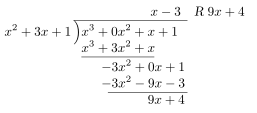
Here is an example of the polynomial division algorithm:
Describe how to perform this algorithm:
This is very much like the long division
algorithm for counting numbers:
-
(a)
- Write part of the quotient;
-
(b)
- Multiply that part of the quotient by the divisor;
-
(c)
- Subtract that product from the dividend;
-
(d)
- Repeat until the remaining part of the dividend is has a degree less than
the degree of the divisor.
Note that, in the last step, what counts as “less than” is different for dividing
polynomials than for dividing counting numbers.
Find the quotient and divisor when dividing by . Quotient: ; remainder:
.
Find the quotient and divisor when dividing by . Quotient: ; remainder:
.
State the
Division Theorem for polynomials. Give some relevant and revealing
examples of this theorem in action.
Informally, when dividing a polynomial by a
(non-zero) polynomial, we can always find a sensible quotient and remainder
(both polynomials). More formally, given and a non-zero divisor , we can
find and such that with the degree of
greater thanequal toless
than
the degree of .
Write in base two.
Find a polynomial such that the ’s are integers greater than or equal to and less
than such that .
How are the previous two problems related?
First, we think of our polynomial as
an object in base . Since the coefficients are or only, when we plug in , we won’t
have to do any rearranging between the places. So, once we plug in , the coefficients
form a number in base . Plugging in is the process we would go through to convert
from base two to base ten. So, the value of the polynomial at will be the base ten
value of , or .
Consider . This can be thought of as a “number” in base . Express this number in
base , that is, find , , such that