Problems about operations and algorithms.
Explain what it means for an operation to be associative. Give some relevant and
revealing examples and non-examples.
Consider the following pictures: 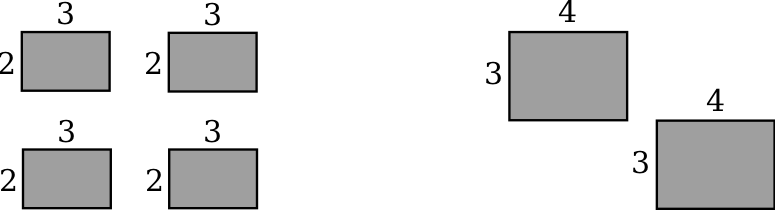 Jesse claims that these pictures represent and .
- (a)
- Is Jesse’s claim correct? Yes. No. Not enough information.
- (b)
- Explain your reasoning.
- (c)
- Do Jesse’s pictures show why multiplication is associative? Yes. No. Not enough information.
- (d)
- If so, explain why. If not, draw new pictures representing and that do show why multiplication is associative.
Explain what it means for an operation to be commutative. Give some relevant and
revealing examples and non-examples.
Explain what it means for an operation to be closed on a set of numbers.
Give some relevant and revealing examples and non-examples.
The counting
numbers are closed under addition and also under multiplication but not under
subtraction or division. The set of even numbers (including and negatives) are
closed under addition, subtraction, and multiplication. The odd numbers, in
contrast, are closed under multiplication but not under addition and not under
subtraction.
Sometimes multiplication is described as repeated addition. Does this explain why
multiplication is commutative? If so give the explanation. If not, give another
description of multiplication that does explain why it is commutative.
Repeated
addition by itself does not explain why multiplication is commutative. Organize the
repeated addition into an array, interpreting as, say, rows by columns. Rotate the
array , and the array becomes rows by columns, or , which must have the
same number of objects. Essentially the same reasoning works with an area
model.
In beginning algebra, simplifying expressions often involves collecting like terms. But
why does this work? Well, the expression is equivalent to by the commutativeassociativedistributive
property. And then it is clear that .
In a warehouse you obtain discount but you must pay a sales tax. Which would save
you more money: To have the tax calculated first or the discount? Explain your
reasoning—be sure to use relevant terminology. In particular, which property of
which operation(s) do you use?
Outline: Build a solution in four steps:
- (a)
- Use a specific starting price.
- (b)
- Generalize the process of computing a price after a discount (assuming no tax).
- (c)
- Generalize the process of computing a price with tax (assuming no discount).
- (d)
- Generalize the two together.
Try a Specific Price. To get started, try a specific starting price, say . Applying the discount first, the price would be . After the tax, the cost is .
Now try applying the tax first. The original price with tax would be . Then with the discount, the cost would be , which is greater thanequal toless than the cost when applying the discount first.
Will this work for any starting price? We need to generalize.
Apply a Discount. Suppose the starting price is . A discount, in terms of , will be
. So the price after the discount would . And by the commutativeinversedistributive
property, this is equal to , or . In other words, rather than computing the discount
and subtracting, we can directly compute the new price by multiplying the original
price by . This makes sense because with a discount of percent, the price we pay will
be percent of the original price.
Apply a Tax. Again, suppose the starting price is .
A tax, in terms of , will be . So the price with tax would . And by the commutativeidentitydistributive
property, this is equal to . In other words, rather than computing the tax and
adding, we can directly compute the new price by multiplying the original price by .
This makes sense because with a tax of percent, the price we pay after tax will be
percent of the original price.
Apply both. Again, let the starting price be
.
If we apply the discount and then the tax, we multiply first by and then by , resulting in the expression .
If, on the other hand, we apply the tax and then the discount, we multiply first by and then by , resulting in the expression .
These expressions are equal because of the identityassociativedistributive and commutativeinversedistributive properties of additionsubtractionmultiplicationdivision . Thus, the final cost is the same either way.
Money Bags Jon likes to give a tip of % when he is at restaurants. He does this by
dividing his bill by and then doubling it. Explain why this works.
Regular Reggie likes to give a tip of % when he is at restaurants. He does this by
dividing his bill by and then adding half more to this number. Explain why this
works.