We learn the definition of the Definite Integral and we compute Riemann Sums.
In mathematics, the symbol is often used to denote summation.
Here are some well know sums:
Riemann Sums
Let be defined on a closed interval . Subdivide the interval into sub-intervals, each of width Denote the endpoints of the sub-intervals by , so that where . (Note that and .)

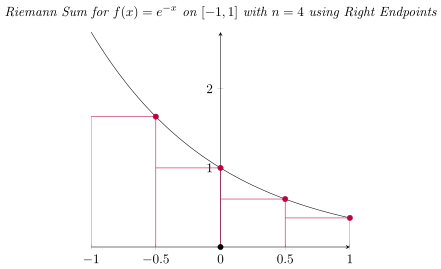
For a function which is positive on the interval the Riemann Sum represents the sum of the areas of rectangles. The heights of the rectangles are given by the function values at the sample points, and the widths are given by .
Below is an applet that shows Riemann Sums visually. You can select the number of rectangles, and the location of the sample points within the sub-intervals.
Left and Right Riemann Sums
Typically, the sample points are chosen according to a prescribed rule, such as ‘‘ left
end point’’, i.e. , or ‘‘ right end point’’, i.e. .
Below is an applet that shows Riemann Sums using left and right endpoints as the
sample points.
Upper and Lower Sums
We can also choose the sample points to be at locations where the function has a
certain property. For example, we can choose such that has an absolute max or min
on the interval at . The Riemann sums in these cases are called upper or lower sums,
respectively.
Below is an applet where the sample points are chosen so that the Riemann Sums are
upper and lower sums.
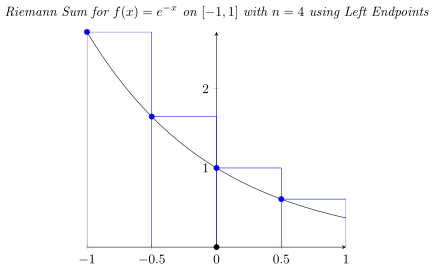

Compute the Riemann Sum for the function on the interval using rectangles and
choosing the sample points to be left end-points.
The Left Riemann Sum is .