You are about to erase your work on this activity. Are you sure you want to do this?
Updated Version Available
There is an updated version of this activity. If you update to the most recent version of this activity, then your current progress on this activity will be erased. Regardless, your record of completion will remain. How would you like to proceed?
Mathematical Expression Editor
Geometric Transformations of the Plane
In Exploration exp:shapeTransformation we saw how geometric shapes in the plane can be manipulated with
matrix transformations. In this section we will study matrix transformations of the
plane in more detail by applying matrix transformations to pixels in photos. We will
treat every pixel of a picture as a point or the head of a vector in \(\RR ^2\). When
a transformation is applied to each pixel, the output pixel is colored the
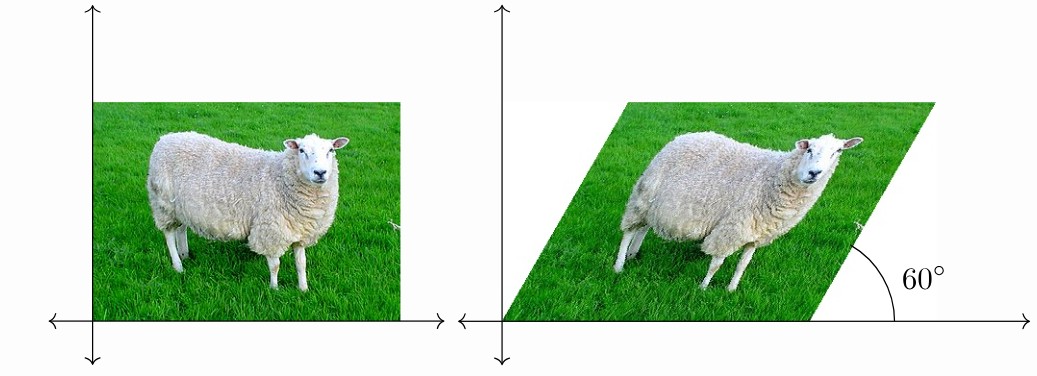
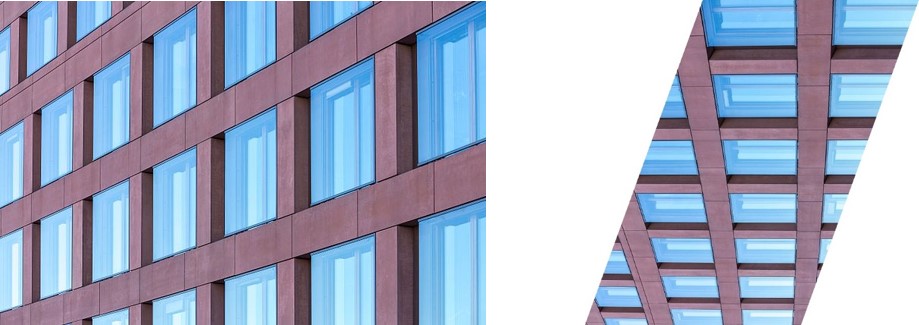
same color as the input pixel. The figure below shows the result of one such
transformation.
Not all transformations are matrix transformations. Practice Problem prob:translation_does_not_work offers a
cautionary tale of what happens when we try to find a matrix for a transformation
when such a matrix does not exist. Luckily, many familiar transformations, including
rotations, scalings, reflections, and shears, are matrix transformations. We will focus
our attention on those.
Recall that by Observation obs:imagesOfijk of Matrix Transformations, we can find a matrix of a
matrix transformation by examining what the transformation does to the standard
basis vectors \(\vec {i}\) and \(\vec {j}\).
Horizontal and Vertical Scaling
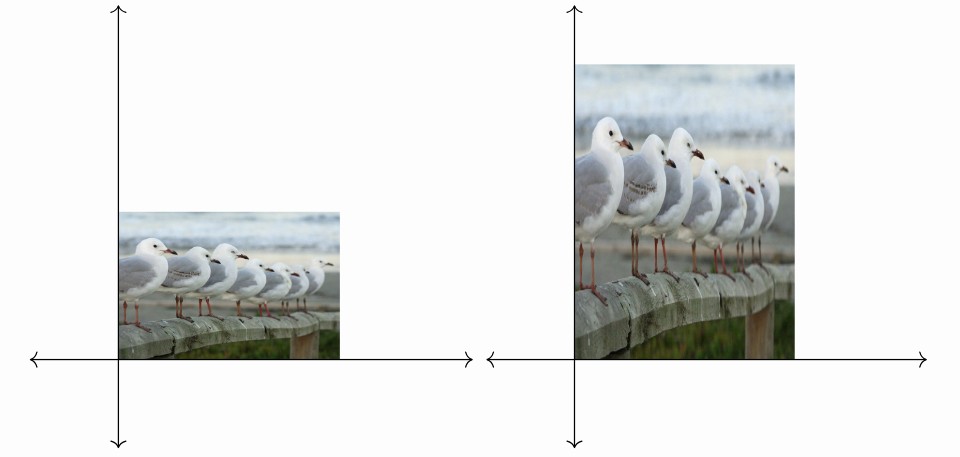
Let us attempt to find a matrix \(M\) for the transformation \(T\) that stretches an image
vertically by a factor of 2, as shown in the figure below.
Consider what this transformation does to the standard unit vectors. We observe
that \(T(\vec {i})=\vec {i}\) and \(T(\vec {j})=2\vec {j}\).
This allows us to construct a candidate for the transformation matrix \(M\), by making
the images of \(\vec {i}\) and \(\vec {j}\) the columns of \(M\). Thus,
\[M=\begin{bmatrix} 1 & 0\\ 0 & 2 \end{bmatrix}\]
We can now check to see what this matrix does to an arbitrary point \((a, b)\). Treating this
point as a vector \(\begin{bmatrix}a\\b\end{bmatrix}\), we compute
Thus, this transformation takes point \((a, b)\) to point \((a, 2b)\). So, the proposed transformation
doubles all \(y\)-coordinates resulting in a vertical stretch by a factor of 2.
In general, a vertical stretch (or compression) leaves \(\vec {i}\) unchanged, and scales the
vector \(\vec {j}\) while preserving its vertical direction. Thus, a vertical stretch (or
compression) maps \(\vec {i}\) to \(\vec {i}\), and maps \(\vec {j}\) to \(k\vec {j}\) for some positive number \(k\). Similarly, a
horizontal stretch (or compression) maps \(\vec {i}\) to \(k\vec {i}\), and maps \(\vec {j}\) to \(\vec {j}\).
where (\(k>0\)), scales objects in the plane
horizontally by a factor of \(k\).
In stating the above formula we stipulated that \(k>0\). If we were to allow \(k\) to be
zero, what would the resulting transformations accomplish? In what way
would the resulting matrices be fundamentally different from matrices \(M_v\) and \(M_h\)?
What would happen if \(k\) were allowed to be negative? (See Practice Problem
)
Horizontal and Vertical Shears
A horizontal shear is a transformation that takes an arbitrary point \((a, b)\) and maps it to
the point \((a+kb, b)\). The effect of this transformation is that all points along a fixed horizontal
line slide to the left or to the right by a fixed amount. Note that the higher the point \((a, b)\)
is above the \(x\)-axis, the greater is the magnitude of \(kb\), resulting in a greater amount of
horizontal slide.
Adding a scalar multiple of the \(y\) component to the \(x\) component can be accomplished
by matrix multiplication. Observe that
A vertical shear is a transformation that takes an arbitrary point \((a, b)\) and maps it to the
point \((a, b+ka)\). This too, can be accomplished by matrix multiplication.
\[\begin{bmatrix} 1 & 0\\ k & 1 \end{bmatrix}\begin{bmatrix}a\\b\end{bmatrix}=\begin{bmatrix}a\\b+ka\end{bmatrix}\]
\begin{equation} M_{vs}=\begin{bmatrix} 1 & 0\\ k & 1 \end{bmatrix} \end{equation}
shears the plane vertically.
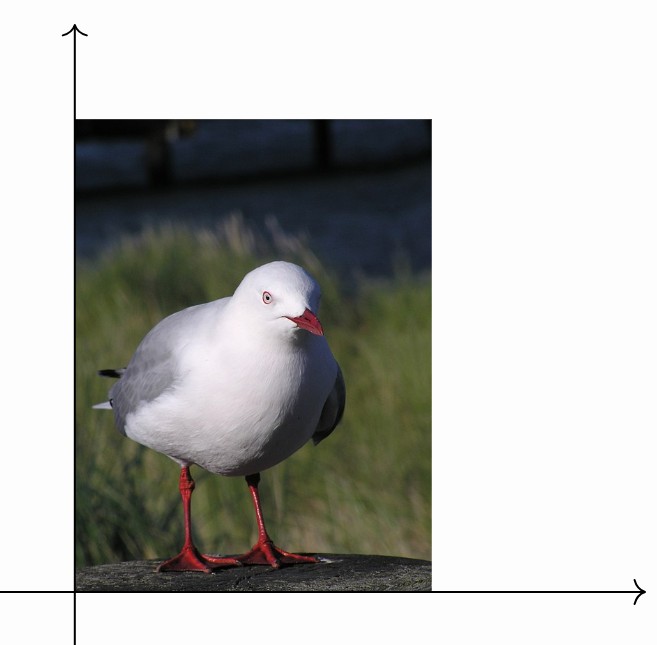
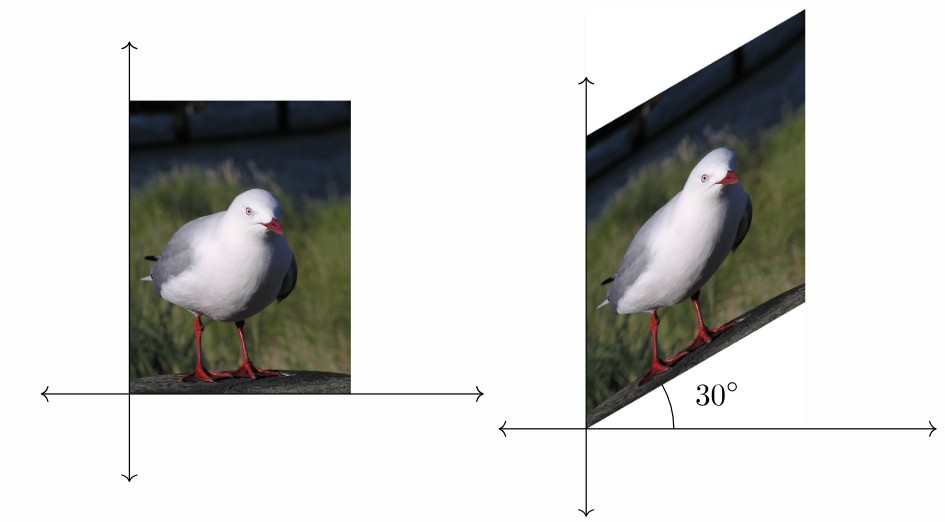
Find the matrix \(M_{vs}\) of a matrix transformation \(T\) that shears the image of a seagull, as
shown in the figure below.
Consider what this transformation does to the standard unit vectors.
The tip of the vector \(\vec {i}\) slides up a vertical line and its \(x\)-component remains the same.
Vector \(\vec {j}\) stays fixed. We observe that \(T(\vec {i})=\begin{bmatrix} 1 \\ \tan 30^{\circ } \end{bmatrix}=\begin{bmatrix} 1 \\ \sqrt {3}/3 \end{bmatrix}\) and \(T(\vec {j})=\vec {j}\). This allows us to construct \(M_{vs}\), by making
the images of \(\vec {i}\) and \(\vec {j}\) the columns of \(M_{vs}\). Thus,
It turns out that rotations about the origin are also matrix transformations. You will
have an opportunity to revisit and prove this claim in Challenge Problems for
Chapter 6.
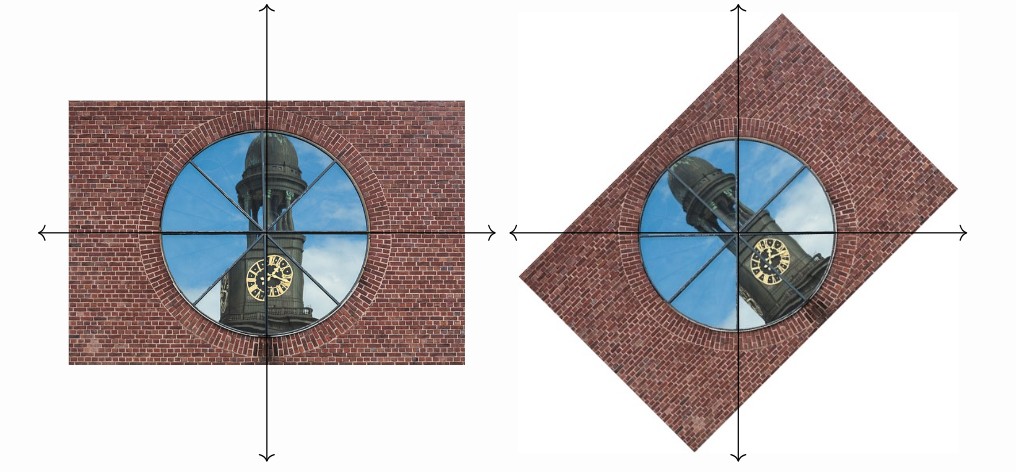
Let \(R_{45^{\circ }}:\RR ^2\rightarrow \RR ^2\) be a transformation that rotates \(\RR ^2\) countercolockwise about the origin by \(45^{\circ }\). Find a
matrix that induces \(R_{45^{\circ }}\).
Consider the action of \(R_{\theta }\) on the standard unit vectors.
We observe that \(R_{\theta }(\vec {i})=\begin{bmatrix} \cos 45^{\circ } \\ \sin 45^{\circ } \end{bmatrix}=\begin{bmatrix} \frac {\sqrt {2}}{2} \\ \frac {\sqrt {2}}{2} \end{bmatrix}\) and \(R_{\theta }(\vec {j})=\begin{bmatrix} -\sin 45^{\circ } \\ \cos 45^{\circ } \end{bmatrix}=\begin{bmatrix} -\frac {\sqrt {2}}{2} \\ \frac {\sqrt {2}}{2} \end{bmatrix}\). This allows us to construct the matrix \(M_{\theta }\), by making the images
of \(\vec {i}\) and \(\vec {j}\) the columns of \(M_{\theta }\). Thus,
rotates the plane
counterclockwise through angle \(\theta \) about the origin.
Reflections about Lines of the Form \(y=mx\)
When a point is reflected about a line, its image is located on the opposite
side of the line and the same distance away from the line as the original
point. This is another example of a matrix transformation. (We will prove
that this is a matrix transformation in Challenge Problems for Chapter
6.)
For example, the figure below shows the reflection of point \(A\) about line \(l\). Note that the
reflection lies on a line through \(A\) perpendicular to \(l\).
Our task is to find the matrix of a reflection of the plane about an arbitrary line
through the origin.
In this problem we will find the matrix for the reflection about the \(x\) and \(y\) axes.
You can easily do this on your own by finding the images of vectors \(\vec {i}\) and
\(\vec {j}\).
We will start with the reflection about the \(x\)-axis.
Now we will turn our attention to transformations that reflect the plane about the
line \(y=mx\). We will assume that \(m\neq 0\).
Consider the vector \(\vec {i}\) and its reflection.
Observe that the head of the image vector, \(T(\vec {i})\), will lie on the line that passes
through \((1,0)\) and is perpendicular to the line \(y=mx\). The equation of this line is given
by
The solution \(x=1\) corresponds to the head of the vector \(\vec {i}\). So, the \(x\)-component of \(T(\vec {i})\) is \(x=\frac {1-m^2}{m^2+1}\). We
find the \(y\)-component of \(T(\vec {i})\) by substituting \(x=\frac {1-m^2}{m^2+1}\) into Equation 6.
Next we need to find the image of \(\vec {j}\). The head of \(T(\vec {j})\) is located at one of the intersections
of line \(y=-\frac {1}{m}x+1\) and the circle \(x^2+y^2=1\).
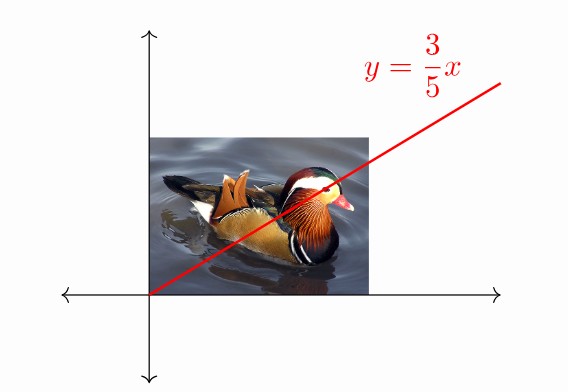
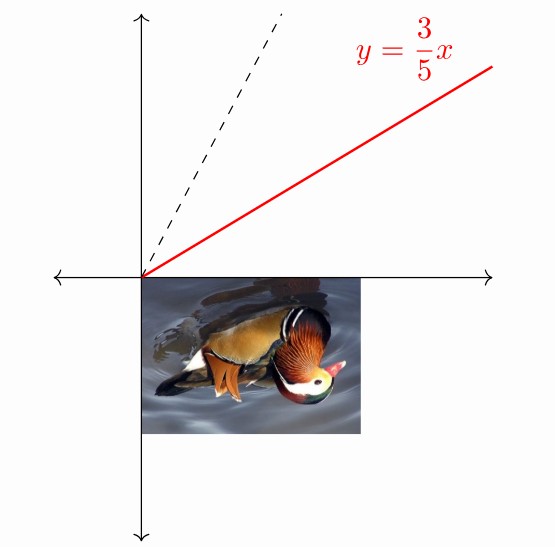
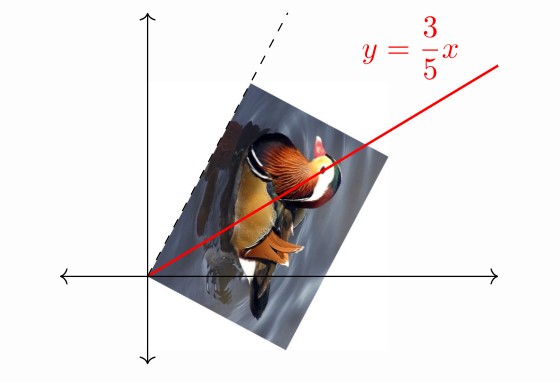
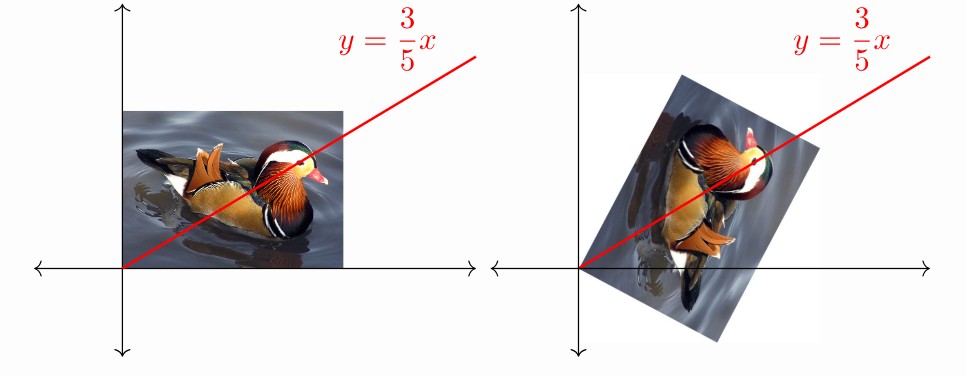
Note that the eye of the duck in Example 9 is located on the line \(y=\frac {3}{5}x\). The reflection
leaves the eye fixed in place. The eye is an example of a fixed point. In Practice
Problem you will be asked to show that every point along the line \(y=\frac {3}{5}x\) is a fixed
point.
Composition of Linear Transformations
If a matrix transformation is followed by another matrix transformation, the
resulting transformation can be represented as a product of the two matrices that
induce the individual transformations. Thus, if \(T_1\) is induced by \(M_1\) and \(T_2\) is induced by \(M_2\),
then \(T=T_2\circ T_1\) is induced by \(M=M_2M_1\).
Remember that matrix multiplication is not commutative, so the order in which the
matrices are multiplied is of utmost importance.
Consider the following example which incorporates a reflection as well as a rotation
of vectors.
(a)
Find the matrix of the linear transformation which is obtained by first
rotating all vectors counterclockwise by an angle of \(\pi /6\) and then reflecting
across the \(x\)-axis.
(b)
Multiply the vector \(\vec {v}=\begin{bmatrix} 1/2 \\ \sqrt {3}/2 \end{bmatrix}\) by the matrix you found in part (a) to illustrate how
the transformation works.
(a)
Using Formula 7, the matrix of the transformation which involves rotating
through an angle of \(\pi /6\) is
As we learned in Exploration , the matrix for the transformation which reflects
all vectors about the \(x\)-axis is \(M_2 = \begin{bmatrix}1 & 0 \\ 0 & -1 \end{bmatrix}\).
Therefore, the matrix of the linear transformation which first rotates through \(\pi /6\)
and then reflects through the \(x\)-axis is given by
From unit circle trigonometry, we know that \(\vec {v}\) makes a \(\pi /3\) angle with the \(x\)-axis. If
we rotate \(\vec {v}\) counterclockwise by \(\pi /6\), it will point straight up.
Following the rotation with reflection across the \(x\)-axis will make it point straight
down. Sure enough,
Use the GeoGebra interactive below to decompose a matrix into a product of two
matrices corresponding to the basic transformations we discussed above: scalings,
rotations, shears and reflections.
Consider the matrix \(M=\begin{bmatrix} 1 & 0\\-1 & -1\end{bmatrix}\). This matrix induces a transformation that can be
broken into two parts: (1) a reflection followed by (2) a shear. Find matrices \(M_1\)
and \(M_2\) that induce the reflection and the shear respectively. Verify that the
product of the two matrices is equal to \(M\) (be careful about the order of the
product!).
Let \(M=\begin{bmatrix}-1&0\\0&-1\end{bmatrix}\). Use the GeoGebra interactive above to visually examine the transformation
induced by \(M\). What sequence of transformations is equivalent to the transformation
induced by \(M\)?
Rotation by 180 degrees. Reflection about the \(x\)-axis, followed by a
reflection about the \(y\)-axis.Reflection about the \(y\)-axis, followed by a reflection about
the \(x\)-axis.All of the above.
Let \(M=\begin{bmatrix}0&1\\-1&0\end{bmatrix}\). Use the GeoGebra interactive above to visually examine the transformation
induced by \(M\). What sequence of transformations is equivalent to the transformation
induced by \(M\)?
Reflection about the \(x\)-axis, followed by a reflection about the line \(y=-x\).Reflection about the \(y\)-axis, followed by a reflection about the \(x\)-axis.All of the above.
None of the above.
In this problem we will consider compositions of two reflections and use geometry to
illustrate non-commutativity of matrix multiplication. Let
\[T_{y=-2x}:\RR ^2\rightarrow \RR ^2\]
be a reflection about the line \(y=-2x\). Let
\[T_{y=x}:\RR ^2\rightarrow \RR ^2\]
be a reflection about the line \(y=x\). We will denote the standard matrices for these
transformations by \(M_{y=-2x}\) and \(M_{y=x}\), and use geometry to demonstrate that \(M_{y=x}M_{y=-2x}\neq M_{y=-2x}M_{y=x}\).
To do this, consider transformations \(T_1=T_{y=x}\circ T_{y=-2x}\) and \(T_2=T_{y=-2x}\circ T_{y=x}\). Transformation \(T_1\) is induced by \(M_{y=x}M_{y=-2x}\), and \(T_2\) is
induced by \(M_{y=-2x}M_{y=x}\).
The figure on the left illustrates the action of \(T_1\) on a single point \(A\). First, \(A\) is reflected
about the line \(y=-2x\), then \(A\) is reflected about the line \(y=x\).
The figure on the right shows the action of \(T_2\) on the same point \(A\). The point is first
reflected about the line \(y=x\), followed by a reflection about the line \(y=-2x\). The final images of
point \(A\) under \(T_1\) and \(T_2\) are clearly different.
Since \(T_1\neq T_2\), we conclude that \(M_{y=x}M_{y=-2x}\neq M_{y=-2x}M_{y=x}\).
Some pairs of matrices do commute. For example, geometry makes it is easy to see
that two rotation matrices commute.
Practice Problems
Consider matrices \(M_v\) and \(M_h\) in (1) and (2).
(a)
If we were to allow \(k\) to be zero, what would the resulting transformations
accomplish?
(b)
If \(k=0\), in what way would the resulting matrices be fundamentally different
from matrices \(M_v\) and \(M_h\) \((k\neq 0)\)?
(c)
Do \(M_v\) and \(M_h\) \((k\neq 0)\) have inverses? What about \(M_v\) and \(M_h\) \((k= 0)\)?
(d)
What would happen if we allowed \(k\) to be negative?
Find a matrix \(M\) that would double the length of a photo horizontally, and triple the
height of the photo.
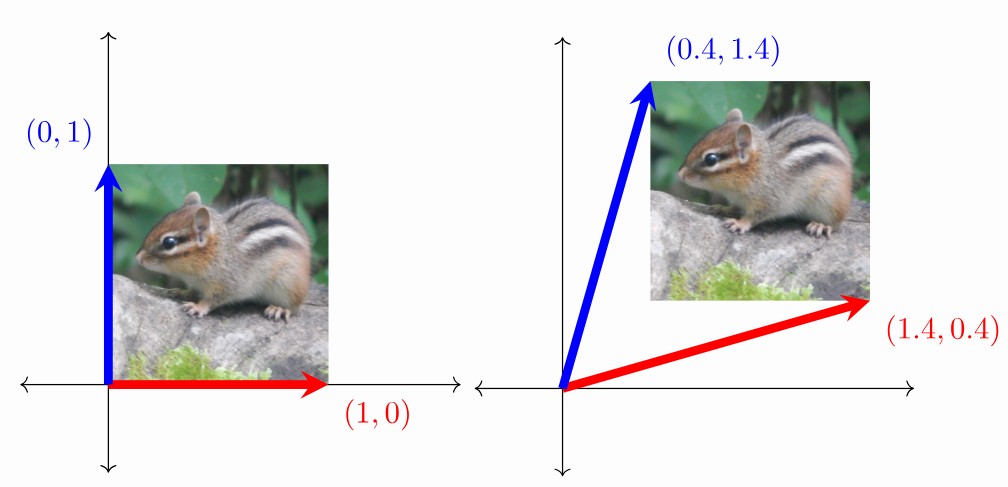
Suppose a 1 by 1 photo of a chipmunk was shifted as shown in the figure.
Suppose we tried to construct a standard matrix \(M\) for this transformation by making
the images of \(\vec {i}\) and \(\vec {j}\) the columns of \(M\). We would obtain
Does this matrix describe the transformation? If so, prove it. If not, explain why not.
A transformation \(T:\RR ^2\rightarrow \RR ^2\) that shifts all points in the plane horizontally or vertically by a
fixed amount is called a translation. Is \(T\) a matrix transformation? Prove your claim.
What is the image of \(\vec {0}\) under \(T\)?
A reflection about the line \(y=mx\) followed by another reflection about the same line,
returns all points to their original position. Prove this using matrix multiplication.
Find the product of \(M_{y=mx}M_{y=mx}\).
Prove that every point along the line \(y=\frac {3}{5}x\) in Example 9 is a fixed point.
The figure below shows a sequence of two matrix transformations that
accomplishes a reflection about the line \(y=\frac {3}{5}x\). The first transformation is a reflection of
the plane about the \(x\)-axis. The second transformation is a rotation of the plane about
the origin. Find matrices that induce the two transformations and verify
that their product (in the correct order) is the reflection matrix of Example
9.
![[Picture]](main.online-b6cc234a63c1bda91f85857131944c01.svg)
![[Picture]](main.online-6d4ec8237c03a958a81614e68563fd19.svg)
![[Picture]](main.online-7120a93f815baa12d3c44b104a2526cd.svg)
![[Picture]](main.online-ad545adce8892ba4ef4a088b52b3fe0d.svg)
![[Picture]](main.online-dd80ad012d517c36518150f53ec63229.svg)
![[Picture]](main.online-15070a0146d624c99079f034886d1f71.svg)
![[Picture]](main.online-de1a9d9d5242d16cd0aa2a9d56e97c50.svg)
![[Picture]](main.online-60a779b62520627ec6a6d5d12727e237.svg)
![[Picture]](main.online-4cae5e2b0e6c86c3ee121453993df214.svg)
![[Picture]](main.online-200f57a900a3ef5650eb441372a9bbe8.svg)
![[Picture]](main.online-bb0b1ac4dac4cd9feaf45cf006fcc14a.svg)
![[Picture]](main.online-bd01ff0d60580171266062af5cdd567a.svg)
![[Picture]](main.online-57c1b834422dcb96b9757c85fc33b4c7.svg)
![[Picture]](main.online-39aad19e35213a5944b8a7e2f8a2df1f.svg)
![[Picture]](main.online-04eff5ed1acc8fb8a0fb23b3c8f60a41.svg)
![[Picture]](main.online-45ab19c94c44d2811990addd45332348.svg)
![[Picture]](main.online-aab5fe78f405422e358ab01b49ea8cda.svg)