Problems about rational numbers.
Ashleigh has a brownie recipe that calls for of a tablespoon of baking powder. (She
has some crazy measuring cups at home!). To represent her tablespoon of baking
powder, she draws the following rectangle.

To represent her of a tablespoon, into how many equal-sized pieces should she cut the entire rectangle? Give the most basic answer you can.
She should cut the rectangle into equal-sized pieces.
To represent her of a tablespoon, how many of those pieces should she shade? Give the most basic answer you can.
She should shade pieces.
In the previous problem, the question asked for “the most basic answer” that you
could give. Why was the question phrased in that way? What other kinds of answers
might there be?
The image below depicts a fraction whose whole is the entire rectangle. What
fraction of the entire rectangle is shaded?

We see that of the rectangle is shaded.
The image below depicts a fraction whose whole is the blue shaded region. What
fraction is the entire drawing of the blue shaded region?
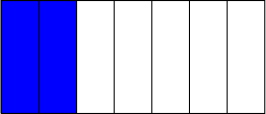
We see that the rectangle is of the shaded region.

The image below depicts a fraction whose whole is the entire rectangle. What
fraction of the entire rectangle is shaded?
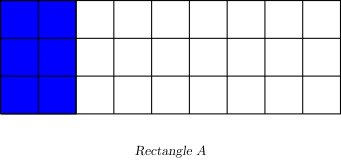
We see that of the rectangle is shaded.
Compare the rectangle above (Rectangle ) with the one below (Rectangle
).
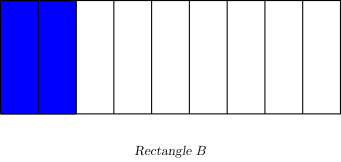
How could we have obtained Rectangle ’s drawing from the drawing of Rectangle ? Choose the best answer below.
The pictures are unrelated. We multiplied the
picture by . We split each of the pieces in the whole for Rectangle into
three equal pieces. We drew two more horizontal lines on the picture.
Comparing Rectangle and Rectangle , we can see the equivalence of which two
fractions?
We see that is equivalent to .
Explain exactly how we can see from the two diagrams that the fractions are
equivalent.
First, notice that we start with the same whole in each picture. When
we cut each of the nine pieces of Rectangle into three pieces, we end up with pieces
making up our whole. At the same time (without doing any more work!) we have also
managed to cut each of the original two shaded pieces into three pieces each, leaving
us with shaded pieces. The shading didn’t change at all, and the total amount didn’t
change at all, so the quantities represented by the two fractions have to be the
same.
Zeke is adding . He uses the following picture.
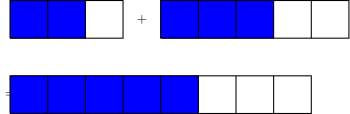
He then reports that the answer is . What is right with Zeke’s reasoning? What is wrong with Zeke’s reasoning?
Zeke is right that we want to combine these two fractions. However, if we were to
combine them, we need to have the same size whole for the addition problem to make
sense. First, he should shade his fractions out of the same whole. Then, he should cut
all of his pieces so that they are the same size, and then combine those same-size
pieces.
What is the reasoning behind “making a common denominator”?
We always make
common denominators when working with fractions. We make common
denominators when we need the pieces in our fractions to be the same size. We
make common denominators because you cannot add fractions if you don’t make
common denominators. We make common denominators so that the fractions are
out of the same whole.
What fraction of the entire rectangle is shaded?
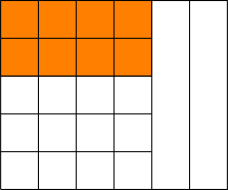
We see that of the rectangle is shaded.
Let’s think of the orange shaded area as the result of multiplying two fractions.
What are these fractions?
If we imagine extending the horizontal lines all the way across our rectangle, we can view one whole group as containing of the entire rectangle. (This would be the continuation of the orange region horizontally across the rectangle.) Then, we can see that we have shaded of that group. Thus, our multiplication problem would be .
A brownie recipe calls for of a cup of flour. If you make of the brownie recipe, how
much flour would you need?
You would need of a cup of flour.
Yesterday, of an inch of rain fell in Doug’s garden. Today, of an inch of rain fell
in Doug’s garden. Over the two-day span, how much rain fell in Doug’s
garden?
of an inch of rain
Sue bought pounds of rice to host a very large party. Sam bought pounds of
rice to host an even larger party. How much more rice did Sam buy than
Sue?
Sam bought more pounds of rice.
For several years, Mya has been depositing of her monthly paycheck into a savings account. This month, Mya has to pay for car repairs, so she can only deposit of her usual deposit amount. How much of her paycheck will Mya deposit this month?
Mya will deposit of her paycheck her usual deposit amount a dollar in her savings account.